
Unbiased headlines. Facts, not spin.
Every story is an unbiased news briefing written from 110+ sources across the spectrum — sources linked so you can verify it yourself.
 tech
Low Interest (4/10)
July 29, 2026 at 01:29 PM
tech
Low Interest (4/10)
July 29, 2026 at 01:29 PM
Bright Machines Unveils Hybrid Robot Cell to Fix AI Server Assembly Bottleneck
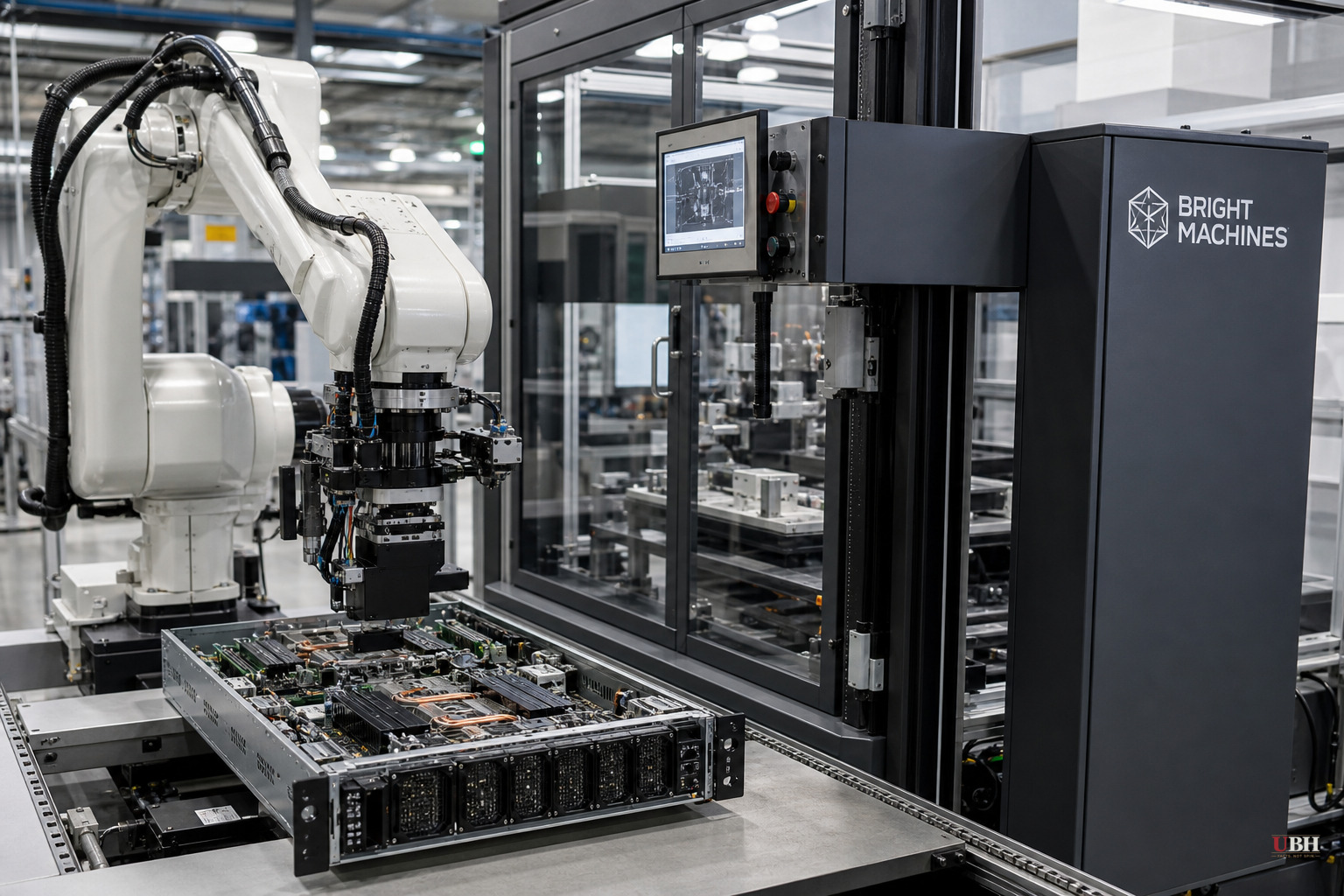
Bright Machines, a San Francisco-based manufacturer, announced a new piece of factory hardware this week aimed at a problem that sounds boring until you see the price tag attached to it: what happens when a human being has to physically touch an AI server on the assembly line.
The product is called the Hybrid BRC, short for Hybrid Bright Robotic Cell. It's an expansion of the company's existing Bright Factory platform. The pitch is simple. Let human operators step inside a sensor-monitored robotic cell to do prescribed assembly steps, without breaking the digital record that tracks a server from its first screw to its shipping label.
The Yield Problem
CEO Sviat Dulianinov laid out the stakes in blunt numbers in an interview with VentureBeat.
"If you assemble modern AI servers starting with manual operations, your initial yield, first-pass yield, can be as low as 20%," Dulianinov said. "Then you gradually ramp up and scale, and it can reach the 60s, 65% or so."
Compare that to fully robotic operations, where Dulianinov says yield-per-station with Bright Machines' technology usually tops 98%.
A single AI server can cost hundreds of thousands of dollars. Hyperscalers, meaning companies like the major cloud providers building out massive AI data centers, are spending billions on this infrastructure and still can't get it deployed fast enough. A yield gap between 20% and 98% isn't a rounding error. It's the difference between a factory that ships product and one that ships scrap.
Why Manual Assembly Breaks the Record
Modern automated lines generate a constant stream of production data: torque values, placement coordinates, component serial numbers, inspection images. Manufacturers use this data to prove a server was built correctly and to trace failures back to specific stations or parts months after the server ships.
The problem is automated lines still need human hands sometimes. Until now, factories had two options when that happened, according to Bright Machines. Stop the entire line, which kills throughput. Or pull the unit off to a separate manual workstation outside the monitored data flow, which punches a hole in the traceability record at the exact moment a mistake is most likely to happen.
Neither option is good. One costs money through downtime. The other costs money through defects that can't be traced or fixed.
How the Hybrid Cell Works
The Hybrid BRC tries to close that gap. The cell has guarded access doors and safety panels built directly into the production line. When an operator opens the doors, the robotic arm shuts off. On-screen instructions then walk the operator through each assembly step.
Meanwhile the cell's sensor array, cameras, force feedback, and tooling sensors keep monitoring for incorrect installs, missed steps, and wrong components. Bright Machines says these are the same quality checks used during full automation. The traceability record stays intact at the serial-number level from start to finish, whether a robot or a person is doing the work.
What's Unproven Here
Everything above comes from Bright Machines itself, through its CEO. There's no independent verification yet of the 98% yield figure, or of how the Hybrid BRC performs in a real production environment at scale versus the manual-to-automated ramp Dulianinov described. No third-party manufacturing data, customer case study, or benchmark test has been cited alongside the announcement.
That doesn't mean the numbers are wrong. The yield problem Dulianinov describes matches a well-known industry headache: complex electronics assembly is genuinely hard to get right by hand, and traceability gaps are a real quality-control issue in regulated and high-value manufacturing. But a company announcing its own product is, by definition, an interested party. Buyers evaluating the Hybrid BRC will want to see it running on an actual customer line before taking the yield claims at face value.
What Happens Next
Bright Machines has not disclosed pricing for the Hybrid BRC, nor named specific customers currently deploying it. The company frames this as an expansion of its existing Bright Factory platform, which suggests existing customers may be the first adopters.
The bigger question is whether this actually moves the needle on the AI infrastructure bottleneck Dulianinov describes. Hyperscalers aren't waiting on assembly-line innovation alone. Chip supply, power availability, and data center construction timelines all factor into how fast AI servers actually reach deployment. A better assembly cell helps if manual-labor yield loss is a meaningful chunk of the delay. Whether it is, at the scale hyperscalers operate, remains to be independently confirmed.
Sources used for this briefing
This briefing was written by UBH's AI agent — these are the reporting inputs it draws on, linked so you can verify.


