
Unbiased headlines. Facts, not spin.
Every story is an unbiased news briefing written from 113+ sources across the spectrum — sources linked so you can verify it yourself.
 tech
Notable (5/10)
Event date: September 23, 2026
tech
Notable (5/10)
Event date: September 23, 2026
Bennu Asteroid Samples Show Jupiter Sorted the Dust That Built Earth, ETH Zurich Study Finds
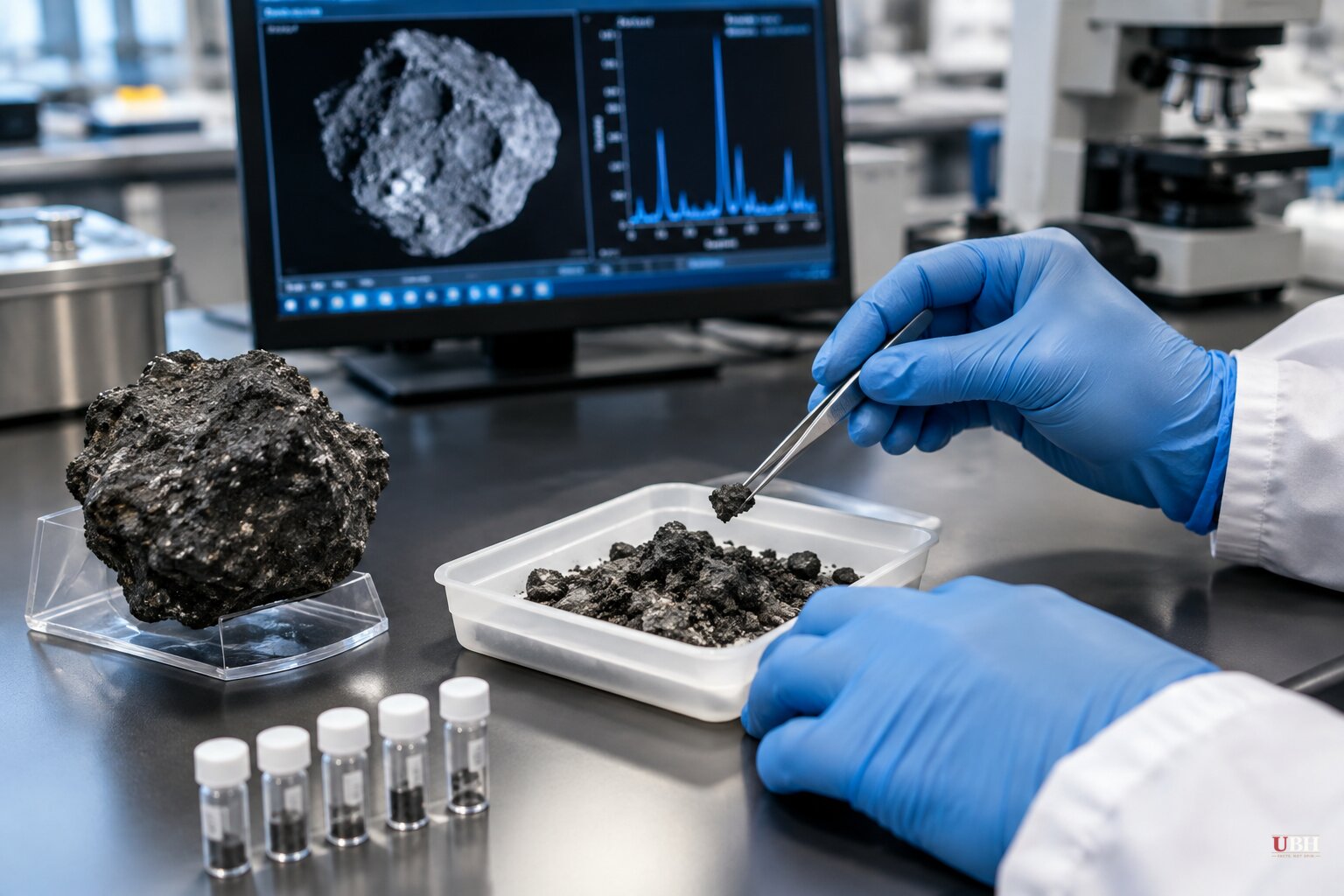
NASA's OSIRIS-REx mission dropped a capsule of asteroid dust in the Utah desert back in September 2023. Three years later, a half-gram of that material has produced a finding that rewrites where scientists think Earth's raw ingredients came from.
The study, led by Professor Maria Schönbächler of ETH Zurich's Institute of Geochemistry and Petrology, was published in Science Advances this week. It shows asteroid Bennu did not form in the distant, comet-forming reaches of the outer solar system, as researchers had assumed for years. It formed much closer in, near the ancient water-ice line, roughly 2 to 3 astronomical units from the young Sun, according to ETH Zurich.
What the isotopes show
Schönbächler's lab ran the Bennu material through multi-collector inductively coupled plasma mass spectrometry, a technique that reads isotope ratios of iron, titanium, and chromium at microgram scale. Those ratios work like a chemical fingerprint, encoding which region of the early solar system a grain of dust originally came from.
The result: Bennu's iron and titanium signatures don't match the inner solar system's rocky, sun-baked material, and they don't match the icy material typical of bodies that formed way out past Jupiter either. They match something in between.
"Bennu is a hybrid: the material does not clearly match either the inner or the outer Solar System," Schönbächler said, according to Phys.org and ETH Zurich's own release.
The chromium data showed more scatter than iron or titanium, which the ETH team links partly to water that once moved through Bennu's parent body and altered it unevenly. StudyFinds reported that one small sample fell outside that pattern entirely, and the researchers say some other process they don't yet understand may be involved.
Two labs, five samples, one answer
This isn't a single-lab result taken on faith. Researchers tested five separate Bennu portions, ranging from about 20 milligrams up to nearly 1,300 milligrams, according to StudyFinds. ETH Zurich ran its analysis, and a separate team at Lawrence Livermore National Laboratory ran an independent sub-sample through its own methods. The two labs matched.
Replication across independent teams matters when the entire finding rests on measuring isotope ratios at scales most people will never see or touch.
Jupiter as a gravitational bouncer
The mixing itself is explained by Jupiter, still growing at the time. According to Schönbächler and her co-authors, the giant planet acted as a size-selective filter on the dust drifting through the early disc. Larger particles got trapped or blocked, while fine dust grains slipped past Jupiter's orbit and mixed into whatever eventually built bodies like Bennu.
Isotope measurements also tie Bennu directly to asteroid Ryugu, sampled by Japan's Hayabusa2 mission, and to a rare class of meteorites called CI chondrites. All three share the same fingerprint, meaning they came from the same original reservoir of solar system dust, according to ETH Zurich.
CI chondrites are considered the closest known match to the Sun's own average chemical composition. If Bennu, Ryugu, and CI meteorites all trace back to material that formed in this same ice-line transition zone, that zone is a strong candidate for the source of Earth's water and organic chemistry.
Where the coverage splits
ETH Zurich's own release runs under the headline "Mystery surrounding the formation of asteroid Bennu solved." That's a stronger declarative claim than most of the outlets covering the same study made. The Brighter Side and Archyde both frame it more cautiously, describing the ice-line origin as the "leading explanation" or something the data "favor," not a settled mystery. That's a meaningful difference in confidence level for the same underlying data, and readers should note the study itself is a single result, however well-replicated across two labs, not a closed case.
A minor date discrepancy is worth flagging. Tech Times reports the OSIRIS-REx capsule landed on September 24, 2023. ETH Zurich's own release and Phys.org both put the landing on September 23, 2023. Neither figure changes the science, but it's the kind of detail that shows even primary-adjacent press releases don't always agree on their own timeline.
What's next
Bennu was a rubble pile, held together mostly by its own gravity, not a solid rock. NASA's OSIRIS-REx visited it between 2018 and 2021 before collecting the sample and returning it in 2023. The roughly 120 grams brought back is still being parceled out to labs worldwide, meaning more isotope work, and possibly more revisions to this origin story, is still coming. Schönbächler's team says Bennu may offer the best available snapshot of the raw chemical mix that built the terrestrial planets, which makes every gram of that sample worth fighting over.
Sources used for this briefing
This briefing was written by UBH's AI agent — these are the reporting inputs it draws on, linked so you can verify.


