
Unbiased headlines. Facts, not spin.
Every story is an unbiased news briefing written from 113+ sources across the spectrum — sources linked so you can verify it yourself.
 tech
Major Story (7/10)
Event date: September 26, 2026
tech
Major Story (7/10)
Event date: September 26, 2026
Rhine River Gauge Goes Negative for First Time in 170 Years, Germany's Fix Is Still 7 Years Away
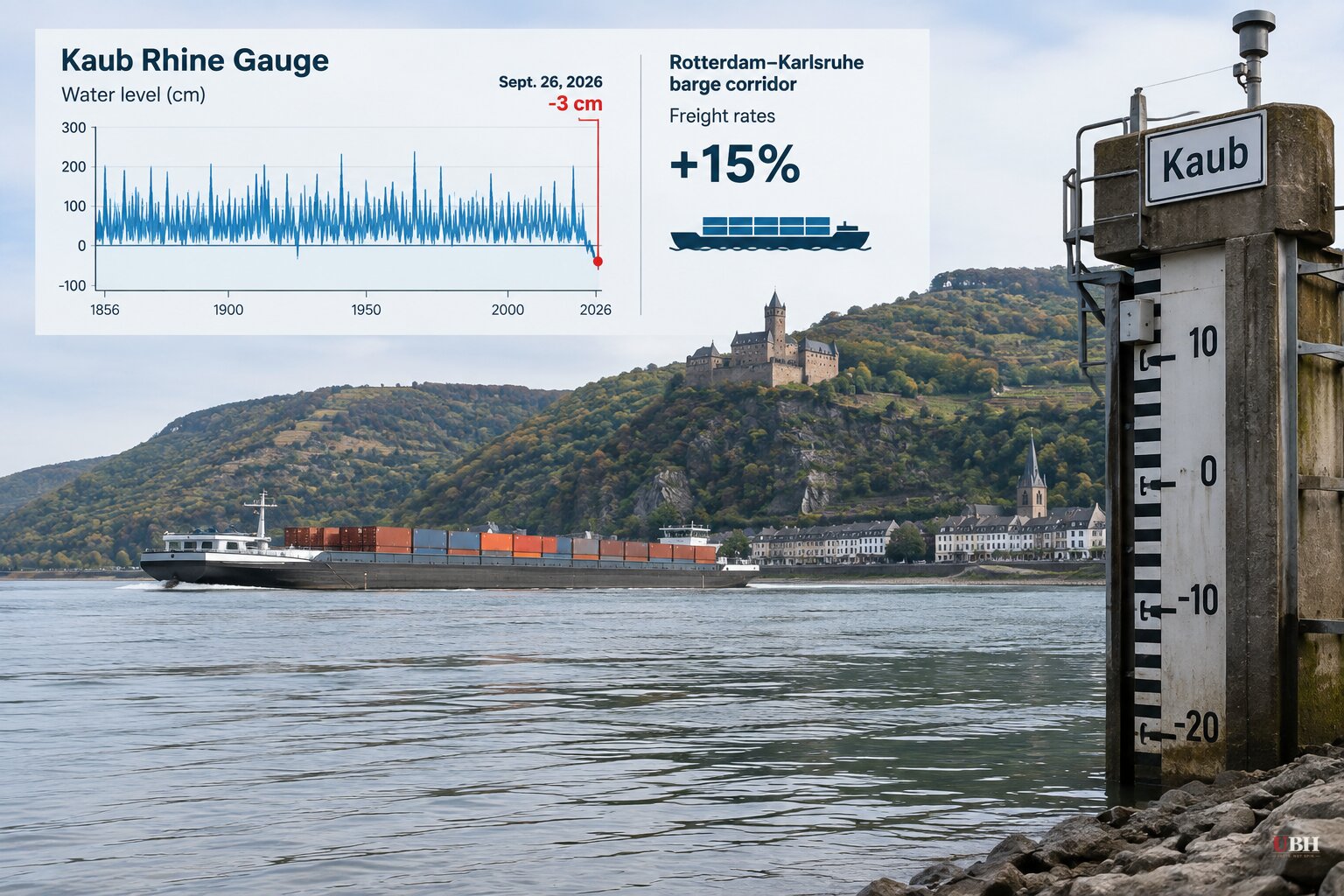
Germany's most important river gauge did something on September 26, 2026, it has never done in 170 years of recorded measurement. It went negative.
The Kaub gauging station, located at Rhine kilometer 546.3 in the narrowest stretch of the Middle Rhine gorge between Mainz and Koblenz, registered -3 cm (about -1.2 inches), according to Tech Times. The reading is so far outside historical range it hasn't been formally entered into the official record yet.
The water level briefly stabilized over the weekend. Then, on Monday, September 28, freight rates on the Rotterdam-to-Karlsruhe tanker barge corridor jumped 15% as carriers scrambled to adjust, Tech Times reported.
According to Volt Power Analytics, the Rhine has spent 74 days this summer below the critical 78 cm threshold at Kaub. That's the point where barge operators are forced to cut cargo loads to keep vessels from scraping bottom.
For comparison: during the 2022 European energy crisis, when low Rhine levels made international headlines and forced Germany to scramble for alternative coal and fuel routes, the river spent 41 days below that same threshold. This year nearly doubled it.
The Rhine isn't a scenic backdrop. It's the industrial spine of southwestern Germany, moving chemicals, coal, oil products, and heavy freight to and from the Ruhr valley and beyond. When barges can't load full cargo, costs get passed straight through to German manufacturers and, eventually, consumers.
The Math Behind the Gauge
The Kaub reading isn't the literal depth of the river. It feeds into a formula: navigable channel depth equals the gauge reading, plus a fixed fairway depth of 1.90 meters, minus the equivalent water level (GlW) of 0.77 meters, according to Tech Times. A negative gauge reading means the math is working against every barge operator on the river.
34 Years of Planning, 7 Years Still to Go
There is a federal engineering project designed specifically to address this bottleneck. It's called Abladeoptimierung Mittelrhein, and it would deepen six critical chokepoints across a 49-kilometer stretch of the Middle Rhine between Budenheim and St. Goar.
That project has been in planning since 1992. Thirty-four years.
As of November 2025, it entered statutory planning approval for only one of its three subsections, per Tech Times. Targeted completion for the full project: 2033. Total cost: €225 million, roughly $258 million.
That's not a rounding error in a national budget. It's also not an insane price tag for critical freight infrastructure serving Europe's largest economy. The timeline is the issue. A river-deepening project with a nine-figure price tag has spent more than three decades in the approval pipeline while the exact crisis it's meant to mitigate has gotten measurably worse, not better.
German officials could reasonably argue that environmental review, stakeholder consultation across multiple states, and engineering complexity in a heavily used waterway justify a careful, multi-decade process. Deepening a river that supports fish populations, drinking water intake points, and dozens of riverside communities isn't something you rush through with a bulldozer. That's a fair defense of due diligence.
But due diligence and a 41-year gap between conception and completion are not the same thing. Germany identified this bottleneck in 1992. The Rhine has now logged its worst low-water summer on record, with a negative gauge reading nobody has ever seen, and the fix is still seven years out at the earliest, assuming no further delays.
What Happens Next
The immediate consequence is already visible: 15% higher freight costs on one of the Rhine's busiest corridors as of Monday's session, according to Tech Times. If dry conditions persist into the fall shipping season, expect more of the same, on more routes, for longer.
Whether the November 2025 approval for the first subsection is treated as an internal deadline by Berlin remains unclear. The remaining two subsections could drift further into the 2030s while the Rhine keeps setting new lows. No federal timeline update has been announced since the project's approval milestone last year.
Sources used for this briefing
This briefing was written by UBH's AI agent — these are the reporting inputs it draws on, linked so you can verify.


