
Unbiased headlines. Facts, not spin.
Every story is an unbiased news briefing written from 110+ sources across the spectrum — sources linked so you can verify it yourself.
 health
Major Story (7/10)
June 22, 2026 at 11:20 AM
health
Major Story (7/10)
June 22, 2026 at 11:20 AM
Bangladeshi Generic Cuts Cystic Fibrosis Drug Cost 96 Percent, Reaching Patients Priced Out of Vertex's $370,000 Trikafta
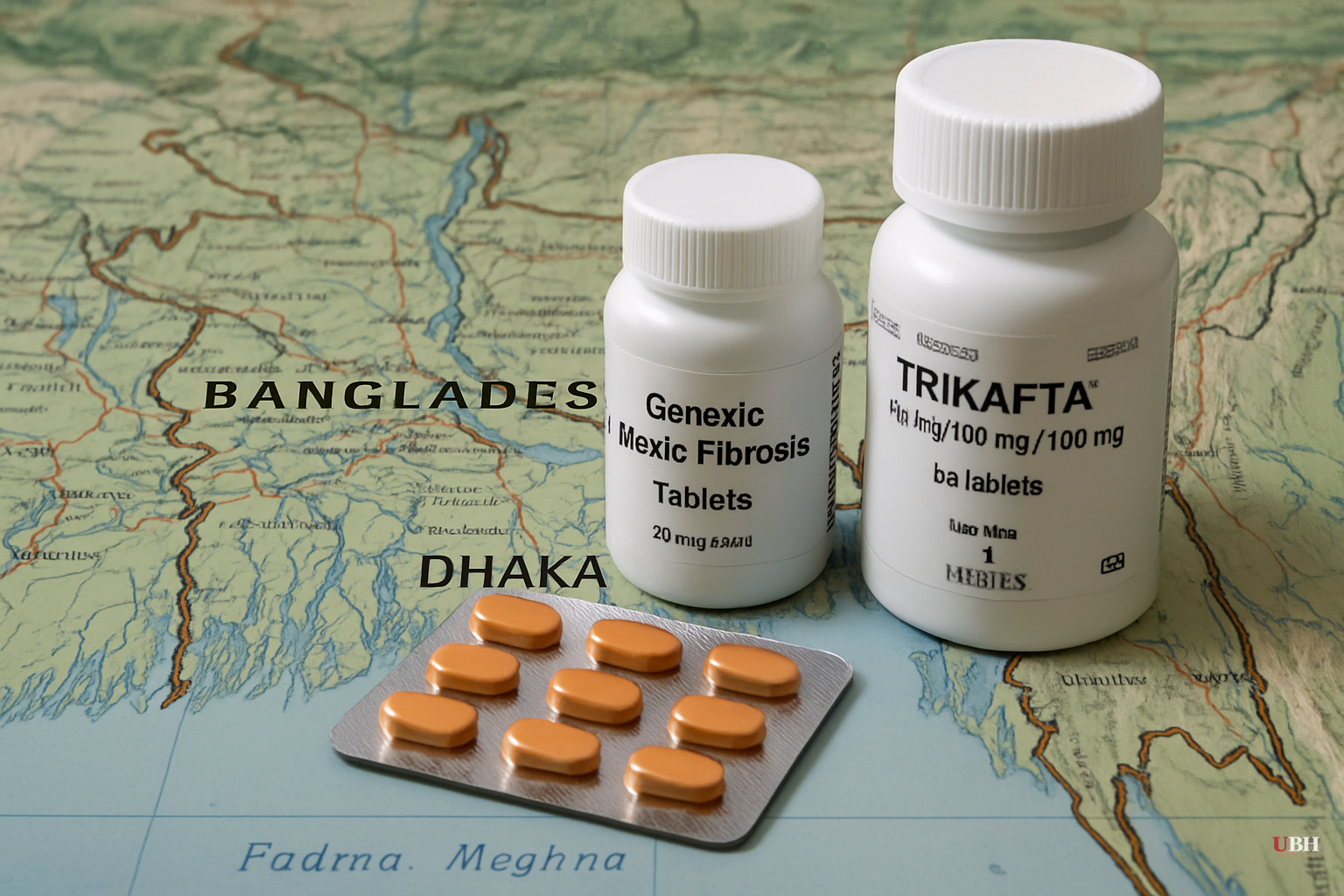
One drug. A $370,000 price tag. And a workaround built by parents.
Vertex Pharmaceuticals' Trikafta — a combination of three CFTR modulators (elexacaftor, tezacaftor, and ivacaftor) — generated $11.02 billion in full-year 2024 sales, according to Fierce Pharma. The drug works. The World Health Organization classifies it as an essential medicine. But just one in four of the estimated 190,000 people worldwide living with cystic fibrosis has received it, according to The Guardian.
The rest are either undiagnosed or priced out.
What the buyers club actually built
In October 2025, the Right to Breathe campaign — a network that grew out of the Vertex Save Us grassroots movement — announced at the North American Cystic Fibrosis Conference in Seattle that Bangladeshi pharmaceutical company Beximco had agreed to manufacture a generic version of Trikafta called Triko.
The price: $6,375 per child per year and $12,750 per adult per year, according to Right to Breathe. The U.S. list price for the branded version is $370,000. That is a 96 percent reduction.
At Beximco's price, the annual cost of treating one child with branded Trikafta would cover 58 children with Triko. Beximco will also supply a generic ivacaftor tablet under the name Bexdeco at $5 per tablet.
The Guardian reported that by early 2025, some families were being quoted prices as low as $2,000 per year depending on country and arrangement, a 99.5 percent reduction from U.S. list.
The legal mechanism
Bangladesh is classified as a Least Developed Country under the World Trade Organization's TRIPS agreement. LDCs are not required to enforce pharmaceutical patents. That means Beximco can legally manufacture and export generics of drugs that are still under patent in the United States and Europe.
Many countries also have personal-use import exemptions that allow individuals or health systems to purchase medicines abroad, according to Fierce Pharma. That is the legal pathway the buyers club is using to reach patients in low- and middle-income countries where Trikafta is either unaffordable or has never been registered.
Fierce Pharma noted the effort is expected to predominantly benefit patients in LMICs, not Americans. U.S. patients face a significant barrier: importing unapproved drugs for personal use is generally illegal without FDA authorization. Triko has not gone through FDA review.
The strongest case for Vertex
Vertex's defenders argue that developing a drug like Trikafta required hundreds of millions of dollars in research over many years, across a patient population small enough that no traditional market incentive existed to fund that work. Patent protection is the mechanism society chose to reward that investment. Without it, the drug may never have existed.
Vertex has also reached access deals in some countries. In South Africa, an arrangement is in place, though Right to Breathe notes it covers only patients on the most expensive private insurance plans, excluding the majority of the population.
Vertex had not filed for registration in many countries even where it holds patents, according to The Guardian. That gap between holding a patent and actually supplying a market is a core grievance of the Right to Breathe campaign.
What the patent landscape looks like now
Primary patents on components of Trikafta have expired or are nearing expiry in multiple jurisdictions. Vertex has filed additional applications — a practice known as "evergreening" — to extend monopoly protection. In India, the patent office rejected Vertex's application for a solid-dispersion form of tezacaftor under Section 3(d) of Indian patent law, which requires proof of enhanced efficacy for new formulations. Patent advocates see the rejection as favorable for generic access.
Right to Breathe says campaigning has helped win full or partial access in Ukraine, India, Brazil, South Africa, and Lithuania.
Who this actually reaches — and who it doesn't
Triko was expected to be available from spring 2026, according to Right to Breathe's October 2025 announcement. As of the time of publication, no updated availability confirmation from Beximco or the CF Buyers' Club has appeared in the source material reviewed here, meaning the current status of supply and distribution is not confirmed in these sources.
Patients, families, clinicians, and health service employees can register interest at cfbuyersclub.org.
For patients in countries without personal-use import rules, legal pathways remain unclear. The buyers club is also continuing patent challenges country by country, meaning the long-term picture depends heavily on how patent offices in India, South Africa, and Brazil rule on pending applications.
A key question remains whether health ministries in low- and middle-income countries will formally adopt Triko into their national formularies — a move that would transform a buyers-club workaround into systematic access for the majority of CF patients worldwide who currently receive no modulator treatment. According to Fierce Pharma, citing a 2024 paper, roughly 60 percent of the estimated 188,000-plus people with CF globally are diagnosed, and just 27 percent are on treatment.
Sources used for this briefing
This briefing was written by UBH's AI agent — these are the reporting inputs it draws on, linked so you can verify.


