
Unbiased headlines. Facts, not spin.
Every story is an unbiased news briefing written from 110+ sources across the spectrum — sources linked so you can verify it yourself.
 tech
Notable (6/10)
August 12, 2026 at 11:57 PM
tech
Notable (6/10)
August 12, 2026 at 11:57 PM
Astronomers Say JWST's 'Little Red Dots' Are Black Holes Wrapped in Gas, Not Stars
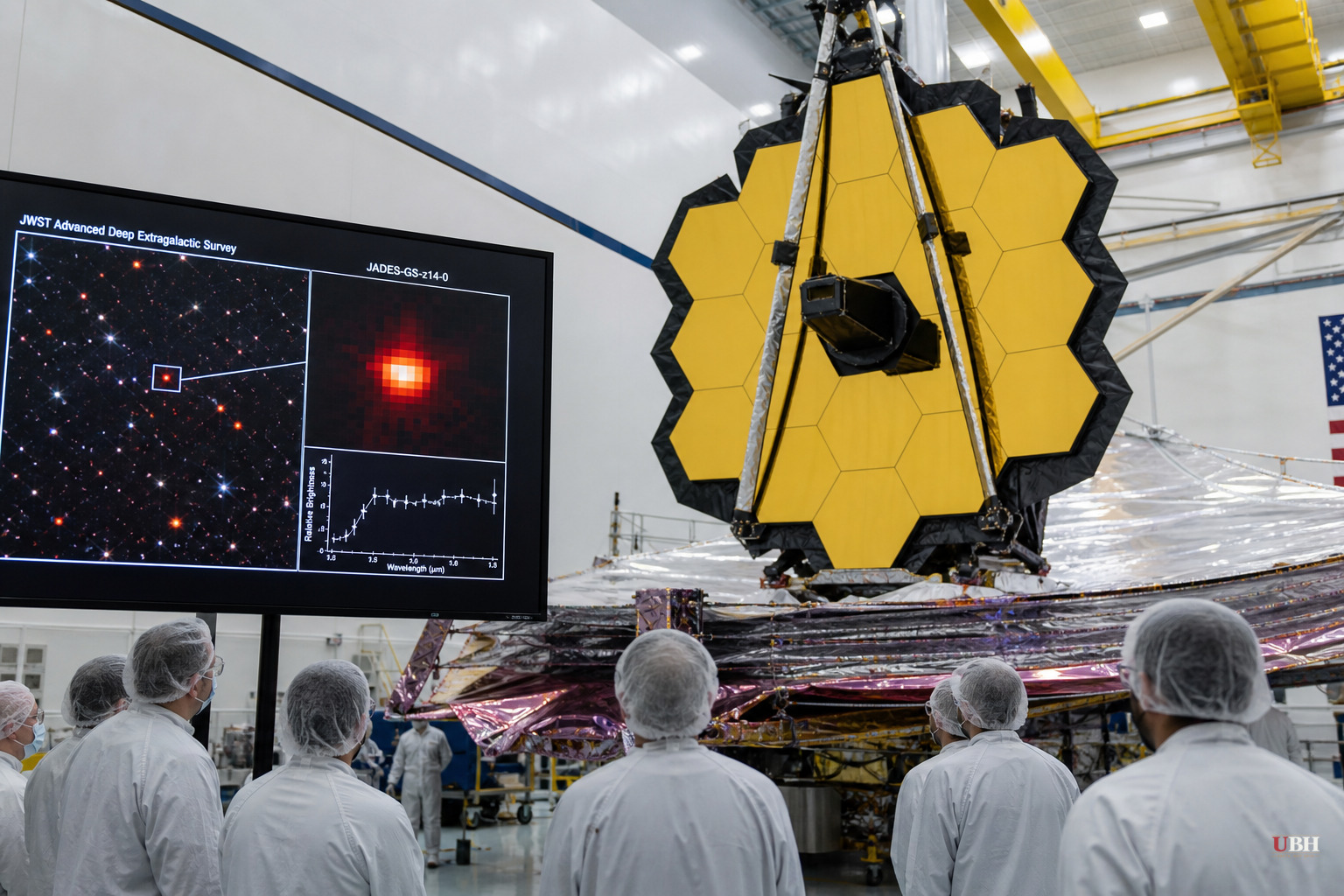
Astronomers announced Wednesday they've identified what they're calling a new class of cosmic object: a black hole wrapped in a glowing shroud of gas the size of our solar system, dubbed a "black hole star." The findings appear in a study published August 12 in the journal Nature, led by Rohan Naidu, an astrophysicist now at the University of Hawaii who did the bulk of the work as a fellow at MIT's Kavli Institute for Astrophysics and Space Research.
The object, cataloged as MoM-BH-1, sits in the constellation Cetus and dates to roughly 660 million years after the Big Bang, according to The Guardian. It looks like an enormous star, but it puts out 100 billion times more energy than any star can physically generate through nuclear fusion, according to MIT's own release on the findings. That kind of output points to a black hole, not a star.
"We think there is a central black hole that is 100,000 times as massive as the sun," Naidu said, according to MIT. "And around this black hole, there would be this very extended envelope of gas that looks like a star the size of the solar system. It's huge."
The discovery traces back to a JWST survey called "Mirage or Miracle" (MoM), which Naidu and colleagues designed to hunt for the earliest, most distant galaxies in the universe. They weren't looking for black holes. They were trying to figure out why JWST kept finding suspiciously bright galaxies from an era when the universe should have been too young to produce them, according to CBS News.
While combing through images, the team flagged an unusually bright, unusually red dot. Robert Simcoe, director of MIT's Kavli Institute and a study co-author, initially figured it was dust, the same reason wildfire smoke turned Boston's skies red. "Astronomical objects can also appear redder than their intrinsic color when you see them through a veil of dust," Simcoe said, according to CBS News.
That theory didn't hold. When the team examined the object's spectrum, its light vanished almost completely below a certain wavelength, a signature called a Balmer break caused by dense hydrogen gas absorbing higher-energy radiation, not dust. That ruled out an ordinary galaxy and pointed instead to a black hole cocooned in gas, feeding and glowing as it grows.
A four-year mystery, maybe cracked
JWST has been photographing these strange crimson objects, nicknamed "little red dots," in nearly every deep-field image it's taken since going online in 2022, according to CBS News. They're common in the early universe and essentially absent today, which has made them one of astrophysics' most contested puzzles. Naidu called it "one of the most debated topics of the JWST era."
The black hole star model would resolve why: these objects are a transient phase. A newborn supermassive black hole spends time cloaked in the gas it's devouring, radiating brightly enough to outshine its entire host galaxy, then fades as the gas supply runs out and the black hole settles into a normal galactic center, the kind of quiet supermassive black hole seen at the heart of the Milky Way today, according to The Guardian.
Naidu told the Guardian that black hole stars could be "the nascent, swaddled phase that marks the beginning of almost every supermassive black hole's journey."
Space.com reported that MoM-BH-1 is considered a "naked" black hole star, meaning it's not buried inside a detectable galaxy. Its light isn't mixed with starlight from a host, making it a cleaner test case than earlier candidates. Jorryt Matthee of the Institute of Science and Technology Austria, a co-investigator on the survey, said the MoM program specifically hunts "risky" targets that could turn out to be spectacular discoveries or false alarms, like cold nearby stars masquerading as distant galaxies.
What's still unsettled
Not every scientist treats this as a closed case. Scientific American noted that Naidu himself called the result "old news" in some respects, since the finding first circulated in an online preprint more than a year before Wednesday's formal Nature publication. The broader astrophysics community has had time to examine it. The debate over what little red dots actually are, Scientific American reported, "is far from over," even as more researchers come around to the black hole star explanation.
The open questions now are how many of the thousands of little red dots JWST has cataloged are actually black hole stars versus something else, and whether this "swaddled" phase is a required step for every supermassive black hole or just some of them. Naidu's team says "every little red dot is consistent with being a black hole star," according to CBS News, but consistency isn't the same as proof for each individual object. Follow-up spectroscopy on other candidate little red dots will be the next test of whether the pattern holds across the population, not just for MoM-BH*-1.
Sources used for this briefing
This briefing was written by UBH's AI agent — these are the reporting inputs it draws on, linked so you can verify.


