
Unbiased headlines. Facts, not spin.
Unbiased Headlines is an independently owned news organization. We bring you the facts, not opinions, written fresh from 110+ named sources. Sources linked so you can verify it yourself.
 tech
Major Story (7/10)
Event date: October 26, 2026 ·
Apple Closes as World's Most Valuable Company at $5.03 Trillion After Nvidia Drops 4.2%
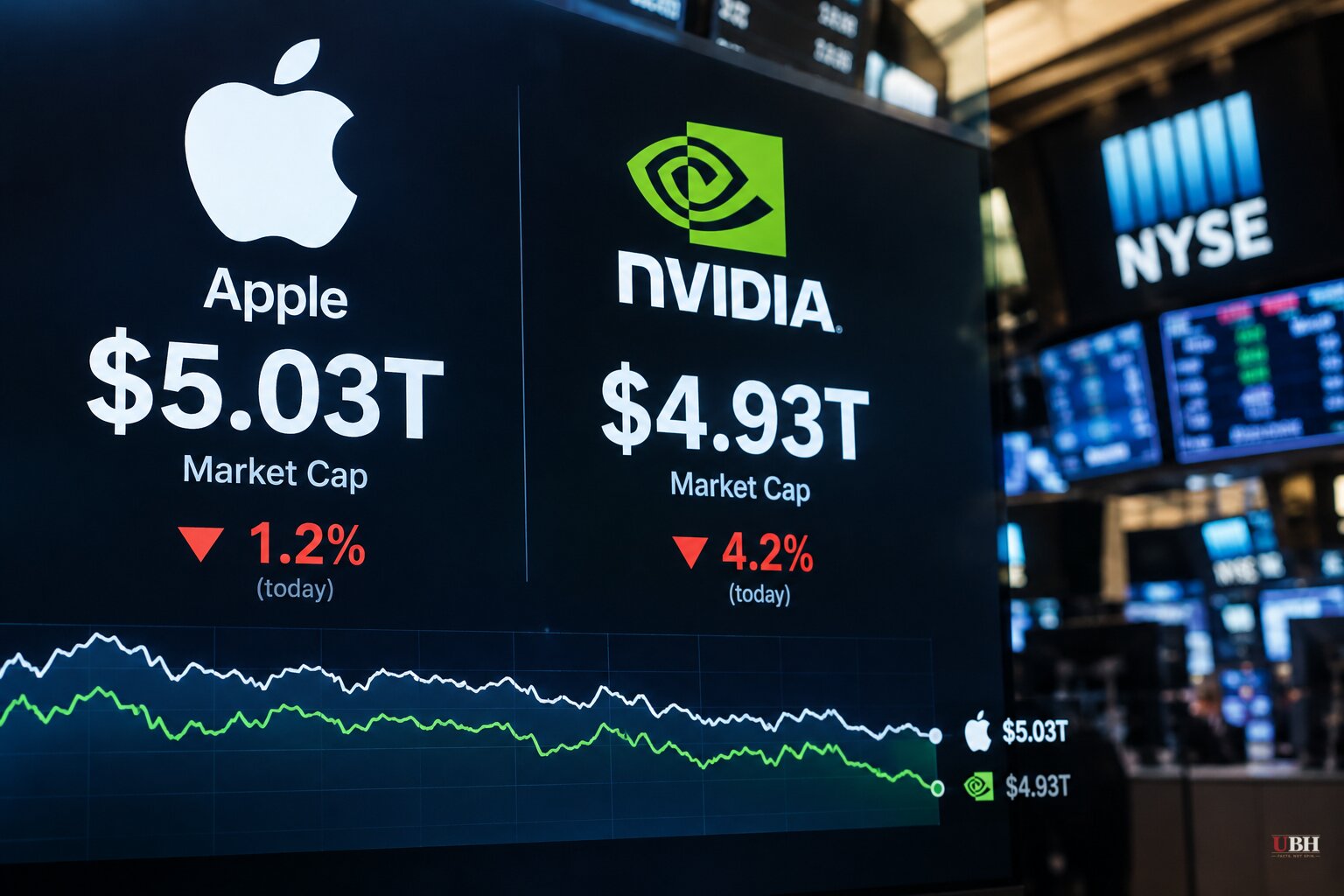
Since Apple briefly topped Nvidia during trading on Friday, Oct. 23, the two companies have swapped places for good, at least for now. At Friday's close on Oct. 30, Apple's market capitalization was $5.03 trillion and Nvidia's was $4.93 trillion.
Apple shares fell 1.2% on the day. Nvidia sank 4.2%. Apple's stock did not rise on the day; it finished on top because Nvidia's drop was steeper.
A week ago the ranking ran the other way: at the Oct. 23 close, Nvidia was worth $5.094 trillion to Apple's $5.074 trillion, a lead of about $20 billion. The day before, on Oct. 22, Nvidia's lead was about $42 billion.
How the week-ago flip played out
On Oct. 23, Apple touched a record intraday high of $351.73, lifting its value to about $5.1 trillion and briefly past Nvidia. That was the day Apple's foldable iPhone Duo reached stores. Nvidia regained the lead by the close.
The Duo starts at $1,999 and tops out at $3,199. Apple's marketing chief, Greg Joswiak, told CNBC that pre-orders were exceptionally strong and pushed back on reports of production problems. Delivery estimates stretch into late January. Morgan Stanley's supply-chain checks point to roughly 6.5 million Duo units produced in the second half of 2026.
Bloomberg reports Friday's close is the first time Apple has overtaken Nvidia since briefly doing so in late July.
Why money is moving
Bloomberg attributes the shift to investors seeking the perceived safety of the iPhone maker amid concerns about AI spending. TradingKey's month-end analysis lists the pressures that built through October:
- Lower-than-expected OpenAI revenue figures.
- Chinese memory-chip competition.
- A hotter-than-expected U.S. inflation report.
- A drop in CoreWeave bonds that put credit risk in focus.
- Meta's free cash flow turning negative.
TradingKey also says disclosures from Alphabet, Amazon and Intel on spending, cash burn or business pressure pushed investors to ask when AI investment will pay off. None of those sources ties Nvidia's 4.2% drop on Friday to a single event.
The rest of the top of the board has moved too. Microsoft ranks third at $3.88 trillion, ahead of Alphabet at $3.44 trillion and Amazon at $2.60 trillion. Tesla gained 12.68% in October and sits eighth at $1.58 trillion.
The case that Nvidia is still the better business
Business Insider's analysis is that Nvidia does not need to be in trouble for Apple to catch it. The chipmaker remains the second-best performer in the Magnificent Seven this year, is outpacing the S&P 500, and has Wall Street analysts in a near-unanimous bullish camp. Apple, in that view, has run alongside the AI trade rather than inside it, helped by a loyal consumer ecosystem, a growing services business and one of the biggest cash piles in the market.
24/7 Wall St. argues the other side of the valuation question. It says Apple trades at 45 times earnings and already prices in a Duo cycle that limited supply will spread across several quarters, while memory costs squeeze margins. Nvidia, it says, is growing far faster at a lower multiple: data center revenue rose 117%, and management expects about 70% revenue growth in fiscal 2028 even with supply limits. The same analysis flags real risks for Nvidia, including no China data center compute revenue in its guidance and financing ties to AI labs.
That piece also cautions that the opposite one-month moves in the two stocks suggest some money is rotating from AI chips toward Apple, though one month is a short window.
What Apple has to show
Apple is under new management. John Ternus has been CEO since Sept. 1, and the Duo is his first major launch. Tim Cook, then CEO, described a "100-year flood" in memory pricing, and Apple has reluctantly raised prices.
Apple's July guidance for the September quarter called for 9% to 11% revenue growth and a 47% to 48% gross margin. That margin included about one percentage point from tariff refunds.
Strong demand cuts both ways. Per 24/7 Wall St., the shortage limits what Apple can book in the December quarter and pushes some revenue into 2027. The higher entry price should lift the average iPhone selling price, which helps margins.
Apple reports fiscal fourth-quarter results on Monday, Nov. 2. Investors will be looking for holiday guidance, Duo supply timing and commentary on China. Nvidia reports Nov. 18, after guiding to $108 billion in revenue for the quarter.
Sources used for this briefing
7 links from 7 independent newsrooms (syndicated copies of the same report count once)
These are the sources it draws on, linked so you can verify.


