
Unbiased headlines. Facts, not spin.
Unbiased Headlines is an independently owned news organization. We bring you the facts, not opinions, written fresh from 110+ named sources. Sources linked so you can verify it yourself.
 tech
Major Story (8/10)
Event date: October 29, 2026 ·
Amazon Signals Outside Trainium Chip Sales for Late 2027 as Samsung Posts Record KRW 107.4 Trillion Profit
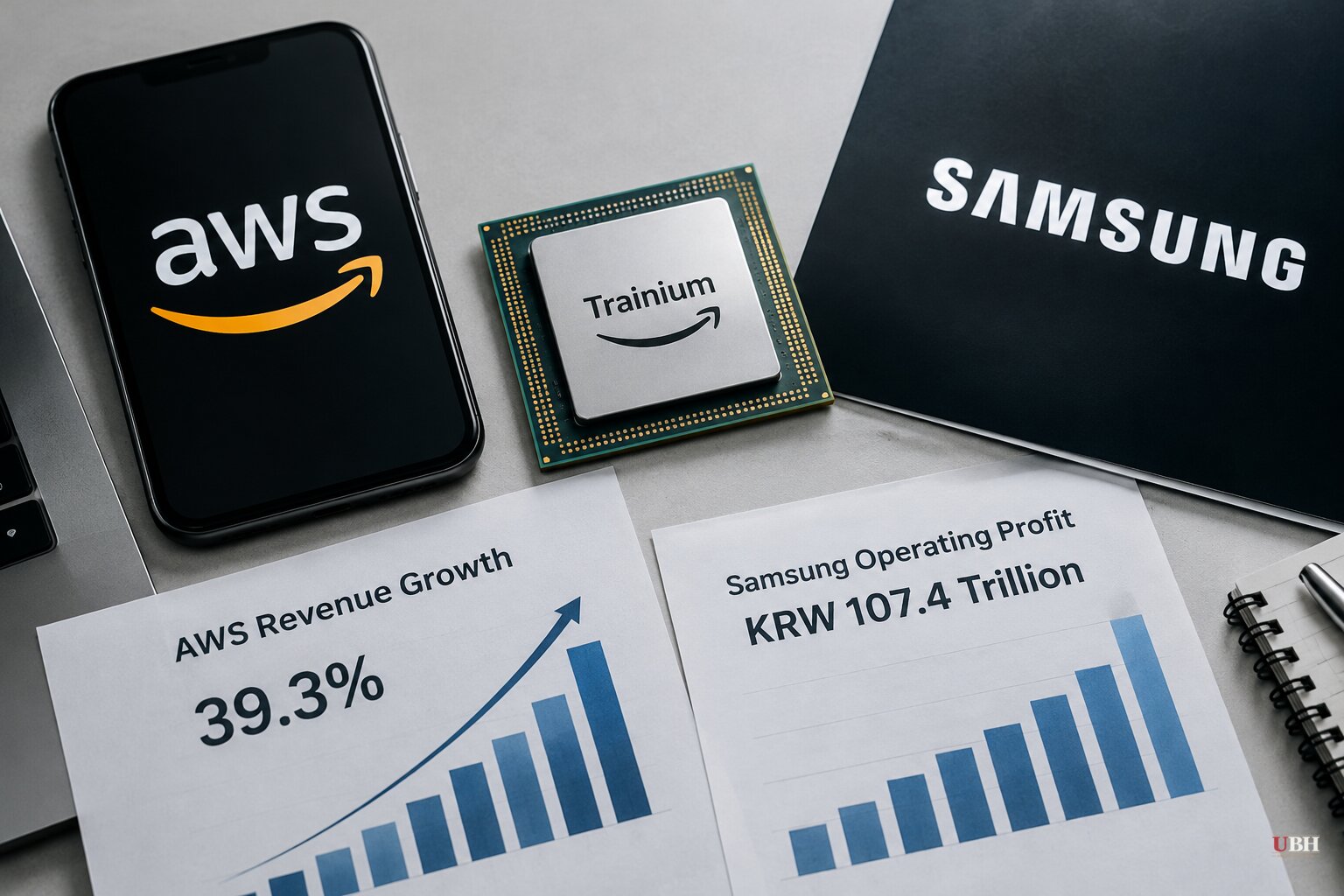
Two of the biggest names in tech reported quarterly results on Thursday, Oct. 29. Their numbers describe the same thing: AI infrastructure spending is still climbing, and chip supply is the choke point.
Amazon: record margin, small miss, and a chip ambition
Amazon posted Q3 revenue of $201.9 billion, up 12% from a year earlier. That was about $350 million short of the $202.25 billion analyst consensus. Earnings per share came in at $1.89 against a $1.96 estimate.
The EPS gap has a specific explanation. The year-ago quarter included a $9.5 billion pre-tax unrealized gain on Amazon's Anthropic investment, and this quarter had no equivalent.
Operating income jumped 61% to $28.1 billion. That is a 13.9% operating margin, the highest in Amazon's history.
AWS drove it. The cloud unit booked $46.0 billion in revenue, up 39.3%, its fastest growth in nearly five years. AWS operating income was $17.8 billion at a 38.7% margin, about 63% of Amazon's total operating profit for the quarter.
AWS's remaining performance obligations, which are contracted revenue not yet recognized, reached $578 billion. That compares with $496 billion at the end of Q2 and $244 billion at the end of 2025.
CEO Andy Jassy said in the earnings release that "our AWS investment in functionality and infrastructure is working." He projected AWS growth above 40% in both 2027 and 2028.
Tech Times reports that Jassy also signaled on the call that Amazon plans to sell its Trainium AI chips directly to third-party data centers beginning in late 2027. The outlet describes that as putting Amazon in direct competition with Nvidia at the hardware layer. Amazon has not, in the material we have, laid out pricing, volumes or customers for such sales. That makes it a stated target, not a product on the market.
Samsung: the first KRW 100 trillion quarter
Samsung Electronics reported Q3 revenue of KRW 195.3 trillion, an all-time high and up 14% from the prior quarter. Operating profit hit KRW 107.4 trillion. The company says that makes it the first tech company to exceed KRW 100 trillion in quarterly operating profit.
Almost all of that came from chips. The Device Solutions division earned KRW 106.5 trillion in operating profit on KRW 147.1 trillion in revenue. The consumer-device division lost KRW 0.8 trillion.
Memory is the engine. Samsung said it scaled up HBM4 sales sharply, and that HBM4 revenue more than tripled from the prior quarter. Third-quarter DRAM average selling prices rose 20%. The company says 2027 HBM supply is already sold out and expects the supply shortage to last through 2028.
Capital spending this year is KRW 84.4 trillion, roughly $63.1 billion, the largest in Samsung's history.
The Taylor, Texas fab
Samsung's foundry business is where the U.S. angle sits. Kang Seok-chae, an executive vice president in the foundry division, said on the call that the number of 2nm order projects this year is expected to more than double from last year. He said new orders are coming mainly from HPC customers, including major hyperscalers.
Kang also said that in 2027, demand is expected to "significantly exceed production capacity across all sub-8nm processes," with utilization above 100%.
The first fab at Taylor has completed cleanroom activation and equipment move-in and is on schedule. Samsung plans full-scale 2nm AI and HPC mass production there next year. The company says it is also considering more fabs and added capacity to meet customer demand.
Kang said HPC will account for more than 50% of total foundry sales next year. In Q4, Samsung plans to begin mass production of the Exynos 2700 mobile processor on its second-generation 2nm process. It also plans to ramp a 4nm NPU product for a major customer.
One new customer detail surfaced separately. Taiwan's Faraday said at an investor briefing that it is working with Samsung on cloud AI ASICs for a U.S. client, built on Samsung's 2nm gate-all-around process. Faraday put the design contract at tens of millions of dollars. That figure covers only non-recurring engineering. The value and volume of Samsung's actual foundry order have not been disclosed.
SammyGuru also reports that Taylor has reportedly been filled with orders from Tesla, Broadcom and Arm. Samsung has not confirmed that list in its earnings materials. Unconfirmed posts on X, relayed by HuggingNews, claim Samsung has ordered extra tools to lift Fab 1 to 20,000 wafers a month in the second half of 2027, with Fab 2 construction starting at the end of 2026. Samsung has not publicly confirmed those figures.
Still in the red
Strong demand has not yet made the foundry unit profitable. SammyGuru, citing Samsung's Q3 report, says the foundry business remained in the red. Revenue and earnings improved from Q2, driven by 4nm HBM base-die sales and expanded advanced-node sales to global customers. Samsung attributes that improvement to those two factors.
The plan depends on 2nm yields. Kang said Samsung will concentrate on stabilizing 2nm yields while developing next-generation processes. He also pointed to 3D stacking, silicon photonics and next-generation base dies for AI memory.
What to watch
Samsung's checkpoint is next year, when Taylor is due to move from equipment installation to full-scale 2nm production. Amazon's is late 2027, when Trainium is supposed to start shipping to outside data centers. Neither company has yet shown the yield data or customer commitments that would confirm those dates will hold.
Sources used for this briefing
7 links from 7 independent newsrooms (syndicated copies of the same report count once)
These are the sources it draws on, linked so you can verify.


