
Unbiased headlines. Facts, not spin.
Unbiased Headlines is an independently owned news organization. We bring you the facts, not opinions, written fresh from 110+ named sources. Sources linked so you can verify it yourself.
 tech
Major Story (7/10)
Event date: October 25, 2026 ·
Five Big Spenders Are Tracking to $803 Billion to $828 Billion in 2026 Capex, With Q4 Implied at Up to $272 Billion
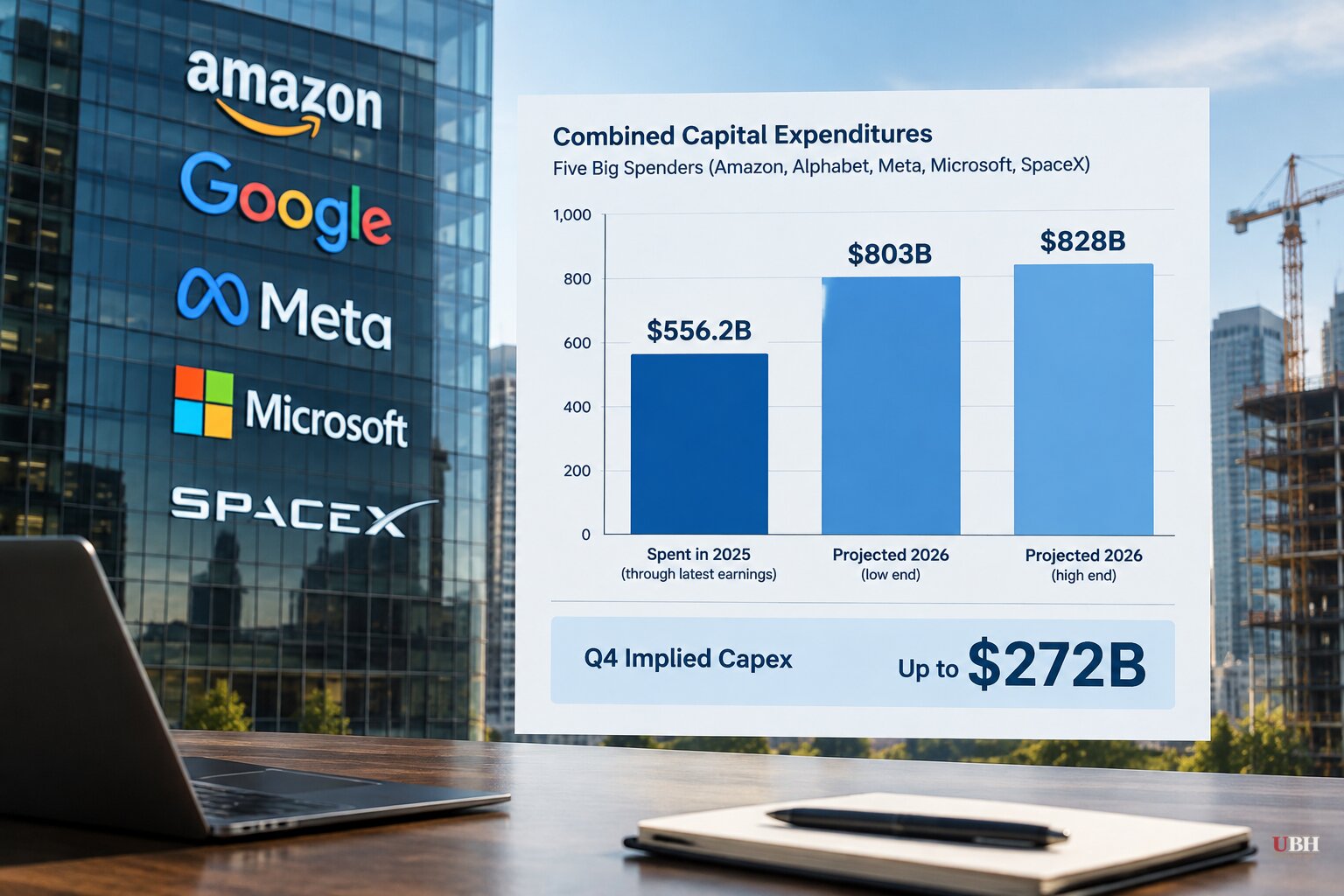
Since Alphabet, Meta, Microsoft and Amazon reported this month, the full-year picture has come into focus: the five biggest spenders have laid out about $556.2 billion in capital expenditures through three quarters of 2026, and their own guidance points to a total of $803 billion to $828 billion by December.
That tally covers Amazon, Alphabet, Meta, Microsoft and SpaceX. It counts broad capital spending, not only AI. Executives at each company have named AI infrastructure as the main driver.
The quarterly numbers
Combined third-quarter spending came to about $227 billion. That is roughly 20% above the $188.5 billion the same group spent in the second quarter.
Amazon was the largest spender, with $75.9 billion in cash capex. CFO Brian Olsavsky said the figure relates primarily to AWS and AI. SpaceX was the smallest at $48.1 billion, though CFO Bret Johnsen has indicated spending will ramp up by next quarter.
The fourth-quarter math is simple. The guidance implies $247 billion to $272 billion for the quarter. The low end assumes Meta and Alphabet land at the bottom of their full-year capex ranges.
Based on those implied figures, Amazon is the only one of the five whose spending would fall from its third-quarter level. Amazon kept its forecast of about $220 billion in cash capex this year.
Microsoft expects about $170 billion in calendar-year capex. That is down from its earlier outlook because of delays in third-party data-center capacity, not a pullback in demand.
2027 is pointed up
No company has published a concrete 2027 figure. The language is consistent anyway.
"We continue to expect our CapEx to increase significantly in 2027," Alphabet CFO Anat Ashkenazi said on the company's Q3 call Wednesday.
Amazon CEO Andy Jassy said Thursday that the company expects to spend "meaningfully more in 2027."
Meta CFO Susan Li said on Oct. 21 that the company is still developing its budget and capacity plans, "but we expect to continue investing aggressively to support both our core business and emerging AI initiatives."
Different counts, different totals
The headline number depends on who is in the group. J.P. Morgan Global Research counts Amazon, Alphabet, Meta, Oracle and Microsoft, and in an Oct. 19 note said its estimate for that group had been revised up from $736 billion to $900 billion for 2026. The bank says that is roughly as much as those companies have spent cumulatively since ChatGPT launched in November 2022.
Bloomberg uses a third figure. It reports a combined $750 billion in Big Tech AI spending this year.
Those numbers are not interchangeable. They differ in which companies are counted and whether they measure total capex or AI-related spending.
J.P. Morgan looks further out. It expects AI capex to reach $5 trillion by 2030. Chief U.S. economist Michael Feroli called the surge "the defining feature of our economic times."
The spending is also going global. The European Commission unveiled its Technological Sovereignty Package in June, including a Cloud and AI Development Act aimed at tripling EU data-center capacity within five to seven years. The EU has launched tenders for up to seven AI "gigafactories," with more than €10 billion in public funding mobilized and construction expected to start in 2027. Unlike the hyperscaler budgets, that is taxpayer money.
Who pays for it
The argument for the spending rests on cloud revenue. J.P. Morgan says AWS revenue grew 37% year over year as of August, to an annualized run rate of about $169 billion, with contracted backlog of $496 billion. The bank reads that backlog as a sign revenue growth should hold for years.
Bloomberg's reporting today, Oct. 30, points at the other side of the ledger. It says the advertising, consumer and retail businesses that fund the $750 billion are beginning to slow. It also says that in some cases the AI technology is cannibalizing the companies' existing businesses. Bloomberg describes the slowdown as early, not a collapse.
The market has already shown how sensitive it is to the spending. Meta's shares jumped in late trading Wednesday after its report, then sank by Thursday's open as investors absorbed plans to raise future spending commitments by $125 billion, to $825 billion. Meta's shares fell 6.1% Thursday, the steepest decline since July.
What comes next
The 2027 budgets are the open item. The companies have said capex rises but have not said by how much, and the fourth-quarter figures will show whether the low or high end of the $247 billion to $272 billion range is the real one. Whether the ad, consumer and retail cash engines that Bloomberg says are slowing can keep funding that growth is the question investors are weighing.
Sources used for this briefing
4 links from 3 independent newsrooms (syndicated copies of the same report count once)
These are the sources it draws on, linked so you can verify.


