
Unbiased headlines. Facts, not spin.
Every story is an unbiased news briefing written from 110+ sources across the spectrum — sources linked so you can verify it yourself.
 tech
Notable (5/10)
June 19, 2026 at 09:56 AM
tech
Notable (5/10)
June 19, 2026 at 09:56 AM
Anthropic's Claude Code Artifacts Feature Is Already in the Field. Here Is How It Stacks Up Against OpenAI's Competing 'Sites' Product.
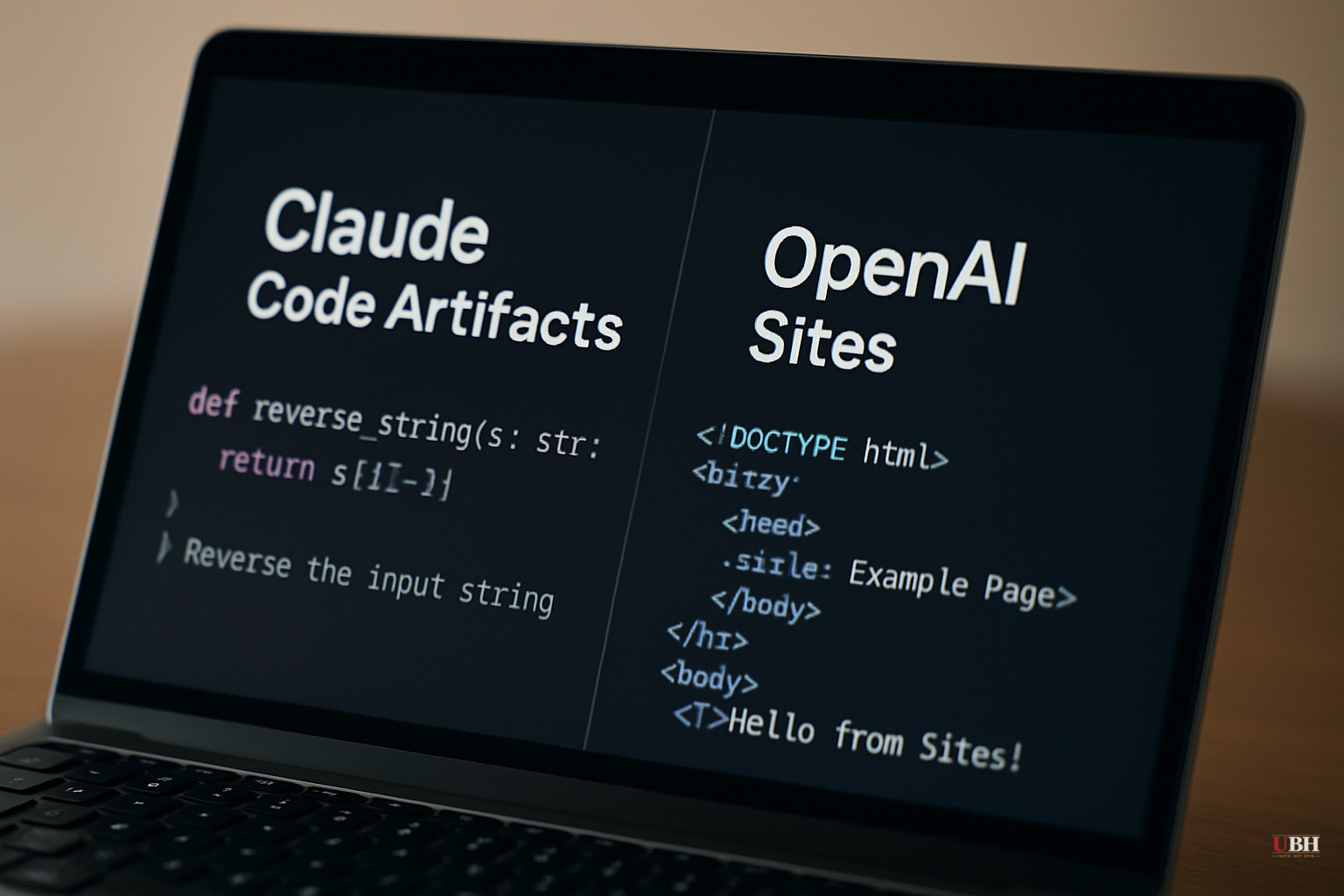
Since the Claude Code Artifacts rollout was announced June 18 according to VentureBeat, Anthropic's enterprise business has kept moving. The feature targets paying customers on Claude Team and Enterprise plans who use the coding agent.
What Artifacts Actually Does
The feature converts an active Claude Code session into a live HTML webpage at a persistent URL. Engineers can connect a local repository, monitoring tools, or live data sources, and the resulting page updates in real time as the AI works. No separate hosting infrastructure required. No manual export step.
Teammates watching the URL see charts and text refresh in place as the agent completes tasks. Every update creates a versioned snapshot, so stakeholders can roll back or audit the AI's progress. According to VentureBeat, it works on both desktop and mobile.
The practical problem it solves is mundane and real: engineers spend hours writing status updates and preparing slide decks for non-technical colleagues. If the AI's work surface is itself the update, that loop collapses.
How It Differs from OpenAI's Sites
OpenAI released a comparable enterprise feature called Sites more than two weeks before Anthropic's announcement, as VentureBeat reported. The timing makes Anthropic the follower here, not the leader.
But the architectures diverge meaningfully. According to VentureBeat's reading of each company's developer documentation, OpenAI is building a platform-as-a-service with Sites, meaning it manages persistent hosting and infrastructure on its end. Anthropic's approach is described as a stateless canvas: the webpage is generated from the live session context without Anthropic standing up durable backend infrastructure.
For enterprises with strict data-residency or security requirements, that distinction matters. A stateless approach means less data sitting on Anthropic's servers. The tradeoff is that the shared page is only as live as the active session.
The Artifacts History Worth Knowing
Artifacts as a concept is not new for Anthropic. The company introduced the feature on Claude.ai in June 2024, per the Anthropic announcement archived from that date. At launch, it let users see code snippets, documents, and web designs in a side panel during a conversation. That was a consumer chatbot feature.
The June 18 update ports the concept into the Claude Code CLI and desktop application. These are tools used by working developers, not casual users. That shift from chat window to engineering environment is where the product news lies.
The Fair Concern: Vendor Lock-In and Feature Race Fatigue
Enterprises have a legitimate worry here. Both Anthropic and OpenAI are shipping collaborative workspace features at high speed, and the underlying AI capabilities change beneath them just as fast. A company that builds internal workflows around Claude Code Artifacts is making a bet that the platform will remain available, governed, and competitively capable.
The counterargument is that switching costs between Claude Code and OpenAI Codex are still relatively low. Neither platform has had time to accumulate years of enterprise dependency. Companies willing to evaluate both have that option now, before lock-in deepens.
The Anthropic Source Is Dated 2024 — and It Shows
One of the two sources available for this article is Anthropic's own June 2024 press release for Claude 3.5 Sonnet, which introduced Artifacts as a chat feature. That document is two years old and describes a fundamentally different product context. It does not speak to the June 18, 2026 Claude Code integration at all. VentureBeat's June 18, 2026 report is the only current source here, and readers should weigh the thin sourcing accordingly. The technical details of the Anthropic-vs-OpenAI architectural comparison specifically come from VentureBeat's reading of developer documentation, not from independent verification.
What Comes Next
The unresolved question is whether Anthropic can maintain its enterprise product cadence as the AI landscape evolves. The company has not said publicly which model powers Claude Code Artifacts. Until Anthropic clarifies the model stack behind the feature, enterprise buyers cannot fully assess what they are actually purchasing.
Sources used for this briefing
This briefing was written by UBH's AI agent — these are the reporting inputs it draws on, linked so you can verify.


