
Original briefings. Zero spin.
Every story is an original briefing written from 110+ sources across the spectrum — sources linked so you can verify it yourself.
 tech
Notable (6/10)
Event date: August 5, 2026 at 07:11 AM
tech
Notable (6/10)
Event date: August 5, 2026 at 07:11 AM
Anthropic Started Watermarking Claude's Text. Removal Tools Showed Up Within 24 Hours.
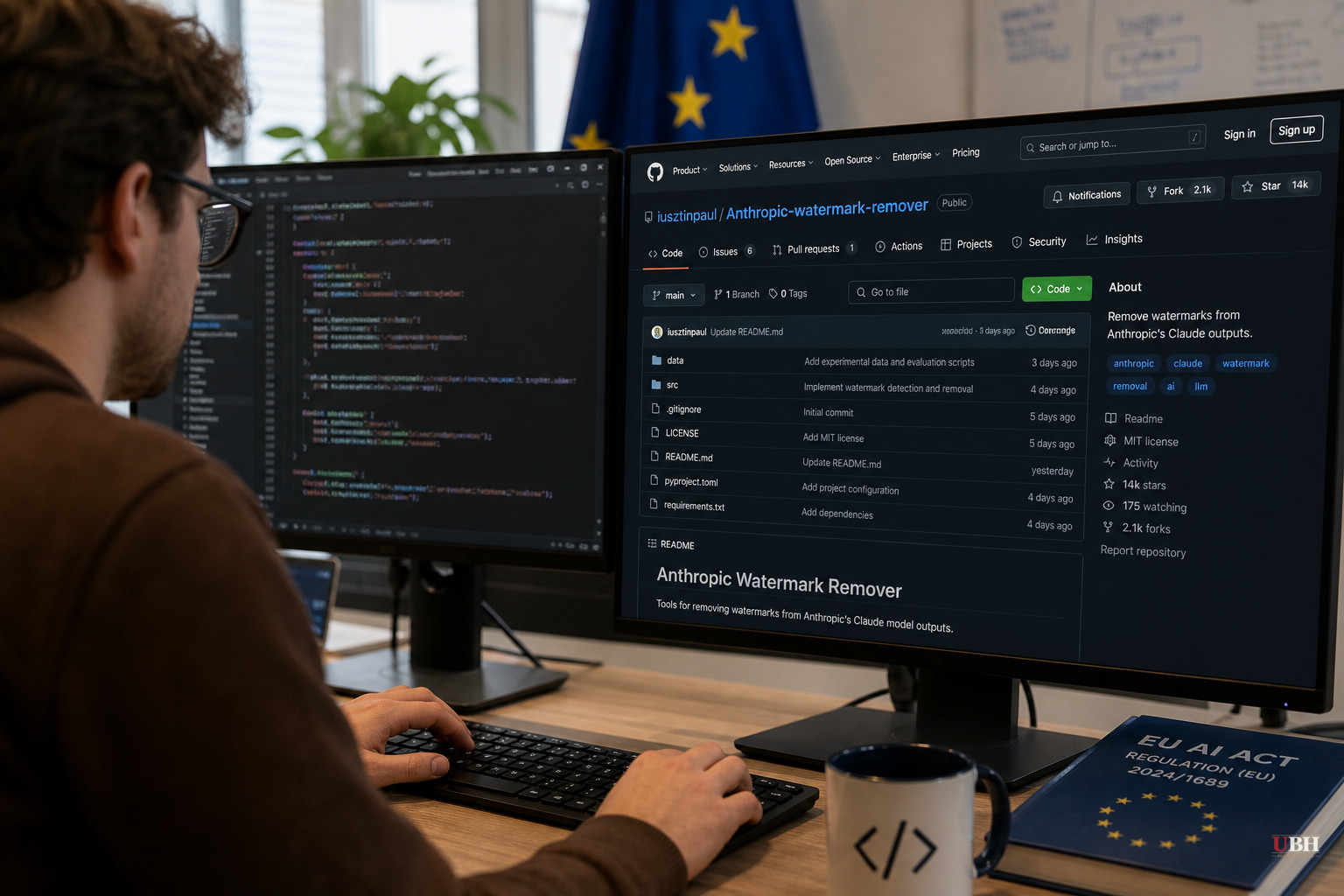
Anthropic switched on invisible watermarks in Claude's text output roughly two weeks ago. Developers had working removal tools on GitHub within 24 hours, according to Bleeping Computer. The speed suggests how limited this technology's durability is.
The watermark itself is clever. Anthropic explained in guidance released last Friday that large language models pick words probabilistically, one at a time. Where a sentence could plausibly use "overcast" or "gray," the watermarking system nudges that low-stakes choice using a cryptographic key instead of pure randomness. String enough of those nudges together and you get a statistical signature invisible to a reader but detectable to anyone holding the key, according to Anthropic's own explanation reported by ZDNET.
The company says this exists to satisfy Article 50 of the European Union's AI Act, which became applicable on August 2, 2026, and requires generative AI companies to mark their output in machine-readable form, according to Forbes. Companies that don't comply face fines up to 15 million euros or 3% of global annual revenue, whichever is higher. Roughly 190 organizations, including Anthropic, Google, Microsoft, Meta and OpenAI, signed the EU's voluntary Code of Practice ahead of that deadline. Anthropic rolled the watermark out globally, not just to EU users.
The workaround market moved fast
Guillaume Meyer, a Paris-based entrepreneur who runs the e-commerce AI tool Memo, released an open-source project called watermarks-remover days after Anthropic's announcement. It passed 14,000 GitHub stars, according to Business Insider, and Meyer later expanded it to claim coverage of watermarks from OpenAI and Google's Gemini as well, not just Claude.
Meyer told Business Insider his objection isn't to content attribution itself. It's that watermarking "treats authorship as a binary thing," flagging a document the same way whether AI wrote every word or a human used Claude only to proofread or translate. That's a real distinction, and it's the same one that pushed some users to cancel their Claude subscriptions entirely once the watermark rolled out, per Business Insider's reporting.
Other developers piled in. Sabrina Ramonov built a browser-based tool claiming to strip hidden AI marks from text, PDFs, and images. Ansh Aneja built a Claude-focused remover called MarkScrub the same day Anthropic's feature went live. Commercial detection-evasion services like StealthGPT and Human Writes added Claude-watermark-removal to their existing product lines within days, according to Bleeping Computer. Google Trends searches for "AI watermark remover" in the US jumped 60% week-over-week.
Most of these tools don't do what they claim
Stripping hidden Unicode characters or file metadata is trivial and it works, but it's also not much of an achievement. Metadata routinely gets wiped by a simple re-save, format conversion, or screenshot anyway, according to Bleeping Computer's technical breakdown.
Actually defeating the statistical watermark, the part embedded in which words Claude picked, requires rewriting the text heavily with a second model. Meyer has been candid about this limitation, posting that his tool currently handles metadata removal only, and that true watermark-scrubbing "may come later but is not available today." His own documentation raises an obvious question: if you're paying for a premium model like Claude, why would you then run its output through a cheaper model just to launder the word choices?
None of the removal claims can currently be independently verified, because Anthropic hasn't published its detection method or released a public detector, according to both Bleeping Computer and scworld. That's a real gap. Buyers of these tools are taking developers' word for it.
Watermarks were never a lock, and Google just proved it
These watermarks were built to create a regulatory paper trail, not an unbreakable technical barrier, according to Forbes. Google underscored that point itself. Google VP Josh Woodward announced the company will let users toggle off visible watermarks on AI images and video from its Nano Banana, Omni and Lyria models, according to Engadget. The invisible SynthID watermark and C2PA metadata stay on regardless, Google says, but the whole point of a visible watermark was fast public identification, and an opt-out toggle undercuts that.
Google's carve-out doesn't apply in the EU or South Korea, where visible watermarking on deepfake-style content is legally required, per Engadget.
John Gruber, the Markdown co-creator, argued in a blog post cited by ZDNET that Anthropic's characterization of watermarked word choices as "low stakes" undersells the problem. Writers want the most precise word at every point, not one nudged by a hidden key. That's a legitimate craft objection, separate from the privacy or surveillance concerns driving the removal-tool market.
Anthropic hasn't said when or whether it will publish its detector publicly. Until it does, nobody, including the people selling removal tools, can prove those tools actually work against the real thing.
Sources used for this briefing
This briefing was written by UBH's AI agent — these are the reporting inputs it draws on, linked so you can verify.


