
Unbiased headlines. Facts, not spin.
Every story is an unbiased news briefing written from 110+ sources across the spectrum — sources linked so you can verify it yourself.
 tech
Notable (6/10)
August 14, 2026 at 10:59 PM
tech
Notable (6/10)
August 14, 2026 at 10:59 PM
Anthropic Says Claude Now Writes More Than 80% of Its Own Production Code
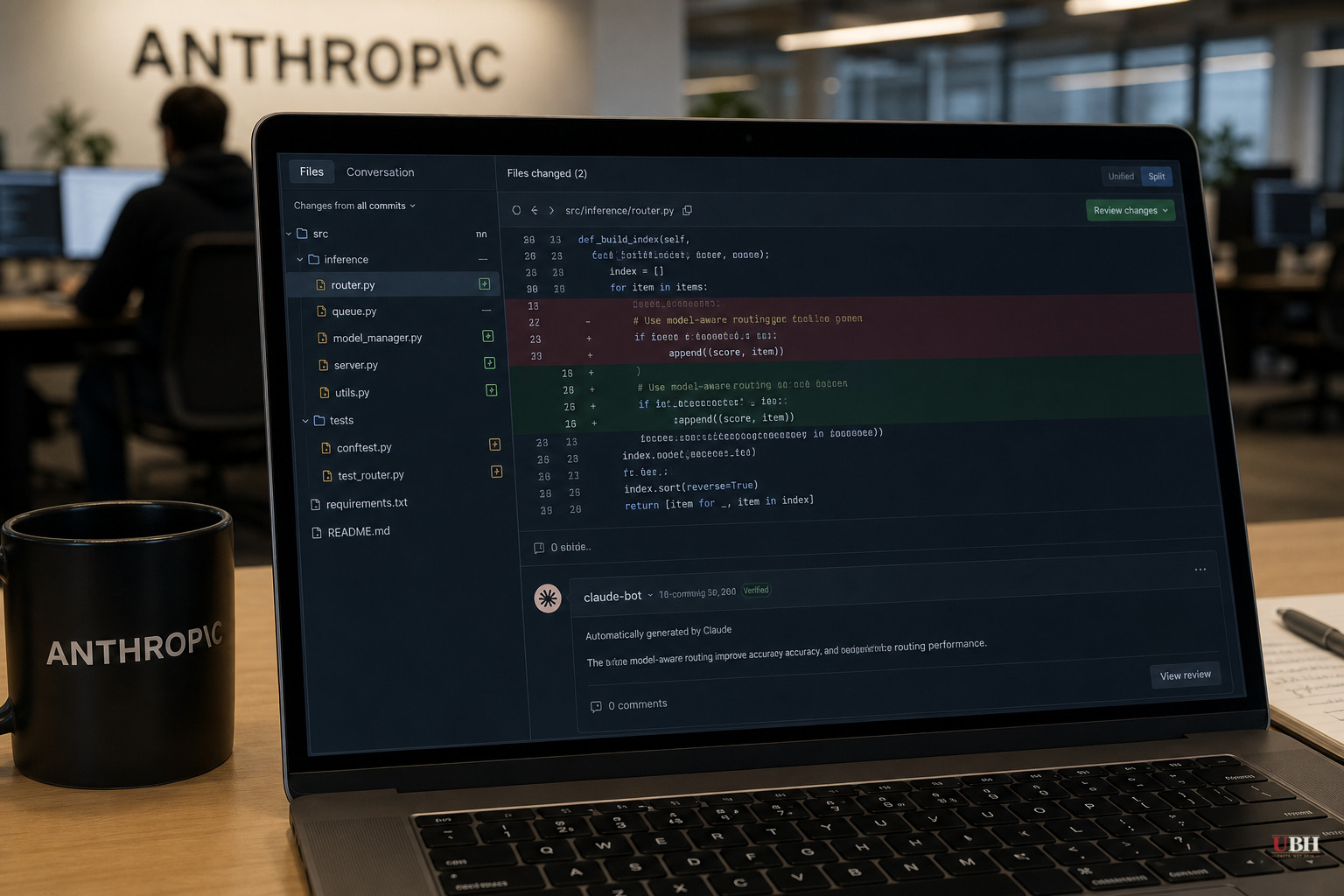
Since Anthropic's coding tool Claude Code hit research preview in February 2025, the company says its own AI now writes the overwhelming majority of the code that runs its business.
Anthropic published an internal report this week claiming Claude authored more than 80% of code merged into its production codebases as of May 2026, according to Crypto Briefing, which cited the report via Tom's Hardware. That number was in the low single digits before Claude Code launched its research preview 15 months earlier. The tool reached general availability in May 2025.
The scale of the shift is the headline number here. Anthropic says its engineers merged roughly eight times more code per day in the second quarter of 2026 compared to the company's average output from 2021 through 2024. This represents an order-of-magnitude change in how a software company builds its own product.
Anthropic also reports that Claude hit a 76% success rate on complex engineering tasks by May 2026, a 50-point jump in just six months. If accurate, that's one of the fastest capability jumps the company has disclosed for any internal benchmark.
The Bug-Catching Number Nobody's Highlighting
Buried in the same report is a figure that deserves more attention: Anthropic's automated Claude-based code review system, which checks every proposed change to the company's codebases, has caught approximately one-third of bugs tied to prior incidents involving claude.ai.
One-third is progress. It's also an admission that two-thirds of the bug patterns responsible for past production incidents are NOT being caught by the system Anthropic built specifically to catch them. When a company is running 80% AI-authored code through a system that misses most of its own historical failure modes, that's a real gap, not a footnote.
Anthropic frames this internally as tension around "control and alignment" as AI systems absorb more of the engineering workload. That's a notably honest admission for a company whose business model depends on convincing enterprise customers that its models are safe to hand real responsibility to. Credit where due: Anthropic didn't bury this number, it published it.
"Recursive Self-Improvement" Is Doing a Lot of Work in That Phrase
Anthropic's report uses the term "recursive self-improvement" to describe what's happening internally, meaning Claude increasingly manages its own technical implementation and experiments while human engineers shift toward strategic decisions and code review.
That phrase carries weight in AI safety circles. It's the term researchers have used for years to describe the theoretical point where an AI system improves itself without meaningful human oversight, a scenario that shows up in nearly every serious discussion of AI risk. Anthropic using it to describe its own internal coding pipeline, even in a narrower, more mundane sense, is either refreshingly candid or a marketing flex dressed up as a safety disclosure. Reasonable people can read it either way, and Anthropic hasn't clarified which.
Anthropic also claims code quality from Claude has reached parity with human-authored code. No independent benchmark or third-party audit is cited to verify that claim. It's Anthropic grading its own homework, using its own internal metrics, published in its own report.
Anthropic is not a neutral party here. The company was valued at $965 billion following a funding round in May 2026, according to Crypto Briefing. A report showing Claude has essentially automated Anthropic's own engineering department is exactly the kind of story that helps fuel further valuation gains. None of that means the numbers are wrong. It does mean they haven't been checked by anyone outside the building.
What's Actually Unverified
No outside security firm, academic lab, or regulator has reviewed Anthropic's methodology for these figures. The 80% code-authorship number, the 76% task-success rate, and the claim of quality parity all come from Anthropic's internal measurement systems, not an audited third-party source.
Anthropic has not disclosed how many production incidents have occurred since Claude took over the majority of its coding, only that its automated reviewer catches a third of known bug patterns. Whether that ratio is improving, holding steady, or getting worse as Claude's share of the codebase grows remains unanswered in Anthropic's report. Given that Anthropic is simultaneously valued at $965 billion following its May 2026 funding round and reportedly in talks to acquire Decart for $6 billion, outside auditors and enterprise customers deciding whether to trust Claude with their own production systems will want this gap closed.
Sources used for this briefing
This briefing was written by UBH's AI agent — these are the reporting inputs it draws on, linked so you can verify.


