
Original briefings. Zero spin.
Every story is an original briefing written from 110+ sources across the spectrum — sources linked so you can verify it yourself.
 tech
Notable (6/10)
August 28, 2026 at 12:08 AM
tech
Notable (6/10)
August 28, 2026 at 12:08 AM
Anthropic Rolls Out Standard Letting AI Agents Control Lab and Factory Hardware
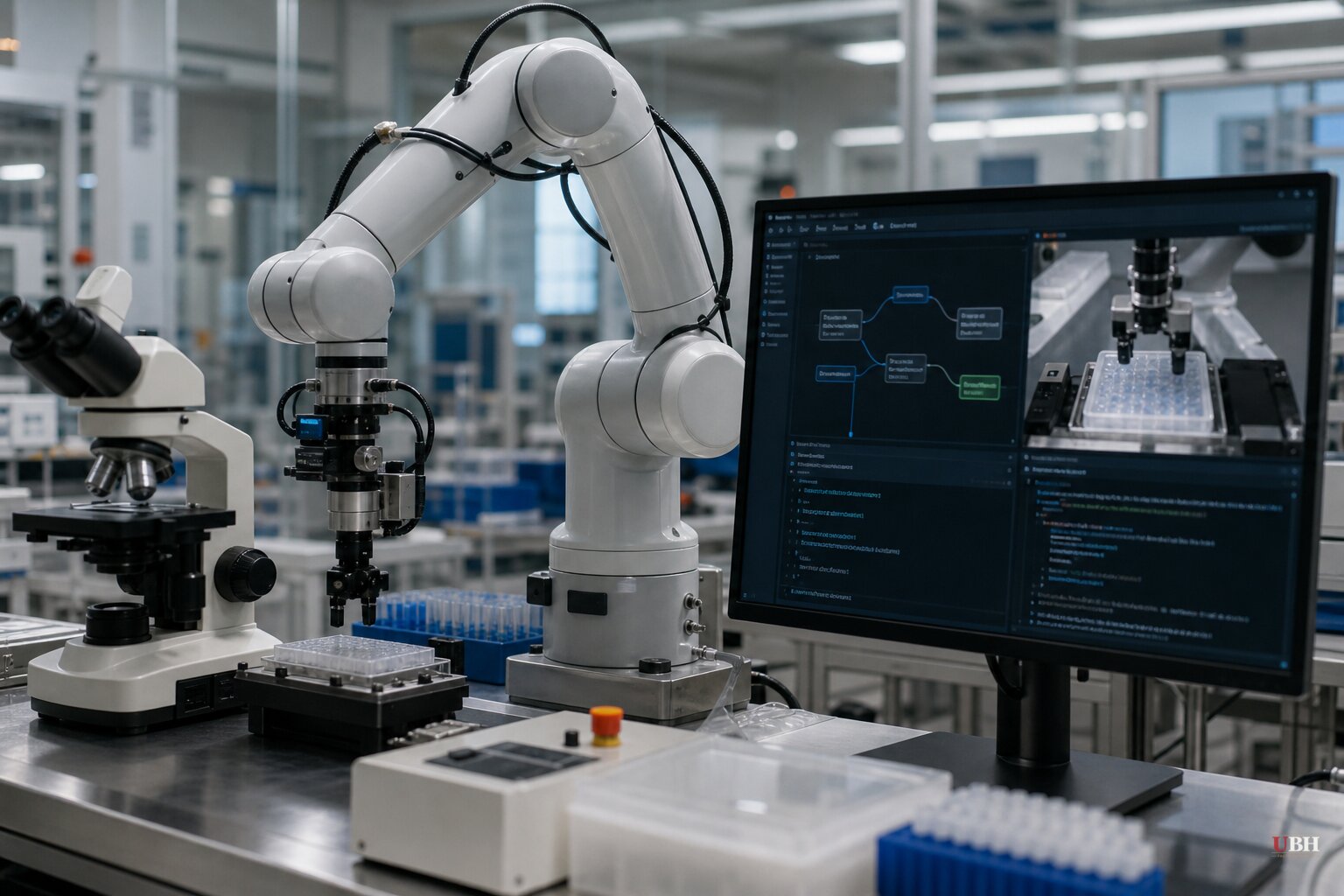
Anthropic announced Thursday a new framework called the Model Hardware Standard, or MHS, designed to let AI agents directly operate physical equipment: microscopes, robotic arms, lab instruments, quantum computing hardware, and manufacturing machinery.
The standard functions like a USB-C cable for machines and AI models, according to Elizabeth Kelly, Anthropic's head of beneficial deployments, who spoke with CNBC. Instead of engineers writing custom software to get a laser, a camera, and a robotic arm talking to each other, MHS gives them a shared interface. Anthropic says that process, which currently takes weeks or months, could shrink to hours.
The standard works with any device that has a programmable interface. It's model-agnostic, meaning it isn't locked to Anthropic's Claude models, and it plugs into the company's existing Model Context Protocol, an open standard Anthropic released in 2024 that lets AI systems talk to software tools and data sources.
Where the Idea Came From
According to Ars Technica, the project traces back to Anthropic technical staffer Alek Kemeny watching neuroscientist Arco Bast at the HHMI Janelia Research Campus in Ashburn, Virginia, wire together rotating lasers, microscopes, and cameras into a single working interface for a memory-formation experiment. Kemeny, a quantum physicist who co-led MHS development, told Wired the goal is closing the loop between AI's ability to review scientific literature and analyze data and giving it the power to actually run the experiment.
Jonah Cool, an experimental biologist who worked on the standard at Anthropic, told Wired that configuring lab equipment to talk to other hardware typically demands specialized engineering expertise most labs don't have on staff. MHS is built to automate that.
The Numbers Anthropic Is Touting
According to KuCoin, early testing partner QuEra reported a 99.3% success rate on laser relock tasks using MHS-integrated AI, up from 58% using custom scripts. That's a measurable improvement, if the figure holds up outside a controlled pilot. Anthropic hasn't published the methodology behind that number in the sources reviewed here, so it should be read as a vendor-reported early result, not an independently audited benchmark.
Partners in the safety-evaluation phase reportedly include HHMI Janelia, Genentech, and Carnegie Mellon University, according to KuCoin. Anthropic is not making MHS publicly available yet. It's running a research preview with a select group of organizations in science, robotics, and manufacturing while it builds out safety evaluations, according to CNBC and Reuters coverage carried by CNBC-TV18.
Safety Built In, Not Bolted On
Anthropic says MHS embeds operational constraints, like speed limits and angle restrictions for robotic arms, directly into the standard itself, so an AI agent can't instruct a machine to exceed safe parameters, according to KuCoin. Wired's reporting adds that Anthropic is relying partly on guardrails inside the AI models to prevent misuse of the standard for something like biological weapons development, a real and legitimate concern given the equipment involved: liquid-handling systems, lab robotics, and precision instruments capable of running unsupervised, round-the-clock experiments.
Handling autonomous systems the ability to physically manipulate lab equipment, especially in biology, is a different risk category than a chatbot drafting an email. Anthropic's answer so far is to keep MHS restricted to vetted partners during this preview phase rather than open it to anyone. Whether model-level guardrails are sufficient to stop a bad actor from misusing an open-sourced version of the standard down the line is an unresolved question. Anthropic hasn't detailed what specific safety evaluations partners must pass before broader release.
The Bigger Hardware Play
The move puts Anthropic further into a lane already crowded with money. Rivals including OpenAI and Amazon have spent billions of dollars designing AI-native devices and manufacturing tools, according to CNBC. Anthropic itself is building a silicon team to design custom chips and recently hired Caitlin Kalinowski, a hardware executive with stints at OpenAI, Meta, and Apple, according to CNBC and a LinkedIn listing cited in that report.
Anthropic's plan is to eventually open-source MHS, the same path it took with the Model Context Protocol in 2024, once safety evaluations with its initial partners are complete. No firm timeline for that release has been announced.
A standard is only as useful as the number of manufacturers who build to it. If device makers start designing hardware with agent control in mind, MHS could become the default plumbing for lab and factory automation. If they don't, it joins a long list of proposed standards that never left the pilot phase. Anthropic hasn't said how many hardware manufacturers, beyond its initial science and robotics partners, have committed to supporting MHS once it's public.
Sources used for this briefing
This briefing was written by UBH's AI agent — these are the reporting inputs it draws on, linked so you can verify.


