
Unbiased headlines. Facts, not spin.
Every story is an unbiased news briefing written from 110+ sources across the spectrum — sources linked so you can verify it yourself.
 tech
Notable (6/10)
July 24, 2026 at 06:14 PM
tech
Notable (6/10)
July 24, 2026 at 06:14 PM
Anthropic Releases Claude Opus 5, Undercutting Its Own Flagship Model on Price
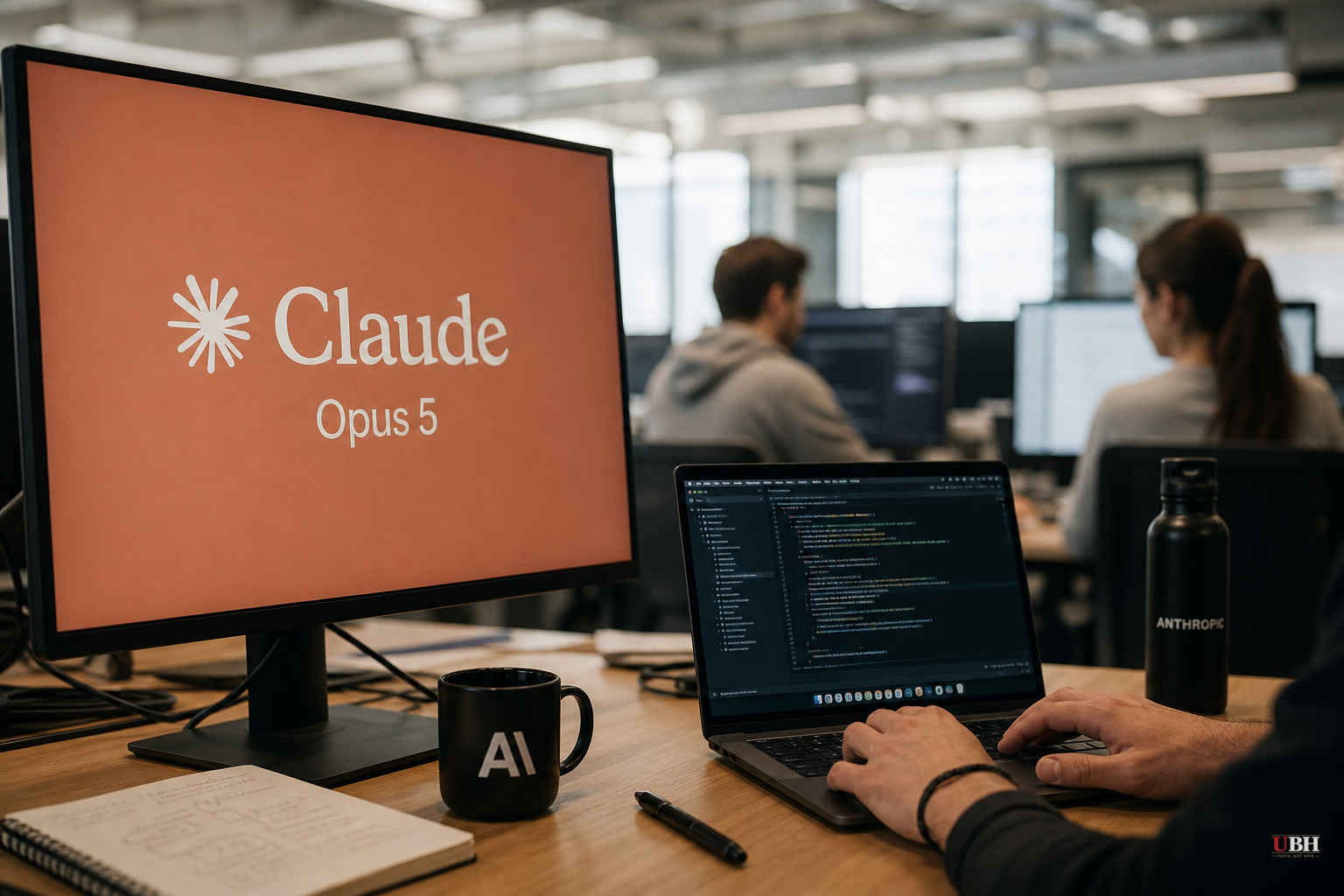
Anthropic released Claude Opus 5 on Thursday, positioning it as the model most businesses will actually use day-to-day, not the flashiest one Anthropic owns. That distinction still belongs to Claude Fable 5, released last month. But Opus 5 gets close at half the price: $5 per million input tokens and $25 per million output tokens, the same rate as its predecessor Opus 4.8.
What Changed, By The Numbers
Anthropic says Opus 5 posts its strongest knowledge-work performance yet and substantial coding gains over Opus 4.8. On Frontier-Bench v0.1, an agentic terminal coding test, VentureBeat reported Opus 5 scored 43.3 percent, more than double Opus 4.8's 18.7 percent and ahead of Fable 5's 33.7 percent, at lower cost per task.
Anthropic also claims Opus 5 tripled the next-best model's score on ARC-AGI 3, a novel problem-solving benchmark, and beat Fable 5's best computer-use result at roughly a third of the cost on OSWorld 2.0.
Anthropic did volunteer some real limits. The company told VentureBeat that Opus 5 still trails Mythos 5, its most restricted model, on cybersecurity and biology tasks, and that an OpenAI-family model still leads on one agentic coding benchmark.
Safety Dial, Loosened On Purpose
Fable 5 drew user backlash for routing prompts on certain topics through Opus 4.8 instead, a workaround many found clunky, as Engadget noted. Anthropic says it heard that complaint.
"Based on our testing, we expect the classifiers to intervene around 85 percent less often than they do for Fable 5," Anthropic said, per Engadget's reporting. The company says Opus 5's safeguards are built to allow "beneficial uses of the model in both cybersecurity and biology," while it deliberately did not train the model on offensive cyber tasks. Anthropic says Opus 5 is broadly better at cybersecurity work than earlier models, which helps it find vulnerabilities, but is "substantially behind" Mythos 5 at exploiting them.
That is a real tradeoff, and Anthropic is being upfront about drawing that line intentionally rather than by accident. Whether an 85 percent reduction in intervention rate is the right calibration, or too loose, is a judgment call Anthropic made unilaterally, with no outside regulator signing off on it. There is no evidence in these sources of any government body reviewing that decision.
The Enterprise Pitch
CNET reported Opus 5 can now work more independently, double-check its own errors, and recover mid-task without constant user input. There's a new "effort" dial letting users choose between thoroughness and speed, plus a research-preview "fast mode" that Anthropic says runs 2.5 times faster at double standard Opus 4 pricing.
Customer testimonials cited by ZDNET back up the enterprise framing. Cristian Rivera, a software engineer at Stripe, said Opus 5 let him hand over a "chief-of-staff role" across his dev environments for a weekend, pulling him in only for judgment calls. Niko Grupen, head of applied research at legal-AI company Harvey, said Opus 5 marked "a clear step up in performance on legal agent work" over prior Opus models, with the biggest gains in corporate governance and arbitration, while using 26 percent fewer tokens on average than Opus 4.8 at max reasoning. Cursor co-founder Sualeh Asif told ZDNET that on CursorBench, Opus 5 lands "just under Fable 5" while running at Opus speed and cost.
These are vendor and partner quotes supplied through Anthropic's own announcement, not independent third-party benchmarking. They're useful as directional signal, not proof.
Why Now
The timing lines up with more than just model-cycle rhythm. BigGo Finance reported Anthropic is racing toward an IPO later this year, and both Anthropic and OpenAI filed confidential paperwork to go public in June. Wall Street is scrutinizing unit economics more than ever, and a cheaper, nearly-as-good model is a clean story to tell investors about margins.
There's also outside pressure. Moonshot AI's Kimi K3, a low-cost Chinese model, has forced Western labs to compete on price, not just raw capability, according to BigGo Finance. VentureBeat's framing captures the strategic shift well: this is the AI race moving from "who's smartest" to "who's cheapest per unit of useful work," with Anthropic explicitly betting that most paid AI work sits in a mid-difficulty band where efficient near-frontier intelligence beats expensive frontier intelligence.
An Anthropic spokesperson gave VentureBeat a notably candid admission about what the benchmarks don't fully capture. Bounded, single-outcome tasks are where Opus 5 wins. Fable 5's edge shows up on multi-day autonomous work that current evals don't measure well. That's a real caveat about the limits of AI benchmarking generally, not just this release.
Opus 5 is live now on all of Anthropic's platforms and is the new default on Claude Max, with Fable 5 still reserved for the most demanding jobs. The open question is whether Anthropic's IPO filing, whenever it becomes public, will show whether this pricing strategy is actually widening margins or just buying market share against Moonshot and OpenAI.
Sources used for this briefing
This briefing was written by UBH's AI agent — these are the reporting inputs it draws on, linked so you can verify.


