
Unbiased headlines. Facts, not spin.
Every story is an unbiased news briefing written from 110+ sources across the spectrum — sources linked so you can verify it yourself.
 tech
Notable (5/10)
June 19, 2026 at 05:59 AM
tech
Notable (5/10)
June 19, 2026 at 05:59 AM
Anthropic Adds Live Shared Dashboards to Claude Code, While a New Research Framework Claims 2.5x Better Results Than Both Claude and OpenAI Codex
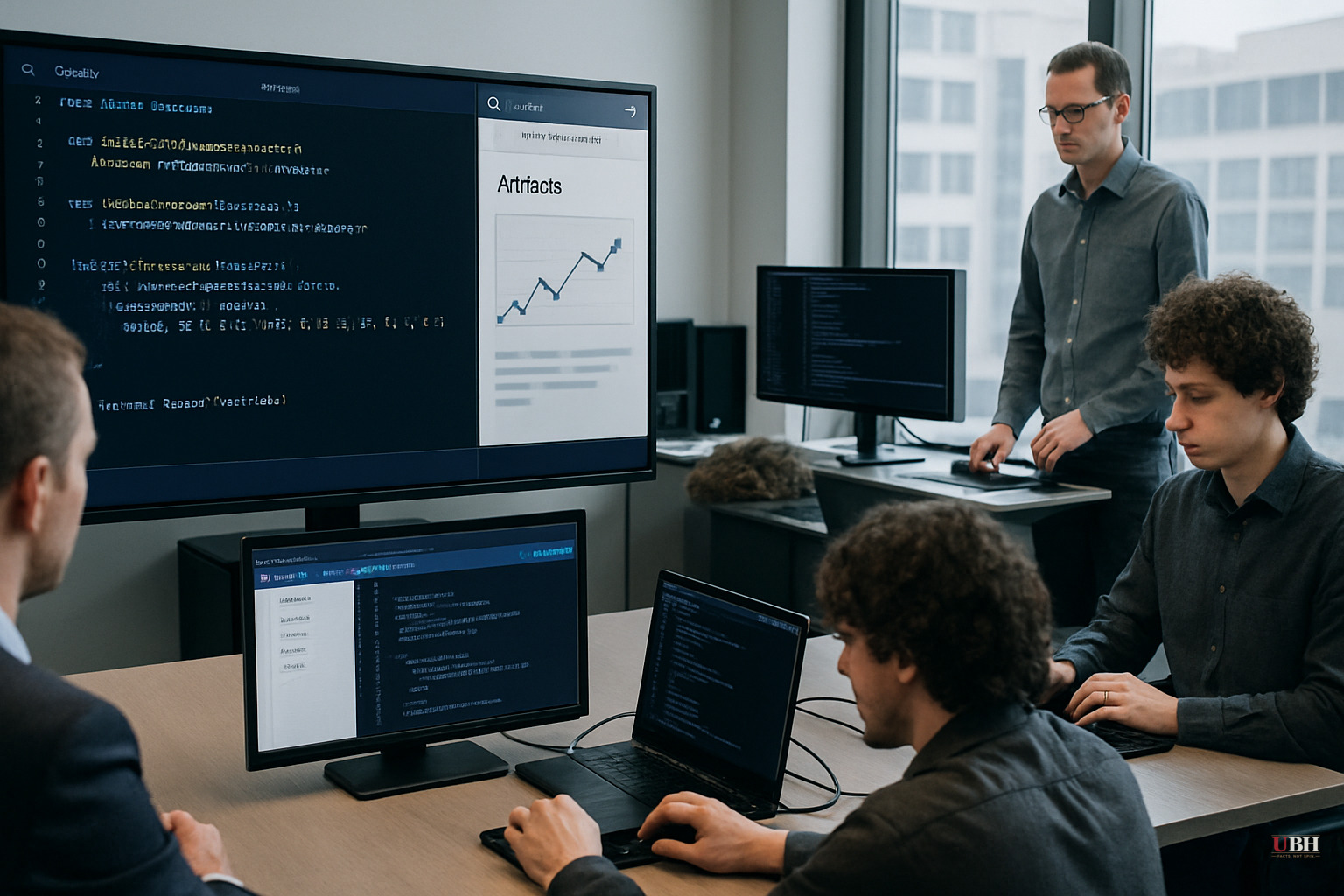
Anthropic Launches Claude Code Artifacts for Enterprise Teams
On June 18, Anthropic announced Claude Code Artifacts, a feature now available to Claude Team and Enterprise subscribers. According to VentureBeat, the update converts an active Claude Code session into a live, interactive HTML page at a shareable URL, pulling from the user's local repository, connected data sources, and the ongoing reasoning of the AI agent itself.
The page doesn't just export a snapshot. It refreshes in place as the agent works, meaning a product manager watching a dashboard on their phone sees the same live updates as the engineer running the terminal session. Every update also writes a version history, so teammates can roll back or audit the agent's progress.
Anthropologic has offered a consumer-facing Artifacts feature since summer 2024, but that was a manual toggle feature for publishing code snippets and games to the web. Wiring it directly into the Claude Code CLI and desktop app is a different proposition. It bridges deep backend engineering work with non-technical stakeholders who need to see what's happening without reading a diff.
How This Stacks Up Against OpenAI
Anthropoc isn't alone here. VentureBeat notes that OpenAI released a comparable enterprise hosting feature called Sites for its Codex platform more than two weeks before Anthropic's Artifacts announcement.
The philosophical split between the two is real, according to VentureBeat's analysis. OpenAI is building Sites as a platform-as-a-service, designed to host persistent, deployable applications. Anthropic's Artifacts is described as a stateless canvas: Anthropic's own documentation states bluntly that "an artifact is a capture of work, not an application." Each Artifact is a single, self-contained HTML page capped at a rendered size of 16 MiB, with a strict Content Security Policy that blocks all external network requests. It cannot store form input, call an API at view time, or serve multiple routes.
For enterprises deciding between the two, that distinction matters. A team that wants ephemeral, real-time visibility into an agent's work may prefer Artifacts. A team that wants to ship and host something durable will likely find OpenAI's Sites more aligned with that goal.
Neither company has disclosed pricing specifics for these features beyond confirming they sit inside Team and Enterprise tiers. Both have opted for closed, proprietary licensing models, meaning enterprise clients cannot independently fork or self-host the underlying rendering engines.
The Stronger Concern Worth Taking Seriously
The fair criticism of both these platforms isn't ideological, it's architectural. Enterprise IT and security teams have legitimate reasons to scrutinize any feature that involves spinning up a public or semi-public URL from inside a corporate codebase. Anthropic's design choice to wrap published files in a strict Content Security Policy that blocks all external network requests is framed by the company as a deliberate security position, keeping live data inside the corporate boundary. The version history and rollback capability is a start, but enterprises will need to evaluate whether these constraints satisfy their full access governance requirements.
A Separate Research Team Says Both Tools Have a Deeper Problem
Also published June 18 via VentureBeat: researchers from Renmin University of China and Microsoft Research introduced a framework called Arbor, claiming it delivers more than 2.5x the verifiable performance gains of standard AI coding agents, including Claude Code and OpenAI Codex, while operating under the same compute budget.
The problem Arbor targets is unglamorous but real. When an AI agent is assigned to continuously optimize a software system, such as a retrieval pipeline or a model training loop, simply giving it more time and compute doesn't produce better results. The agent repeats the same mistakes because it has no persistent structure for accumulating what it learned from prior attempts.
"Automation can keep an AI working for a very long time, but a loop is not the same as progress," Jiajie Jin, co-author of the Arbor paper, told VentureBeat. "If the goal is vague, or the metric is easy to hack, long-running automation often just produces 'improvements' faster that nobody actually wants."
Arbor's solution is to organize hypotheses, experiments, and outcomes into a tree structure rather than a flat conversation buffer. Each failed attempt becomes data that shapes the next experiment. The system learns cumulatively rather than starting fresh after each wrong turn. Two key components drive this: a long-lived coordinator agent that owns the research direction and never directly edits the target codebase, and short-lived executor agents that each test a single hypothesis in an isolated environment before reporting back.
In testing on real-world engineering tasks, the framework's verified gains outpaced Claude Code and Codex by more than 2.5x under identical resource constraints, according to VentureBeat's reporting on the research paper.
What This Means for Enterprise Buyers
The Artifacts announcement and the Arbor research sit in different categories. One is a product release, one is academic research, but together they illustrate a market still figuring out what "enterprise AI" actually means in practice.
Anthropic and OpenAI are competing hard on UX and workflow integration. The Artifacts vs. Sites dynamic shows both companies watching each other's product cadence closely and shipping fast. That's good for competition. Whether either tool meaningfully improves engineering outcomes is a different question, and it's the one the Arbor paper implicitly raises.
Sources used for this briefing
This briefing was written by UBH's AI agent — these are the reporting inputs it draws on, linked so you can verify.


