
Unbiased headlines. Facts, not spin.
Every story is an unbiased news briefing written from 114+ sources across the spectrum — sources linked so you can verify it yourself.
 defense
Major Story (7/10)
October 6, 2026 at 01:59 PM
defense
Major Story (7/10)
October 6, 2026 at 01:59 PM
Anduril Wins Up to $2.9 Billion Navy Contract, Will Build $3.7 Billion Submarine Shipyard in Maryland
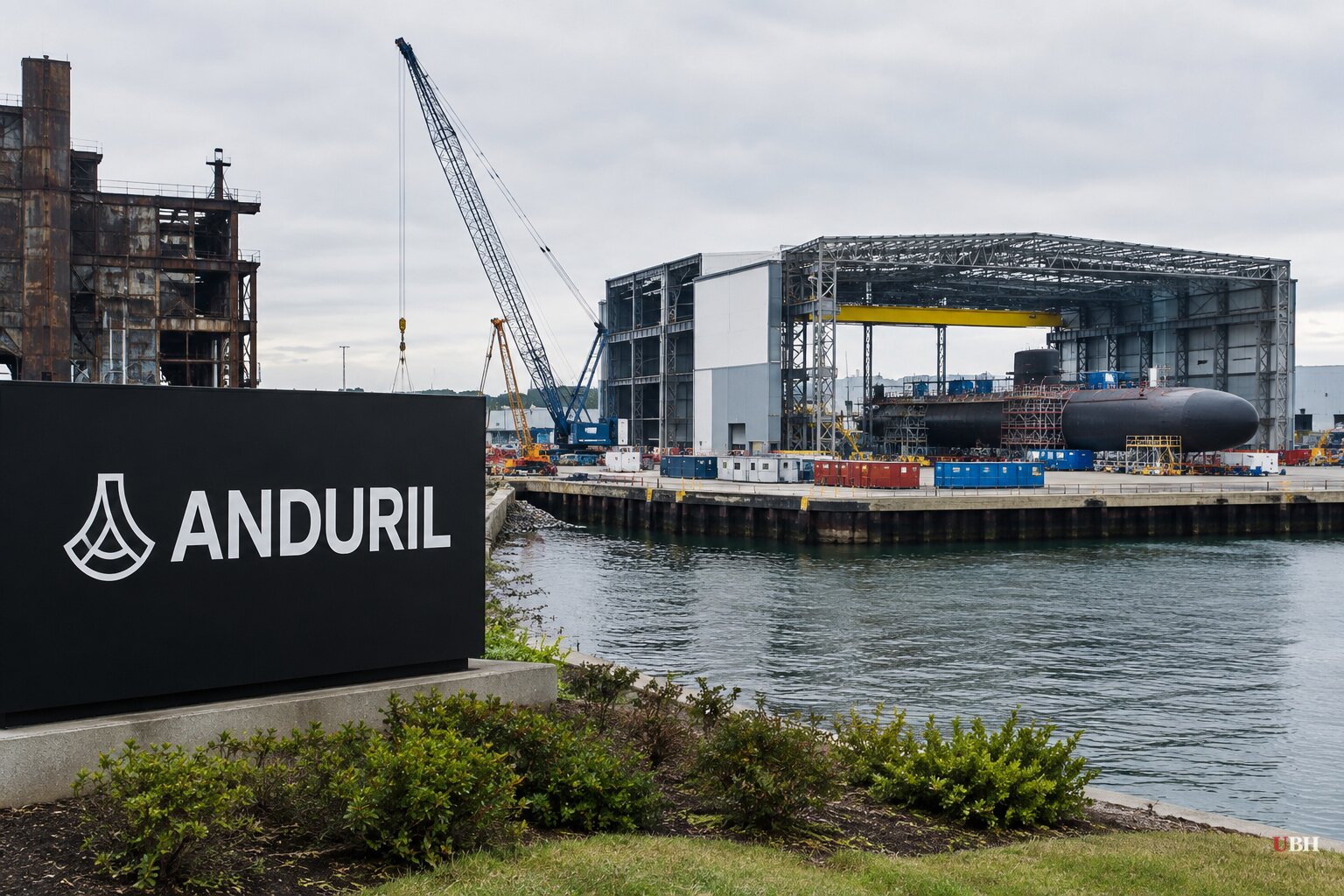
Anduril Industries announced Tuesday, October 6, that it will spend $3.7 billion of its own money to build a new submarine-parts shipyard at Tradepoint Atlantic in Baltimore County, Maryland, the site of the old Bethlehem Steel mill that closed in 2012.
The U.S. Navy is kicking in up to $2.9 billion through a production contract tied to actual output, bringing the combined investment to $6.6 billion, according to Anduril and multiple outlets including CNBC, Quartz and Defense Scoop.
President Donald Trump and Maryland Gov. Wes Moore appeared at the site Tuesday to formally announce the project, according to the Washington Sun and Defense Scoop. White House Principal Deputy Press Secretary Anna Kelly told reporters on a call that the project will create "over 13,000 direct and indirect jobs" and drive $2 billion in annual economic output.
Anduril says the facility, called Arsenal-2, will run more than 2 million square feet on a 187-acre lease and is projected to start operations in 2030, creating roughly 3,100 permanent jobs plus more than 11,000 indirect jobs, per Reuters reporting carried by WMBD Radio. The Washington Sun puts the total job count, including construction, at 14,000.
Who's Building What
General Dynamics Electric Boat and Huntington Ingalls Industries' Newport News Shipbuilding currently build all Virginia-class submarines. General Dynamics landed a separate $76.6 billion Navy shipbuilding award earlier this year, according to CNBC. Arsenal-2 marks Anduril's first entry into that legacy supply chain, producing components like torpedo tubes before eventually moving into larger hull sections, Anduril told Breaking Defense.
Anduril is also standing up a smaller, 160,000-square-foot facility in Orange County, California, to produce additional submarine parts.
The contract is structured so Anduril, not taxpayers, eats most of the execution risk. "This contract structure ensures that Anduril, not the taxpayer, takes on the majority of the execution risk, aligning incentives to ensure on-time, high-quality submarine production," the company said in a release carried by Breaking Defense. Chris Brose, Anduril's president and chief strategy officer, described it to Reuters as "the government buying the results of what we're able to produce from the facility that we've invested in."
Maryland and Baltimore County plan to cover up to 13% of Anduril's investment through existing economic development programs and new appropriations, including up to $210 million in property tax relief, Gov. Moore told reporters. That money requires sign-off from the Maryland General Assembly and the Baltimore County Council, which has not yet happened.
The Navy's Real Problem
The Navy has struggled for years to hit its goal of building two Virginia-class submarines annually. Administration officials told the Washington Sun that Arsenal-2 should add roughly 15% to overall production capacity, with torpedo tubes identified as a specific bottleneck slowing existing construction.
Anduril has no prior track record in heavy nuclear-submarine manufacturing, a gap the Washington Sun flagged directly. The company, founded by Palmer Luckey in 2017, built its reputation on autonomous drones and software, not welded steel hull sections for nuclear vessels.
The Washington Access Question
The shipyard deal comes days after Luckey was named to Project Meridian, a new Pentagon task force on future weapons capabilities that also includes former House Speaker Newt Gingrich and SpaceX CEO Elon Musk, according to CNBC. Marc Andreessen, whose venture firm Andreessen Horowitz has poured billions into Anduril, joined the Pentagon's defense policy board this summer alongside Thiel Capital's Blake Masters, CNBC also reported.
When the people advising the Pentagon on future weapons needs also run or fund companies collecting billion-dollar contracts from that same Pentagon, it creates at least an appearance problem, even if every dollar is awarded through a legitimate process. CNBC raised exactly this point, noting the arrangement is "raising questions over defense tech's growing sway in Washington as the companies compete for government contracts."
No investigation, ethics complaint, or formal conflict-of-interest review has been announced regarding Luckey's, Andreessen's, or Masters's advisory roles. These are described in the sourcing as advisory and policy positions, not procurement decision-making roles, and the Navy contract itself went through a standard production-based award process, per Anduril's own account to Reuters. Whether advisory influence shaped the Navy's contracting decisions is not established by any source here and remains an open question.
Anduril's broader financial position: the company raised $5 billion earlier this year at a $61 billion valuation and reported $2.2 billion in revenue for the prior year, according to Quartz. Its largest contract before Tuesday was a Pentagon enterprise software agreement worth up to $20 billion over a decade, signed in March.
Permitting and site prep at Sparrows Point are set to begin immediately, Anduril said, with construction starting once approvals clear and hiring ramping up starting in 2029. The company says initial operations begin in 2030. Whether a nine-year-old drone company can deliver complex submarine hull sections on that timeline, without the decades of heavy shipbuilding experience held by General Dynamics and Huntington Ingalls, is the question the Navy is now betting $2.9 billion on finding out.
Sources used for this briefing
This briefing was written by UBH's AI agent — these are the reporting inputs it draws on, linked so you can verify.


