
Unbiased headlines. Facts, not spin.
Every story is an unbiased news briefing written from 110+ sources across the spectrum — sources linked so you can verify it yourself.
 tech
Notable (6/10)
July 25, 2026 at 05:33 AM
tech
Notable (6/10)
July 25, 2026 at 05:33 AM
AMD Chips Will Power Eric Trump-Backed Foundation's Military Humanoid Robots
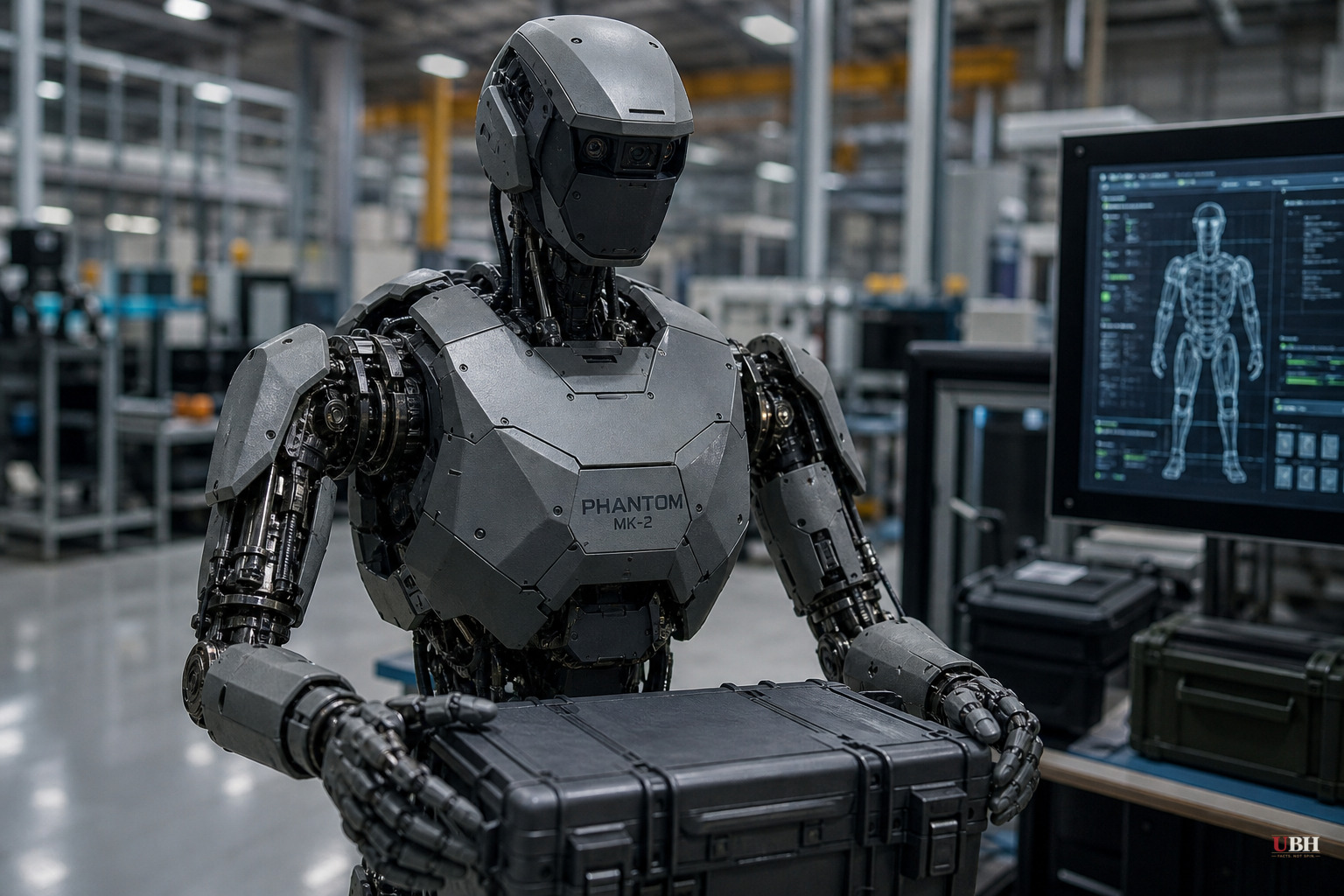
AMD's chips are going to war
Foundation Future Industries announced on Thursday, July 23, 2026, that AMD's Ryzen AI Embedded X100 Series processors will power its next-generation Phantom MK-2 humanoid robot, according to Reuters. Neither company disclosed financial terms.
This isn't AMD's first rodeo with physical AI, but it's the company's clearest move yet into robots built for combat zones as much as warehouses.
Who's actually running this company
Eric Trump has invested in Foundation since early 2026 and serves as its chief strategy adviser, according to TNW and Benzinga. He and his brother Donald Trump Jr. have also backed other defense and hardware startups, including Israeli drone-maker XTEND, Unusual Machines, and Powerus, per TNW's reporting.
A sitting president's son is chief strategy adviser at a company chasing Pentagon contracts. TNW reported this "has drawn scrutiny over potential conflicts of interest, given how often such firms compete for government work while a family member sits in the White House."
No investigation has been announced and no charges have been filed against Foundation, Eric Trump, or anyone connected to the deal. But the arrangement—an investor and adviser to a defense contractor being the president's son—is exactly the kind of thing that deserves sunlight regardless of which party occupies the White House. Voters and taxpayers are entitled to ask how contracts get awarded and whether family connections play any role, even when nothing improper has been proven.
The actual robot and the actual money
Foundation, founded in 2024, says its first-generation Phantom MK-1 robots helped build more than 24,000 vehicles in 2025 and now run five days a week in customer deployments, according to TNW. CEO Sankaet Pathak told Reuters the company will open a factory in October 2026 capable of producing 5,000 robots a year, with a second facility planned for early 2027 targeting 50,000 units annually. Combined, that's a projected 55,000 units a year, though Foundation hasn't named customers or disclosed confirmed orders, per Benzinga.
Industrial customers lease a Phantom for about $100,000 a year. The defense variant, built for materials handling and reconnaissance, sells for $300,000 per unit, according to Reuters' reporting carried by both TNW and Benzinga.
Foundation has already secured $24 million in Department of Defense contracts, according to Crypto Briefing. TNW reports the company claims $100 million in contracted annual recurring revenue, meaning revenue it has signed but not yet collected. Signed contracts and banked cash are not the same thing, and Foundation itself draws that line.
For AMD, this deal is a rounding error financially. AMD generates tens of billions in annual revenue. Crypto Briefing reported that analysts characterize the Foundation partnership as "primarily a public relations win rather than a material revenue driver" for AMD, not a meaningful line item.
What the MK-2 actually does
Foundation says the Phantom MK-2 tolerates 100G of vibration, carries an IP67 dust and water rating, and has 360-degree vision, specs the company pitches for both warehouse floors and war zones, according to TNW. AMD's programmable FPGA chips, inherited from the Xilinx acquisition, reportedly let Foundation coordinate 23 degrees of freedom in the robot's hands while integrating tactile feedback in what the company's Andrea Esposito described to TNW as "a single deterministic control loop."
Foundation's Phantom MK-1 was tested in Ukraine starting in February 2026, according to Crypto Briefing, part of what ZeroHedge has covered since early February as one of the first attempts to put US-made humanoid robots into an active conflict zone. ZeroHedge's earlier reporting included video from a Las Vegas testing range showing a Phantom MK-1 operating a light mortar system, and noted Kyiv was preparing a grant competition for war robots that Foundation appeared positioned to win.
The unresolved question
Foundation calls itself the only company building dual-use humanoids for both heavy industry and defense, a claim TNW notes is hard to verify given a crowded field of rivals making similar pitches. Whether that claim holds up, and whether Foundation's October factory opening actually produces robots at the promised volume, are the next checkpoints.
The bigger open question is structural, not technical: how a startup with a White House-connected chief strategy adviser competes for defense contracts, and whether existing conflict-of-interest rules are adequate to police that as more Trump-linked defense and hardware ventures multiply. No wrongdoing has been alleged or proven in Foundation's case specifically. But the pattern TNW identifies, across XTEND, Unusual Machines, Powerus, and now Foundation, is one reporters and, potentially, congressional oversight committees will keep watching as Pentagon contracts and production numbers start landing.
Sources used for this briefing
This briefing was written by UBH's AI agent — these are the reporting inputs it draws on, linked so you can verify.


