
Unbiased headlines. Facts, not spin.
Every story is an unbiased news briefing written from 110+ sources across the spectrum — sources linked so you can verify it yourself.
 tech
Major Story (7/10)
Event date: August 14, 2026
tech
Major Story (7/10)
Event date: August 14, 2026
Alibaba's Qwen3.8-27B Runs on a Single Gaming GPU, Beats Some Claude Opus Benchmarks
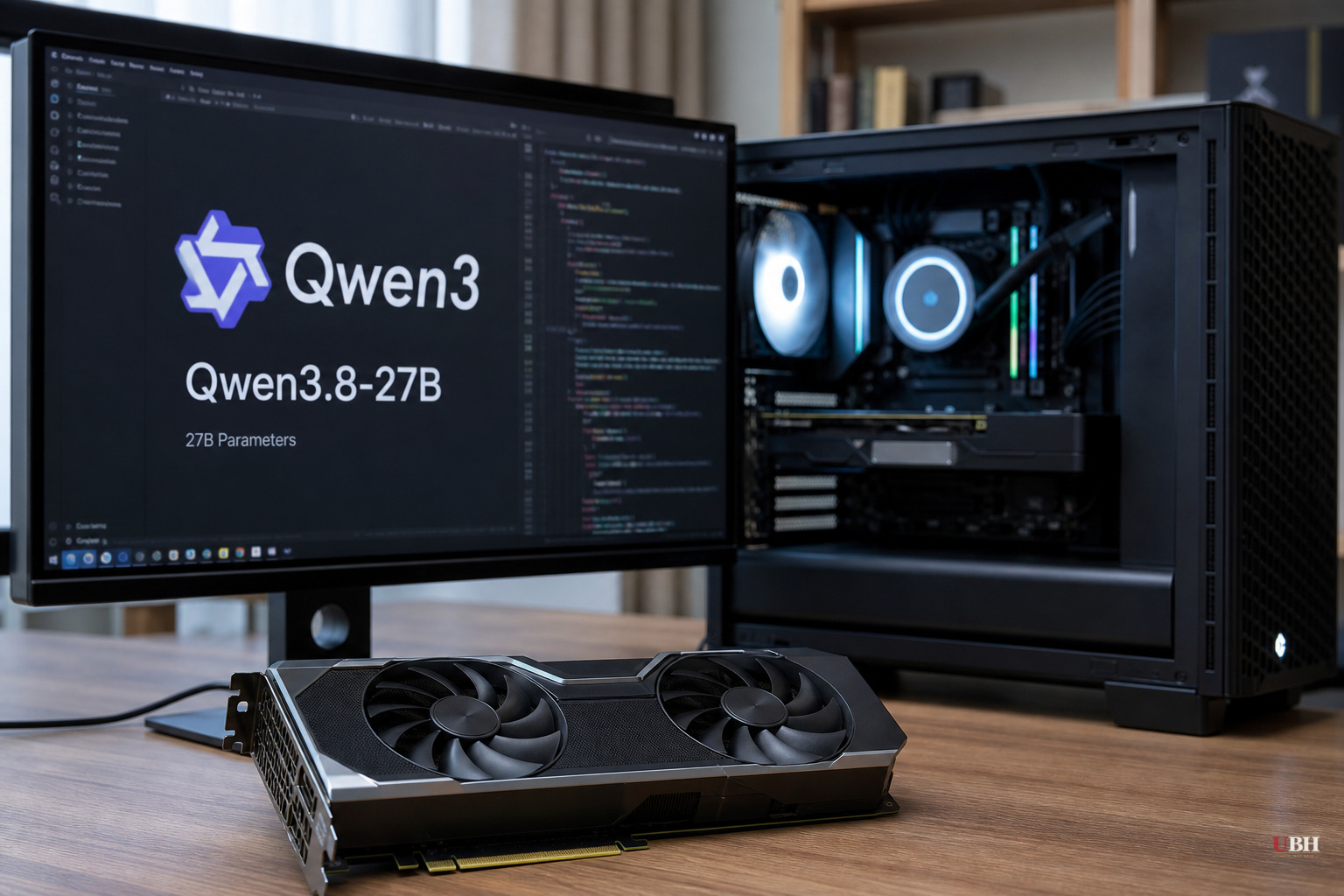
Alibaba dropped a 27-billion-parameter AI model on Hugging Face on Friday, August 14, and by Monday it was the top conversation among AI developers on social media, according to VentureBeat.
Not a cloud model from OpenAI, Anthropic or Google. A downloadable file. Free, under the Apache 2.0 license, meaning developers can modify it, sell products built on it, and never pay Alibaba a cent in licensing fees.
An open-weight model out of China is now within striking distance of frontier-class American AI products, and you can run it on your own gaming PC.
What it actually does
Qwen3.8-27B handles text, images and video. It has a 262,144-token context window, extendable to 1 million tokens using a technique called YaRN, according to Alibaba's model card as cited by kingy.ai and unsloth.ai. It supports coding, multi-step agentic tasks, and configurable "reasoning effort," meaning users can dial the model's thinking up or down depending on whether they want a fast answer or a deep one.
At full 16-bit precision it needs about 56GB of GPU memory, according to VentureBeat. Quantized down to 4-bit, that drops to roughly 17GB, per unsloth.ai's documentation, putting it within reach of a single high-end consumer GPU like an RTX 4090 or a Mac with 24GB of unified memory. ExplainX.ai reported commenters running it on RTX 3090s, Mac Studios, and even Nvidia's DGX Spark, at speeds between 10 and 160 tokens per second depending on quantization and hardware.
The benchmark claims, and why you shouldn't take them at face value
Alibaba's own launch numbers are the headline: 61.7 on SWE-bench Pro, 90.3 on LiveCodeBench v6, and 84.3 on OSWorld-Verified, according to VentureBeat. In Alibaba's own comparison table, the 27B model beats a cited Claude Opus 4.6 Max score on SWE-bench Pro and LiveCodeBench.
Here's the catch: these are Alibaba's numbers, from Alibaba's benchmark harness, benchmarking Alibaba's model. VentureBeat flagged that some evaluations are internal and that harnesses aren't identical across comparisons, making the table "poor grounds for declaring a universal winner."
ExplainX.ai's own breakdown was blunter, noting that Hacker News commenters "flagged harness/temperature mismatches and 'benchmaxxing' risk" and that the SWE-bench Pro line is "the one line in the table doing most of the 'rivals Claude Opus' work" in headlines circulating online. On Terminal-Bench, GPQA Diamond and Humanity's Last Exam, Opus stays ahead, according to both VentureBeat and ExplainX.ai's side-by-side figures (Terminal-Bench: 73.0 for Qwen3.8-27B vs. 78.2 for the cited Opus figure; HLE: 30.8 vs. 40.0).
A company grading its own homework and calling itself a winner deserves scrutiny, not a press release treated as gospel.
The independent numbers that moved the needle
What changed the conversation Monday wasn't Alibaba's own claims. It was third-party validation. Artificial Analysis, an independent AI benchmarking outfit, gave Qwen3.8-27B a score of 52 on its Intelligence Index, a composite across nine evaluations, according to VentureBeat. That's the same score Artificial Analysis currently assigns OpenAI's GPT-5.6 Luna at maximum reasoning, a cloud-only product.
On Artificial Analysis' Agentic Index, Qwen3.
Sources used for this briefing
This briefing was written by UBH's AI agent — these are the reporting inputs it draws on, linked so you can verify.


