
Unbiased headlines. Facts, not spin.
Unbiased Headlines is an independently owned news organization. We bring you the facts, not opinions, written fresh from 110+ named sources. Sources linked so you can verify it yourself.
 sports
Low Interest (4/10)
sports
Low Interest (4/10)
Airlink Defends Twin-Jet Flyby That Passed Within 46 Feet of Packed Cape Town Stadium
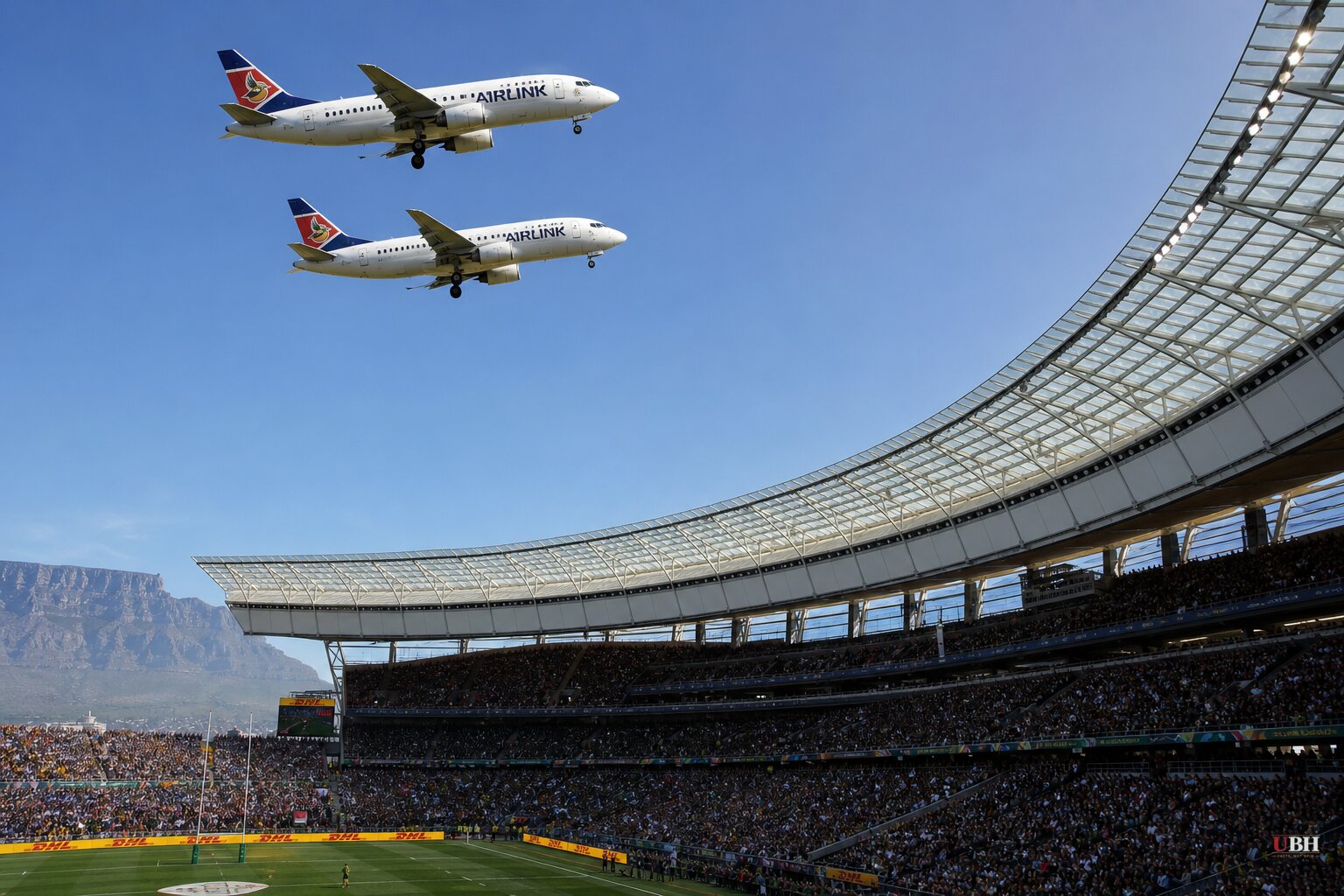
Two passenger jets flew low enough over a packed rugby stadium in Cape Town on Saturday that flight-tracking data shows barely 40 to 50 feet separated the lead aircraft from the roof. Now the airline that flew them is defending the stunt against a wave of criticism from professional pilots.
The two Embraer jets, operated by South African carrier Airlink, roared over DHL Stadium ahead of the second rugby union Test between South Africa and New Zealand, according to the Associated Press. The stadium held an estimated 56,000 fans. Smoke and pink dust flares shot up from the roof as the jets passed, with the second aircraft flying directly through the cloud, the Associated Press reported.
Flight-tracking service Flightradar24 estimated the lead jet cleared the stadium roof by just 41 to 46 feet, according to reporting from the Associated Press, the Guardian and Euronews. The BBC cited Flightradar24's analysis putting the figure at under 50 feet, roughly 15 meters. The jets were traveling at around 150 knots, about 172 mph, when they crossed the stadium, Airlink said.
No passengers were aboard either aircraft. Airlink said each jet carried three senior captains, filling the roles of commander, co-pilot and safety and technical officer.
Airlink says it followed the rules
In a statement issued Sunday, Airlink said the flight was carefully planned and rehearsed with backing from regulators. "The South African Civil Aviation Authority and Air Traffic Navigation Services provided valuable guidance, approval and support to ensure a safe flyby," the airline said, according to the Associated Press and Euronews. On social media, the airline summed up its defense in three words: "Planning. Precision. Performance."
Sports Minister Gayton McKenzie publicly praised the maneuver, calling it "spectacular" and joking on X, as quoted by Euronews, that next time he'd ask the pilots "to land on the field." His enthusiasm reflects a real strain of national pride in South Africa, where the flyby tradition traces back to a Boeing 747 pass over Johannesburg's Ellis Park before the 1995 Rugby World Cup final, a moment immortalized in the film Invictus and tied to Nelson Mandela's first year as president, according to the BBC.
Pilots say the margin was too tight
The strongest pushback came from people who fly for a living. Chris Martinus, president of the Aircraft Owners and Pilots Association South Africa, told the Associated Press the lead aircraft appeared to be "dodging over the roof and climbing over the one side and dipping below and then climbing over the other side. That was a little bit uncomfortable." He added that at that altitude, "you just don't have options" if anything goes wrong.
Keith Tonkin, an Australian aviation consultant and former military and commercial pilot, told the Associated Press that Embraer jets are regional passenger aircraft not designed for that kind of low-level flying and warned the stunt sets a risky precedent for future events.
Scottish pilot Scott Bateman went further in a social media post cited by Euronews, saying he was "aghast" and that "hundreds of professional aviators around the world have looked at those images and expressed concern." He argued that commercial aviation didn't become one of the safest forms of transport "by defending everything that worked" but "by relentlessly examining the things that nearly didn't."
A flyby that goes exactly as planned proves the plan worked once, not that the margin was sound. Two jets in tight formation over 56,000 people leaves essentially zero room for a bird strike, a wind gust or a mechanical hiccup. Aviation professionals raising that concern aren't being killjoys, they're pointing at the same logic that grounds planes after near-misses instead of waiting for a crash.
At the same time, Airlink has a case. Three senior captains per aircraft, a dedicated safety officer role, no passengers aboard, and sign-off from South Africa's Civil Aviation Authority and Air Traffic Navigation Services beforehand is a real regulatory process, not a rogue stunt. If the concern is that regulators rubber-stamped something dangerous, that's about how SACAA evaluates these events.
No investigation has been announced by South African aviation authorities into Saturday's flyby, and none of the reporting indicates SACAA plans to revisit its approval process. Whether this becomes the new standard for South African rugby, as Tonkin warned, or a one-off that regulators quietly tighten up after, remains an open question the aviation authority hasn't yet answered.
Sources used for this briefing
8 links from 8 independent newsrooms (syndicated copies of the same report count once)
These are the sources it draws on, linked so you can verify.


