
Unbiased headlines. Facts, not spin.
Every story is an unbiased news briefing written from 110+ sources across the spectrum — sources linked so you can verify it yourself.
 health
Major Story (7/10)
June 23, 2026 at 08:03 AM
health
Major Story (7/10)
June 23, 2026 at 08:03 AM
AI Tools Are Getting Better at Catching the Heart Conditions Most Doctors Miss
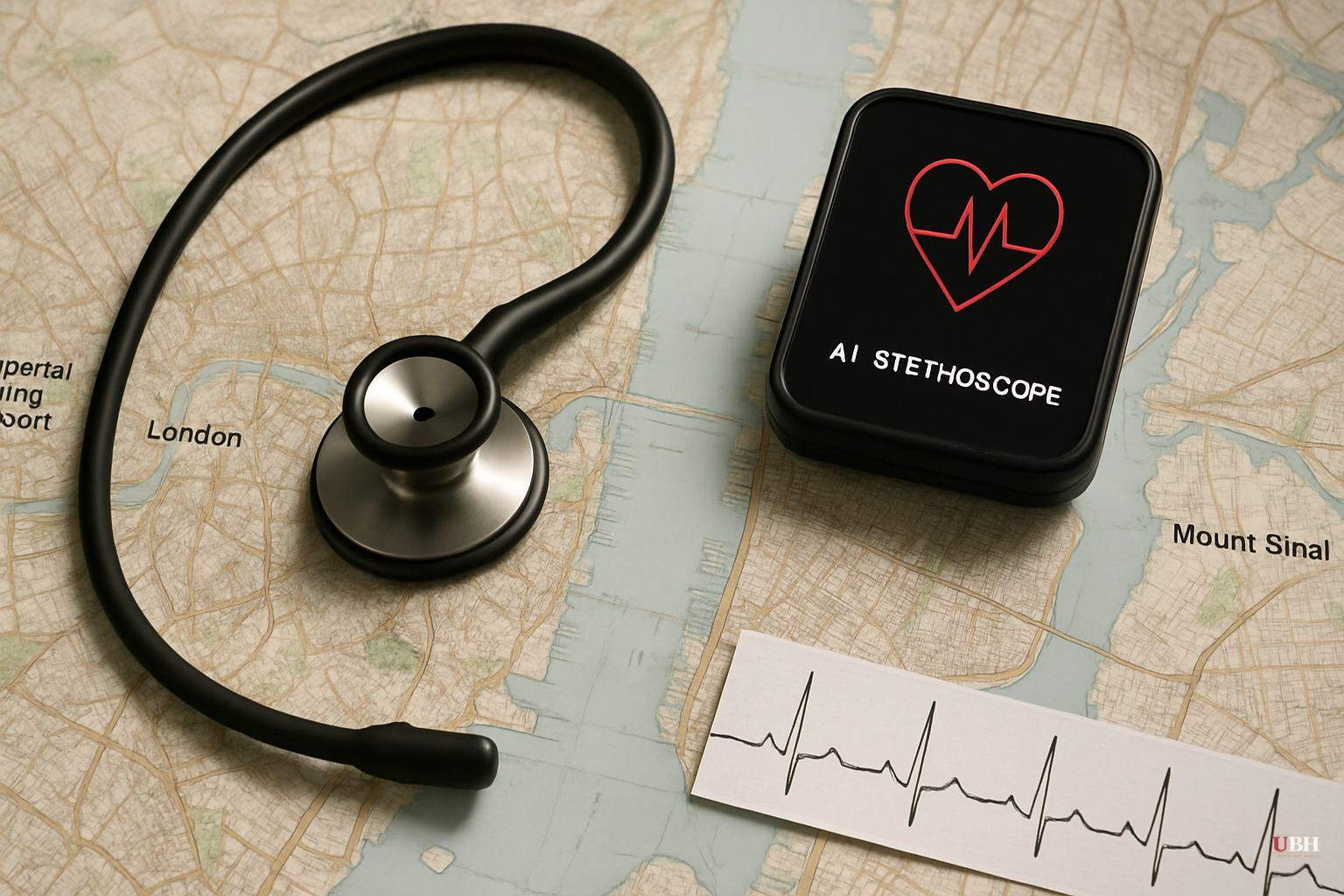
Two separate research efforts are tackling different but overlapping blind spots in cardiac diagnosis, with AI-assisted tools targeting conditions that routinely slip past standard clinical workflows.
The AI Stethoscope
Researchers at Imperial College London and Imperial College Healthcare NHS Trust developed a device about the size of a playing card that can screen for three heart conditions in 15 seconds. The tool, manufactured by California company Eko Health, sits on a patient's chest, records an ECG and captures the sound of blood flowing through the heart simultaneously. That data is sent to the cloud for analysis by AI algorithms.
The conditions it targets — heart failure, atrial fibrillation, and heart valve disease — are all cases where early detection changes outcomes. AF raises stroke risk; valve disease progresses silently; heart failure treated late kills people who could have been stabilized.
The study behind the device involved roughly 12,000 patients from 200 GP surgeries across the UK, according to The Guardian. Patients examined with the AI stethoscope were twice as likely to receive a heart failure diagnosis compared to similar patients who were not. They were three times more likely to be diagnosed with atrial fibrillation. For heart valve disease, the detection rate was nearly double.
Dr. Patrik Bächtiger of Imperial College London's National Heart and Lung Institute put it plainly: "The design of the stethoscope has been unchanged for 200 years — until now."
Results were presented at the European Society of Cardiology annual congress in Madrid, the largest heart conference in the world.
The Hidden Inheritance Problem
A separate AI advance targets hypertrophic cardiomyopathy, or HCM. A condition doctors have nicknamed "the great masquerader," it affects roughly 1 in 200 people worldwide and causes the heart muscle to thicken and stiffen, raising the risk of heart failure and sudden cardiac death. According to reporting by The Brighter Side of News, approximately 85% of people who have HCM don't know they have it.
The problem: HCM's symptoms — chest pain, shortness of breath, fainting — look like dozens of other conditions. A definitive diagnosis typically requires an echocardiogram or MRI, tests that usually only get ordered after symptoms have already worsened.
The FDA had previously approved an algorithm called Viz HCM to flag HCM risk from standard ECG readings. Researchers at Mount Sinai Hospital went further. In a study published in the journal NEJM AI, Dr. Joshua Lampert — Director of Machine Learning at Mount Sinai's heart hospital — and colleagues recalibrated the algorithm to produce probability scores rather than simple binary alerts.
Instead of "high risk," the new system tells a clinician something like: "This patient has roughly a 60% chance of having HCM." The team tested the improved tool on nearly 71,000 patients who had ECGs between March 2023 and January 2024. Dr. Matthew Martinez, a cardiologist specializing in HCM and sports medicine, described the potential directly: "By using AI with ECG and improving care coordination, we can reveal more hidden cases and make care faster and more efficient."
The Misdiagnosis Problem These Tools Are Trying to Solve
One honest concern with AI diagnostic tools is over-detection. Flag too many patients as at-risk and you burden the system with unnecessary follow-up tests, generate patient anxiety, and potentially expose people to procedures they don't need. That's a legitimate clinical trade-off, not a trivial one. Cardiology wards aren't infinite, and echocardiograms cost money.
That concern is real. But the diagnostic failure rate in the current system is also real, and documented. Medical guidance platform Ubie, citing clinical research reviewed by Dr. Yoshinori Abe of internal medicine, notes that asthma in adults over 65 is routinely misdiagnosed as heart disease — and vice versa — because shortness of breath, chest tightness, and fatigue overlap across both conditions. Clinicians often rely on age-based assumptions and skip spirometry when multiple chronic conditions are already in the picture. The result is delayed treatment, unnecessary cardiac medications, and preventable hospitalizations.
The AI tools described above are specifically designed for primary care entry points. GP offices, not specialist centers. The probability-score approach of the upgraded Viz HCM algorithm is a direct engineering response to the over-flagging concern: give clinicians a gradient of risk rather than a binary alarm, so judgment still lives with the physician.
What's Still Unresolved
The Imperial College AI stethoscope study has been presented at a major conference, but no timeline for broader NHS rollout was announced at the Madrid congress, according to The Guardian's reporting. The Eko Health device is commercially available in some markets, but whether UK NHS trusts or U.S. health systems will adopt it at scale — and on what reimbursement basis — remains an open question.
For the Viz HCM recalibration, the Mount Sinai team published in NEJM AI, which invites peer scrutiny. The 71,000-patient sample is large, but Mount Sinai's stated next goal is to expand the system across more health centers — meaning external validation across different hospital systems and demographic groups is still in progress. That validation step is what separates a promising research result from a clinical standard.
Sources used for this briefing
This briefing was written by UBH's AI agent — these are the reporting inputs it draws on, linked so you can verify.


