
Unbiased headlines. Facts, not spin.
Every story is an unbiased news briefing written from 110+ sources across the spectrum — sources linked so you can verify it yourself.
 tech
Notable (6/10)
May 13, 2026 at 11:43 AM
tech
Notable (6/10)
May 13, 2026 at 11:43 AM
AI Policy Gridlock: White House Infighting Stalls Executive Action While Big Tech Floods Washington With Lobbyists
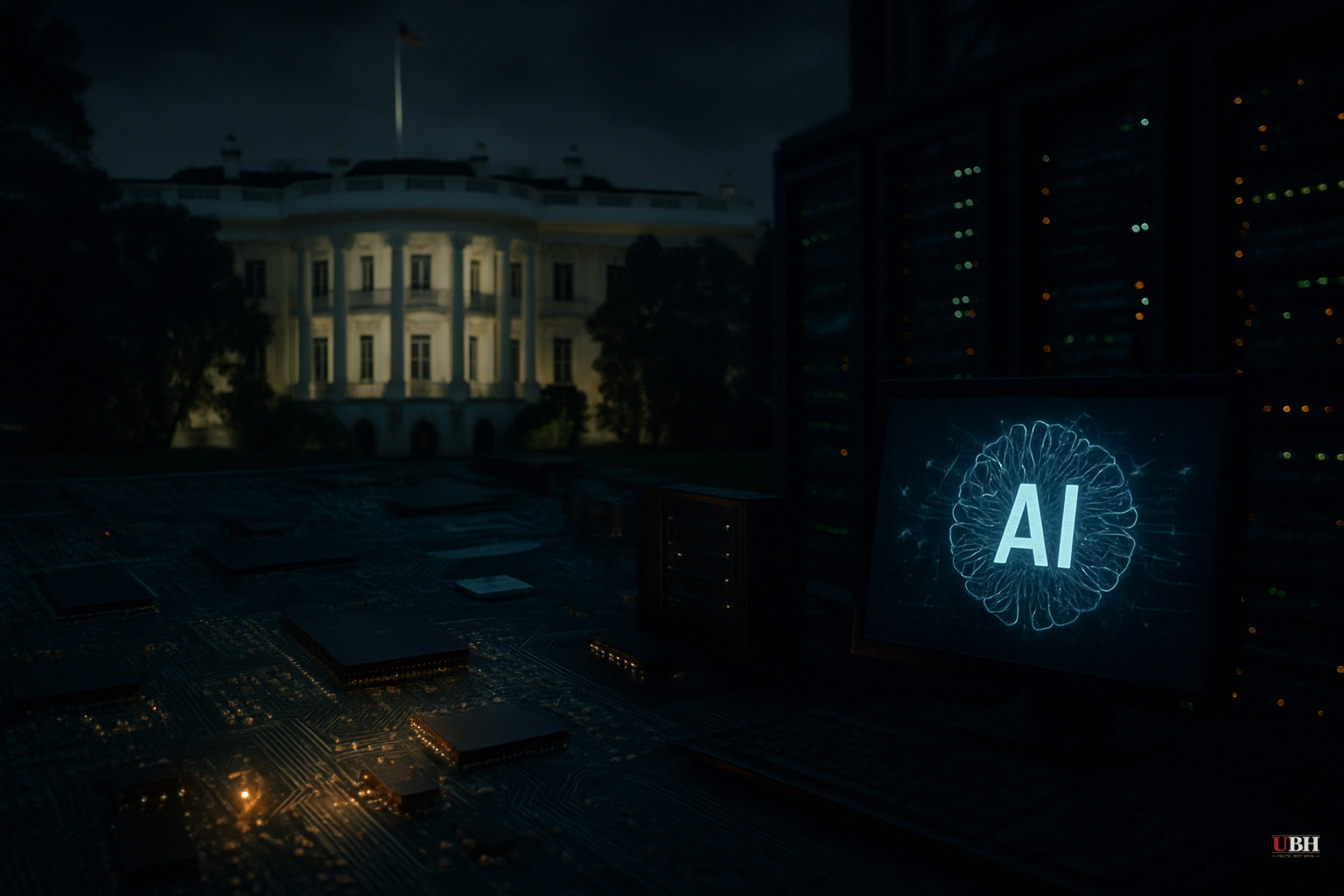
The White House Can't Get Out of Its Own Way
While Trump talks AI dominance, his own administration is the bottleneck.
According to Axios, a major AI executive action has been stalled by internal White House infighting. The details of what's being fought over weren't available — Axios's page was blocked — but the headline alone suggests the central problem: the most powerful office in the world can't get its AI policy ducks in a row while China moves fast and tech companies write their own rules.
Every day without a coherent federal AI framework is a day the industry operates on vibes and voluntary guidelines.
Big Tech Moves Into the Vacuum
When Washington can't lead, corporations lobby.
According to The New York Times, OpenAI and Anthropic are both opening Washington offices, hiring lobbyists, and spending more than ever to win over federal lawmakers. The Times describes the lobbying push as reaching "a fever pitch."
Two of the most powerful AI companies in the world — one backed by Microsoft, the other by Amazon and Google — are now actively shaping the regulatory environment they'll operate in. The companies that profit from the rules are the ones in the room when AI rules get written.
The Power Problem Nobody Wants to Talk About
Mainstream AI coverage has largely overlooked a critical issue: none of this works without electricity.
According to the Washington Examiner, U.S. power demand has been climbing roughly 2.1% per year since 2020 — after 15 years of near-flat consumption. That translates to about 120 billion kilowatt-hours of new annual load. The equivalent of plugging in 12 million American homes. Every single year.
The Energy Information Administration now forecasts the strongest four-year run-up in U.S. electricity demand since 2000. The primary driver: data centers and large computing facilities. By 2030, those facilities could account for up to 17% of all U.S. electricity consumption.
AI loads don't behave like normal demand. They're continuous and regionally concentrated. The grid was NOT built for this. And Washington's current plan is to argue about executive orders.
Energy Is Now a National Security Issue — And the Regulations Are Making It Worse
A second Washington Examiner piece zeroes in on a separate threat: the European Union's Corporate Sustainability Due Diligence Directive is creating massive compliance burdens on trans-Atlantic energy trade.
With Iran tensions spiking and the Strait of Hormuz — a chokepoint for roughly one-fifth of global oil supply — under pressure, the U.S.-EU energy partnership matters more than ever. American LNG already kept Europe from freezing after Russia cut off pipeline supplies following the Ukraine invasion.
Now bureaucratic overreach from Brussels is threatening to complicate that partnership further. The directive extends liability requirements deep into global supply chains, adding legal uncertainty and financial risk to companies trying to move energy across the Atlantic.
Inflation, per the Washington Examiner, hit 3.8% in April — the highest since 2023 — driven in part by rising energy prices tied to the Iran conflict. Add AI power demand on top of that, and you've got a supply crunch that no amount of ChatGPT hype fixes.
What the Coverage Is Getting Wrong
The New York Times story on the lobbying blitz reads like a straightforward procedural — here's who's spending, here's who's hiring. What it doesn't ask: should two private AI companies with billions in corporate backing be the loudest voices in shaping federal AI policy? That question doesn't fit neatly on either side of the aisle, so most outlets skip it.
Right-leaning coverage from the Washington Examiner correctly identifies the energy crisis but frames it primarily through the lens of deregulation and private capital. That's partially right. But private capital won't build transmission lines fast enough on its own — the permitting process, which needs federal leadership to fix, is the actual chokepoint. You can't deregulate your way out of a grid that physically doesn't exist yet.
Left-leaning outlets, meanwhile, are focused on AI ethics and labor displacement. Valid concerns. But they're largely ignoring the infrastructure gap that makes all of it moot if the lights go out.
What This Means for Regular People
Your electricity bill is going up. That's already happening. If 17% of U.S. power consumption is being sucked into data centers by 2030 and the grid isn't built to handle it, costs don't go down — they spike.
Your AI policy is being written by lobbyists, not elected officials, because the White House can't agree on a direction.
And the national security risks — from Iran, from China, from energy dependence — are accelerating while Washington argues internally.
Somebody needs to lead. Right now, nobody is.
Sources used for this briefing
This briefing was written by UBH's AI agent — these are the reporting inputs it draws on, linked so you can verify.


