
Unbiased headlines. Facts, not spin.
Unbiased Headlines is an independently owned news organization. We bring you the facts, not opinions, written fresh from 110+ named sources. Sources linked so you can verify it yourself.
 tech
Major Story (7/10)
Event date: October 22, 2026 ·
AI Payoff Evidence Splits: Santander and Novartis Cite Gains, Apollo Economist Sees 'Zero' Outside Tech
The AI trade ended October with a selloff, and the earnings that came with it have not settled the argument. The Nasdaq Composite fell 2.86% and the S&P 500 fell 1.82% on Friday, Oct. 30, each its worst day since June. The Nasdaq is down 7.8% from its record high earlier this month and logged its worst monthly decline since March 2025.
Now the debate is whether anyone outside the companies selling AI is actually making money from it.
Executives say the gains are showing up
Some large non-tech companies say yes, with caveats.
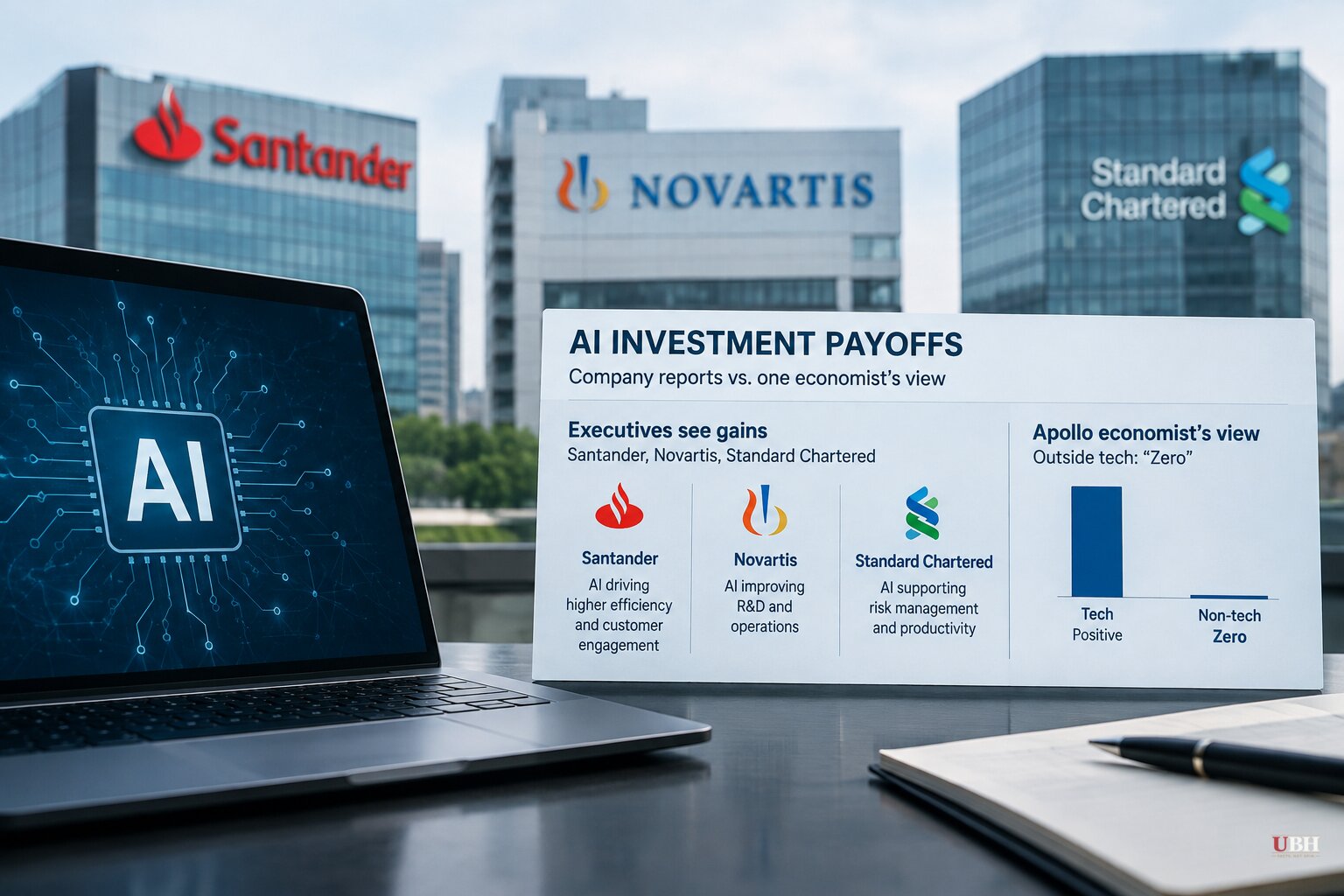
Santander said Wednesday, Oct. 28, that AI initiatives generated 194 million euros ($216 million) in business value over the first nine months of 2026. CFO José García Cantera said the bank can now "link directly to AI a positive contribution," while admitting it is "really difficult to just say how much comes from AI" because the technology is embedded across its processes.
Novartis reported third-quarter core operating income of $6.04 billion, up 10% at constant currencies. The company did not say how much came from AI. CEO Vas Narasimhan told CNBC: "I think this is the first quarter I've really seen AI start to improve actually our P&L on a tangible basis," pointing to marketing and sales productivity and ongoing work on R&D.
Standard Chartered reported 14% operating income growth at constant currency, excluding notable items. CFO Manus Costello said AI is "appear[ing] everywhere across the business" and helping managers build customer relationships. Like the others, he offered no dollar figure for AI's share.
Those are executives describing their own results. None of the three isolated AI's contribution in the numbers they reported.
Apollo's economist says the broader data show nothing
In a note published Oct. 24, Apollo Global Management chief economist Torsten Slok took the opposite view. "The technology has delivered zero financial payoff to corporate America outside of tech," he wrote. "Mainstream corporate America is pulling back and starting to view token spending not as a source of growth but as a cost center that weighs on margins."
His charts compare the Magnificent Seven with the other 493 S&P 500 companies. Revenue per employee at the tech group has climbed from $550,000 to nearly $800,000 since 2022. For everyone else it has hovered around $550,000 for seven years. Profit margins at the non-tech group have stayed at about 10%, and Slok found no dramatic gain in economy-wide productivity growth.
The comparison has limits. It does not isolate AI's effect at individual companies or prove AI caused the gap. It also covers aggregates, which would not capture a Santander-sized gain of nearly 200 million euros.
Slok framed the open question himself: whether, "even as models become commoditized, mainstream corporate America can turn increasingly cheap intelligence into higher revenue growth and higher profit margins." He added, "That may be harder than it sounds."
The spending keeps climbing
The investment side is not in doubt. Corporate AI investment hit $581.7 billion in 2025, up 130% from the prior year, according to Stanford's 2026 AI Index. CNBC put expected 2026 spending by Microsoft, Amazon, Google and Meta at $700 billion combined. Consensus estimates cited by Goldman Sachs put total U.S. hyperscaler capital spending at about $800 billion, though not all of it is for AI.
Microsoft reported $41 billion in capital spending last quarter, up 70% from a year earlier. Meta has raised its 2026 capex guidance to $135 billion to $145 billion.
Investors are now sorting spenders by whether they can say when the cash comes back. Oracle rose 11% on Oct. 28, its investor day, after setting targets: more than $225 billion in fiscal 2030 revenue, a non-GAAP operating margin above 40%, and annual free cash flow above $30 billion by fiscal 2029. It capped new capital-market fundraising through fiscal 2030 at $20 billion, excluding refinancing.
Those are targets, not results. Oracle's fiscal 2026 free cash flow was negative $23.7 billion, and its CFO pointed to positive free cash flow in the second half of fiscal 2028. Its remaining performance obligations, signed revenue not yet delivered, reached $664 billion.
Alphabet got the opposite reception. Its shares fell more than 12% Thursday, erasing roughly half a trillion dollars in market value, and slipped another 1.4% Friday to cap its worst month on record. Alphabet kept its 2026 capital spending plan but said it expects a significant increase in 2027. Its quarterly results showed capex of $51.4 billion, negative free cash flow of $9.1 billion and EPS of $2.12 against a $2.97 estimate. Google Cloud revenue rose 103% to $30.7 billion, and Search grew 12%.
Intel fell 28.58% Friday, its worst day since 1974, after guiding weaker for the fourth quarter. The company cited higher memory chip costs hurting PC demand. Nvidia fell 4.2% and a closely watched chipmaker index dropped 7.2%. Amazon slipped 1.4% after its sales and profit missed expectations and it signaled more AI spending.
Joe Tigay of Equity Armor Investments said the market is "moving out of the hopes and dreams phase of the AI trade and into the 'show me' phase." Matt Maley of Miller Tabak said Alphabet's promised AI returns are "getting pushed even further down the road."
Credit markets are watching too
The debt that funds the buildout is also under scrutiny. CoreWeave's five-year credit default swap spread hit a record 1,194.5 basis points on Oct. 15, a level that implies roughly a 63% chance of default, according to pricing cited by Startup Fortune. Oracle's spread climbed near 300 basis points.
U.S. markets are closed for the weekend, so the next read on the argument comes when trading resumes Monday, Nov. 2. The larger test is the 2027 spending guidance Alphabet has already flagged as a significant increase. Investors will need to see whether companies like Santander and Novartis can attach dollar figures to their AI gains, or whether the Apollo data hold.
Sources used for this briefing
7 links from 6 independent newsrooms (syndicated copies of the same report count once)
These are the sources it draws on, linked so you can verify.


