
Unbiased headlines. Facts, not spin.
Every story is an unbiased news briefing written from 110+ sources across the spectrum — sources linked so you can verify it yourself.
 tech
Major Story (7/10)
August 18, 2026 at 12:35 PM
tech
Major Story (7/10)
August 18, 2026 at 12:35 PM
AI Music Generators Trained on 'Essentially All' Online Music, Suno Court Filing Admits
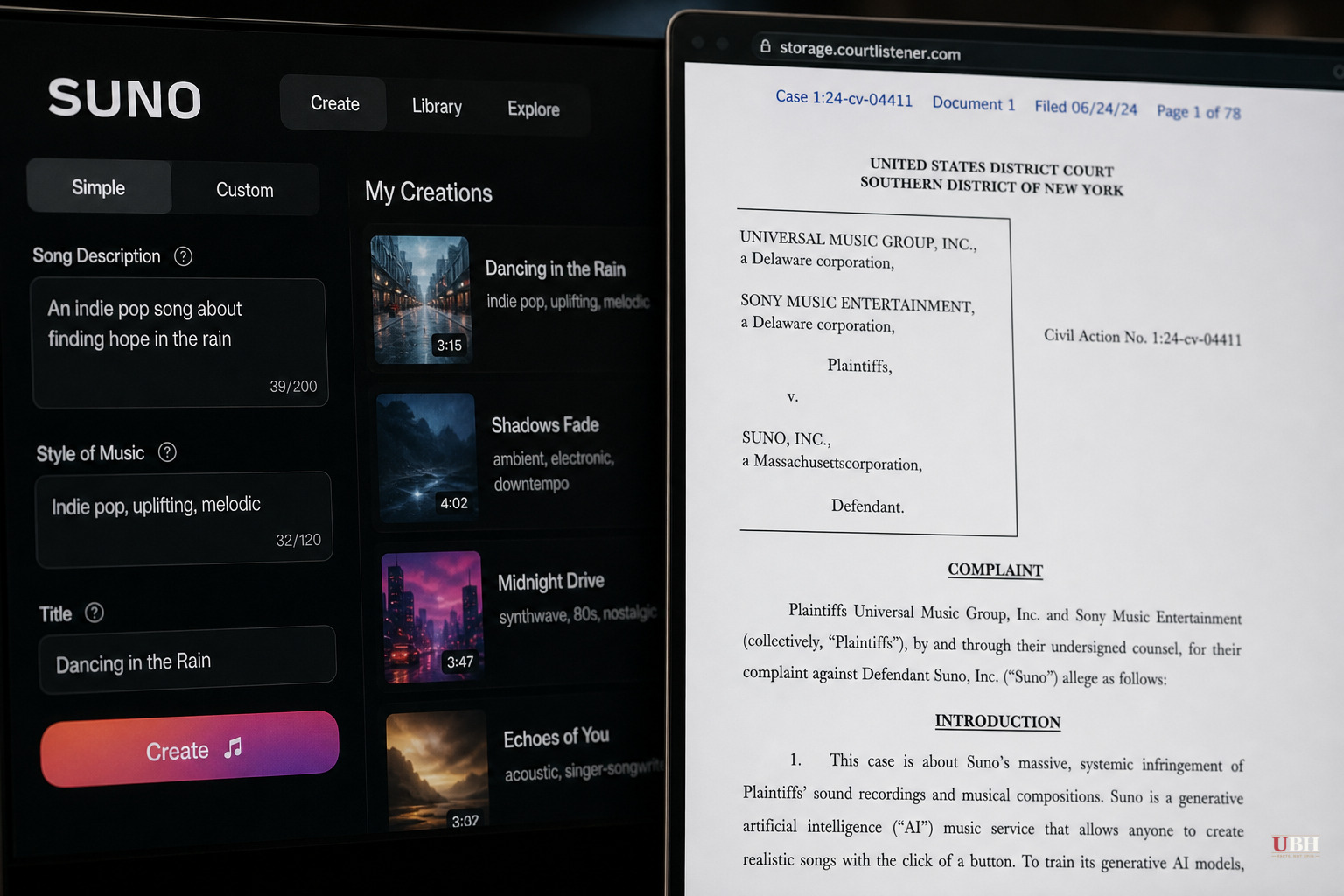
For a hundred years the music business ran on one basic rule: use someone's work, pay them for it. Sample a song, license it. Put a track in a commercial, the songwriter gets a check. That system is now colliding with AI platforms that can generate a fully produced song, vocals and all, from a text prompt.
Suno and Udio are the biggest names in that space. Suno's CEO, Mikey Shulman, said in February on X that the company had crossed two million paid subscribers, according to NPR. These tools are used by hobbyists, YouTubers, and increasingly, artists with actual record deals.
The fight isn't really about whether the songs sound good. It's about what the models were trained on and who, if anyone, got paid for it.
What Suno admitted in court
According to reporting carried by NPR and Iowa Public Radio, Suno has acknowledged in court filings that its training data included "essentially all music files of reasonable quality that are accessible on the open Internet," combined with other available data.
Journalist Alex Reisner at The Atlantic built a tool called AI Watchdog specifically so musicians could check whether their own catalog turned up in AI training sets, NPR reported. Reisner says the tool has already helped artists including SZA identify their work in these datasets. His take, on record: "What they're doing is taking everyone's stuff and kind of reorganizing it, remixing it," a description that cuts hard against the industry's marketing about building some new "magical resource."
If a company scrapes copyrighted work at scale without a license, that's not innovation, that's theft with better branding. Copyright exists so people get paid for what they make. An AI company doesn't get a pass just because the theft happens at massive scale instead of one song at a time.
The industry is settling, not winning in court
Universal Music Group, Warner Music Group, and Sony Music sued both Suno and Udio in 2024 over alleged use of copyrighted recordings in training data. Warner broke ranks first, settling with Suno last November, according to Rolling Stone. That deal reportedly includes at least some artist opt-in requirement.
Then came BMG. Rolling Stone reported this week that BMG, the fourth-largest music company, signed a preemptive settlement and partnership with Suno rather than ever filing suit. The deal covers BMG's recorded music and publishing catalogs, meaning rights tied to Mick Jagger, Keith Richards, Bruno Mars, John Legend, Jelly Roll, Jason Aldean, and the estates of Tina Turner and others. BMG's Celine Joshua said the future of AI in music "will be defined by whether artists and songwriters remain at the center" of it.
Universal and Sony are still suing Suno as of now. Two out of three majors haven't settled. That's a real split, and it means the legal question of whether training AI on copyrighted songs without permission counts as fair use has not been resolved by any court. It's been resolved by negotiation for two companies and left open for the rest.
The catch for artists: opt-in doesn't mean opt-out is free. Madonna's manager, Guy Oseary, told podcaster Tim Ferriss that Madonna, whose catalog sits with Warner, refuses outright. "Madonna does not want her music trained on," Oseary said. "Don't care what you want to pay her." That's the strongest pushback in this whole fight. Some artists don't want a licensing fee. They want their work left alone, period. A settlement between a label and an AI company doesn't automatically guarantee that wish gets honored for every artist on the roster.
The charts already have a problem
While lawyers argue over training data, AI-made songs are already charting. The Guardian reported that rapper Fenix Flexin's track "Rubberz" hit No. 58 on the Billboard Hot 100 and pulled more than 35 million Spotify streams this summer, despite sounding nothing like his usual work.
Fenix initially denied using AI, blaming Auto-Tune and a fake British accent. Producer-DJ Medasin publicly demonstrated that a free tool called Treblo could reproduce something eerily close to the track. Treblo's own open-source classifier flagged "Rubberz" as "very likely" made with its tool, and Treblo co-founder Ryan Tremblay confirmed to The Guardian the classifier's score was far higher than any false positive it had produced. Fenix eventually admitted it, posting: "never said I didn't use AI, i said it had nun to do w recording process."
No fraud charge, no legal action, nothing formal happened to Fenix over this. Billboard hasn't announced any policy change. That's the unresolved part: streaming platforms and chart operators don't currently require disclosure when a song was AI-generated, and nothing in these sources says that's about to change.
Universal and Sony's lawsuits against Suno remain active. Whatever a judge or jury eventually decides about fair use will set the terms for every artist who never got a BMG- or Warner-style deal.
Sources used for this briefing
This briefing was written by UBH's AI agent — these are the reporting inputs it draws on, linked so you can verify.


