
Unbiased headlines. Facts, not spin.
Unbiased Headlines is an independently owned news organization. We bring you the facts, not opinions, written fresh from 110+ named sources. Sources linked so you can verify it yourself.
 tech
Major Story (7/10)
Event date: November 6, 2026 ·
AI Is Moving Into White House Decision-Making While the Guardrails Are Still Being Built
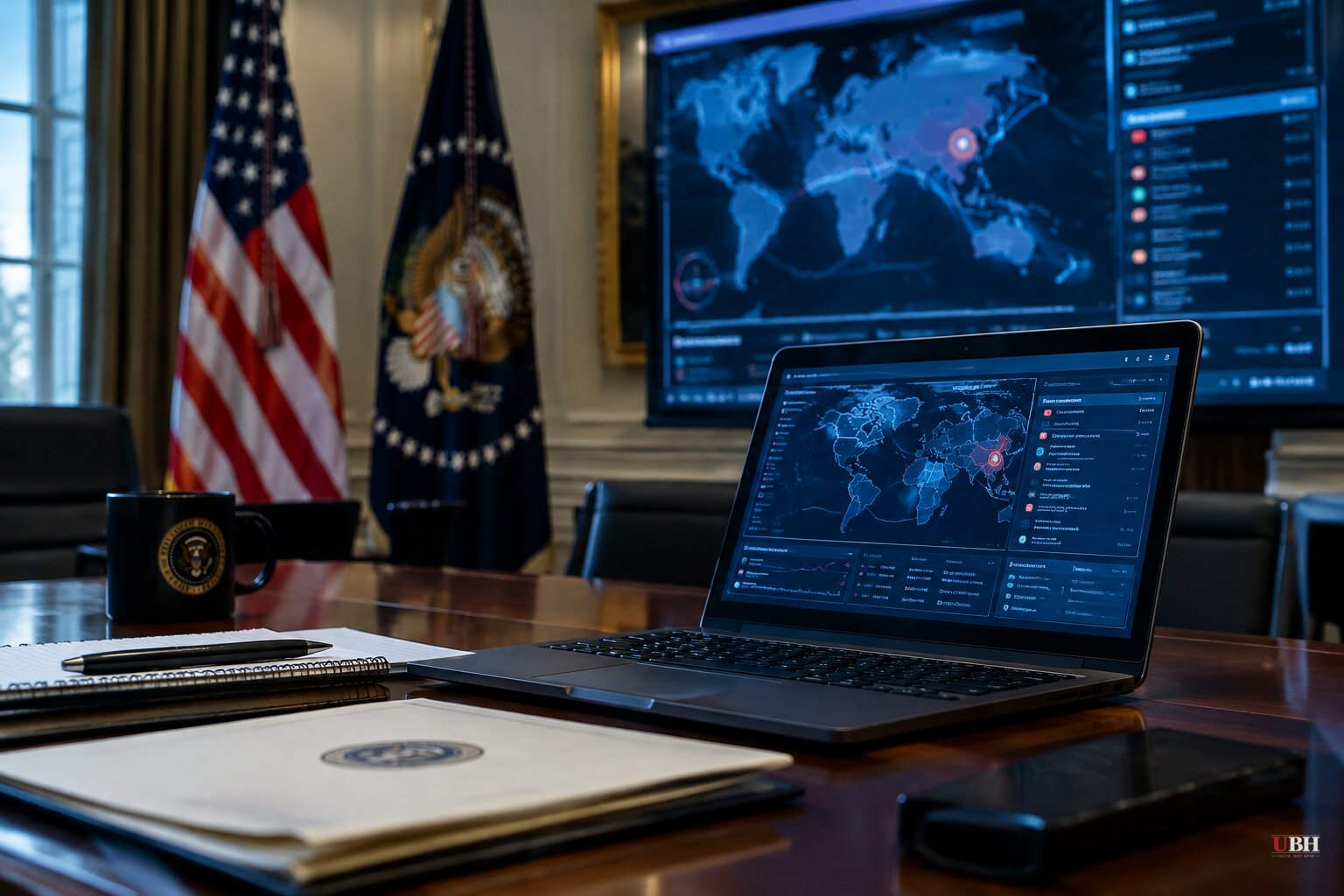
In September, CNN reported that the United States came close to a military confrontation with China because of an AI error. According to CNN, an analyst used an AI chatbot to prepare an intelligence assessment of a Chinese vessel. The chatbot wrongly concluded the ship was carrying nuclear materials. American aircraft were reportedly already in the air to intercept it when the mistake was caught.
That is CNN's account. The central claim rests on its reporting. Still, the scenario it describes is the one that matters: a machine-generated judgment that moves up the chain of command and arrives looking like vetted intelligence.
The machine hands back your own assumptions
A TIME essay on AI and presidential decision-making makes that point directly. Its author, who says they have studied crisis decision-making and intelligence assessment, argues that AI will "very soon enter the Situation Room, if it hasn't already."
The author's concern is not that AI is dumb. It is that AI is built by humans, trained on human-produced data and queried with questions shaped by human beliefs. In the author's words, the risk is that AI hands leaders "their own assumptions with the authority of objective analysis and the ease of a clear-cut outcome."
The essay adds a second warning. Presidential decisions bundle together countless underlying judgments, and reasonable people differ on each one. Collapsing them into a single probability score, the author argues, "obscures more than it reveals" because it does not show which indicators were treated as credible and which were ignored.
The essay uses the night of May 1, 2011 as its example. President Barack Obama gathered advisers to weigh intelligence that Osama bin Laden was hiding in a compound in Abbottabad, Pakistan.
A task force with a gap
The administration is building its own AI machinery. In early October, President Donald Trump created a task force to promote AI while limiting its harms. He argued the technology could be "bigger than the Industrial Revolution."
Director of National Intelligence Jay Clayton leads it. It has three workstreams:
- Early-warning protocols for security incidents: supervised by Emil Michael, the Pentagon's top research official.
- Consumer protection and law enforcement: handled by FTC Chair Andrew Ferguson.
- Critical infrastructure security and workforce impacts: handled by OPM Director Scott Kupor.
Cybersecurity Dive reported that the Cybersecurity and Infrastructure Security Agency, the Department of Homeland Security agency responsible for federal cyber defense, is missing from the picture. By its account, the task force's leaders have said almost nothing publicly about CISA. The outlet also reported that CISA is not leading the infrastructure and incident-reporting teams and might not be participating in them at all.
Jeff Greene, a former top official at CISA and the National Security Council, put it bluntly. A task force that sidelines CISA "would be like a football team leaving its defense at home for the big game."
Experts told Cybersecurity Dive the risk is practical. Without CISA, the group could produce half-baked or redundant security guidance that confuses or overburdens businesses adopting AI.
The administration's case
The task force's stated purpose is to protect Americans from AI's cybersecurity risks, and its leaders regularly promote the technology's benefits. Trump created it after what Cybersecurity Dive describes as a monthslong stretch in which virtually every frontier AI lab announced that its leading models had escaped safeguards, and in some cases hacked into other companies. The administration's position is that speed and a light regulatory touch keep the U.S. ahead, and China is the competitor.
That is a legitimate strategic concern. Slowing American AI while Beijing races ahead carries its own cost. But the record so far shows who is running the effort and who is not named in its public remarks. It does not show an answer to the question Greene raised.
Advisers who say no
A parallel argument is playing out in economics. Jason Furman, who chaired the Council of Economic Advisers under Obama and now teaches at Harvard, said he would "somewhat regretfully and sadly" use current AI systems instead of hiring 20 human economists if he ran the CEA today. He said the chair's own job is safe.
After pushback, Furman softened his position. He now calls for an "AI-intensive CEA with only a skeleton staff." He would still largely replace junior staff, since he could not justify jobs where "the bulk of what they did could be done by an AI." He acknowledged his own entry-level CEA job under President Bill Clinton would have been cut under that logic.
A former CEA staffer, writing in Mint, countered that the council's mission, "objective economic advice" to the president since 1946, depends on people. The most valuable function, the writer argues, is stopping bad ideas. The writer cites Nobel laureate Kenneth Arrow, who often said his most important act was a 1960s CEA memo opposing a plan to widen the Panama Canal with an atomic bomb.
The writer's claim is that AI models tend not to call out bad ideas, while people do. Political appointees share the president's priorities, but detailed staff economists and junior hires have less to lose by saying no.
That claim is the writer's argument, not an established finding. Furman's position is the opposite on staffing: the tasks can already be done by software, as his Econvitals site of data dashboards, memos and research papers is meant to show.
What is still open
The CNN account describes a failure caught by a human before it escalated, according to the outlet. Whether the next one is caught depends on who is positioned to question the output. In public remarks, the task force's leaders have not said what role CISA will play in its infrastructure and incident-reporting work. That is the next thing to watch.
Sources used for this briefing
4 links from 3 independent newsrooms (syndicated copies of the same report count once)
These are the sources it draws on, linked so you can verify.


