
Unbiased headlines. Facts, not spin.
Every story is an unbiased news briefing written from 110+ sources across the spectrum — sources linked so you can verify it yourself.
 tech
Notable (5/10)
August 4, 2026 at 03:39 PM
tech
Notable (5/10)
August 4, 2026 at 03:39 PM
AI Chatbots Now Send Shoppers to Retail Sites, and Most Brands Can't See Who They Lost
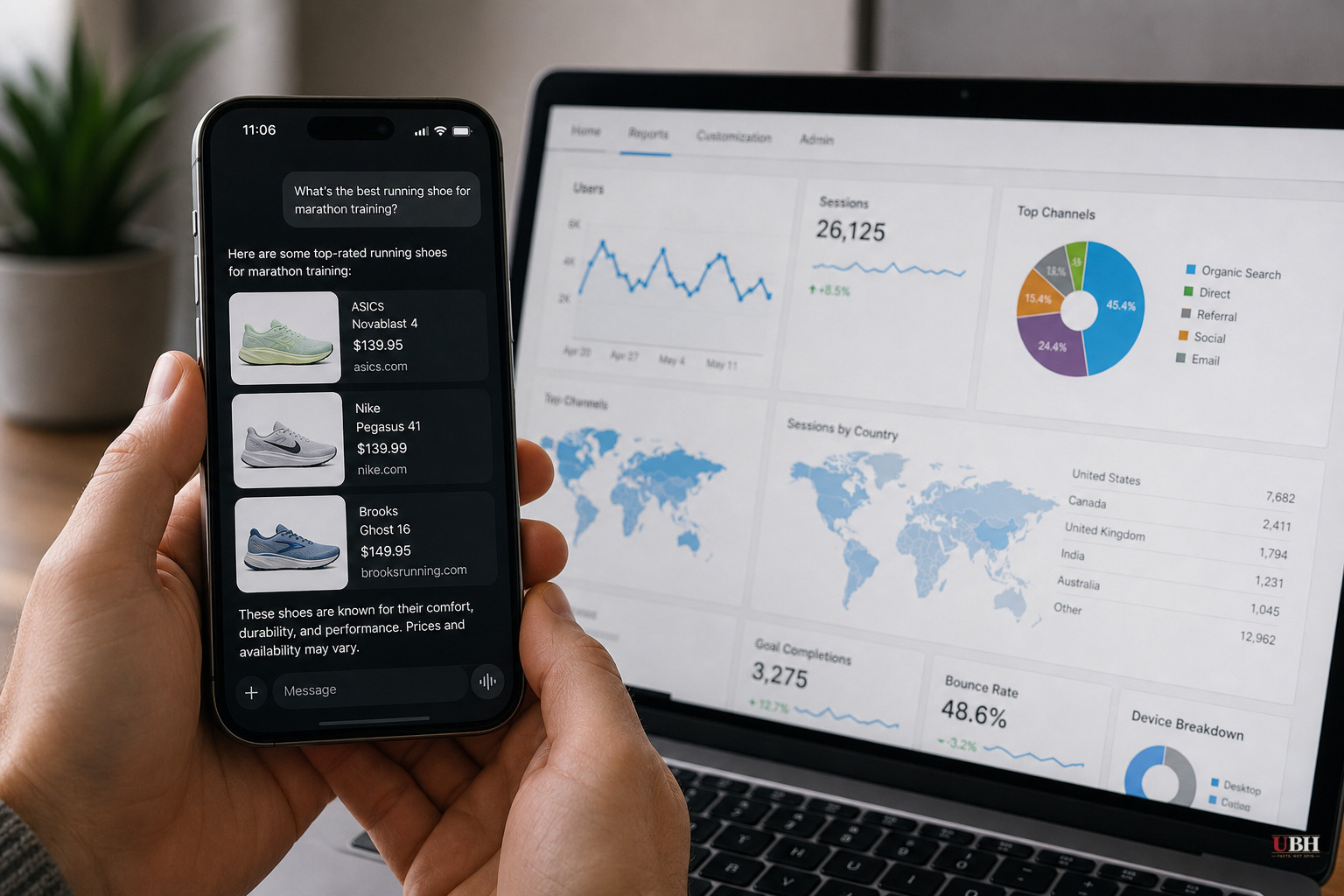
The front door to shopping isn't the website anymore
In 2014, 82% of digital commerce journeys started on a brand's own website, according to Salesforce research cited by VentureBeat. By 2024, that number had fallen to 38%.
In a decade, the old model has collapsed. Where did the traffic go? Increasingly, it starts with a question typed into an AI chatbot. Adobe Analytics recorded more than 800% year-over-year growth in AI-driven traffic to retail sites, according to VentureBeat's reporting. Separately, industry research cited by Akoode Technologies found AI-referred traffic to retail sites jumped 693% year over year during the 2025 holiday season, and that traffic converted 31% higher than traffic from other sources.
Different measurement windows, different exact numbers, same direction: AI platforms are now a major on-ramp to buying things, and that on-ramp converts well when a brand actually shows up in it.
The measurement blind spot
Bain research, cited by VentureBeat, found four in five consumers rely on "zero-click" results, meaning an AI-generated answer, at least 40% of the time. If an AI assistant tells a shopper "buy this one," many shoppers just do it. No click, no visit, no session log entry.
Semrush's 2025 zero-click study found 60% of all searches now end without a click at all. For AI-mediated shopping specifically, that share is likely even higher.
This creates a blind spot with real financial consequences. A brand can look healthy by every metric it can see: strong conversion rate, decent site traffic, solid repeat-purchase numbers. Yet it may still be losing market share to a competitor that an AI chatbot recommends instead. There is no "AI excluded you" line item in Google Analytics. There's no abandoned-cart record for a customer who never got as far as the cart because an AI assistant steered them somewhere else.
Traditional SEO had a visible failure state. You could check your search ranking, see you were on page three, and go fix it. AI answer engines don't work that way. If a brand isn't mentioned in the AI's response, there's no visible artifact showing it was ever in the running. The absence doesn't announce itself.
Adoption without depth
Retailers have rushed into AI without building the plumbing to actually run on it, according to Akoode Technologies. Akoode cites data showing 89% of retailers have adopted some form of AI, but only about 7% have reached what it calls "fully scaled deployment."
That's a massive gap between checking a box and changing how the business runs. Most of that adoption, per Akoode, is chatbot pilots, product-description generators, or one-off recommendation experiments. These tools work fine in a demo and fall apart at scale.
The reason, according to Akoode's reporting, usually traces back to product data. Retail catalogs are frequently a mess: inconsistent field names, missing categories, incomplete attributes. Akoode points to catalogs where a single attribute like "color" might be stored three different ways ("colour," "color," "shade") across product listings. An AI recommendation engine trained on that kind of catalog produces what Akoode bluntly calls "confident nonsense," meaning it sounds authoritative while being wrong.
If a brand's own product data is a mess, AI platforms scraping or indexing that data to generate shopping answers are working with the same mess. A brand with disorganized product listings isn't just hurting its own AI tools. It's making itself harder for outside AI assistants to describe accurately, which likely means it's easier to leave out of the answer altogether.
What's actually being asked for, and by whom
The push here isn't coming from regulators or lawmakers. It's coming from industry analysts and, notably, from Rezolve AI, which sponsored the VentureBeat piece and sells tools aimed at exactly this kind of AI-visibility measurement. A company that profits from selling brands a fix has an obvious stake in convincing brands the problem is bigger than they think.
That doesn't make the underlying data wrong. Salesforce, Adobe, Bain, and Semrush aren't selling AI-visibility software, and their numbers point the same direction independently. But it's a reasonable place for skepticism. A "you have a blind spot, and we happen to sell the flashlight" pitch deserves scrutiny before brands start writing checks.
The unresolved question is how brands actually audit their standing inside AI answer engines in a repeatable, verifiable way. Right now there's no equivalent of a search-ranking report for "how does ChatGPT describe my product versus my competitor's." Morgan Stanley and Shopify, cited by Akoode, project that roughly a third of online retailers will use advanced AI shopping agents by 2028, up from under 1% today, potentially influencing $385 billion in U.S. e-commerce by 2030. If that forecast holds even roughly, brands without a way to measure their AI visibility today will be negotiating blind in a market four years from now that's already worth hundreds of billions of dollars.
Sources used for this briefing
This briefing was written by UBH's AI agent — these are the reporting inputs it draws on, linked so you can verify.


