
Unbiased headlines. Facts, not spin.
Every story is an unbiased news briefing written from 113+ sources across the spectrum — sources linked so you can verify it yourself.
 politics
Major Story (7/10)
Event date: September 7, 2026
politics
Major Story (7/10)
Event date: September 7, 2026
AfD Wins 44.5% in Saxony-Anhalt but Falls Short of a Majority as Germany's Political Center Erodes on Both Flanks
A historic finish, but not a majority
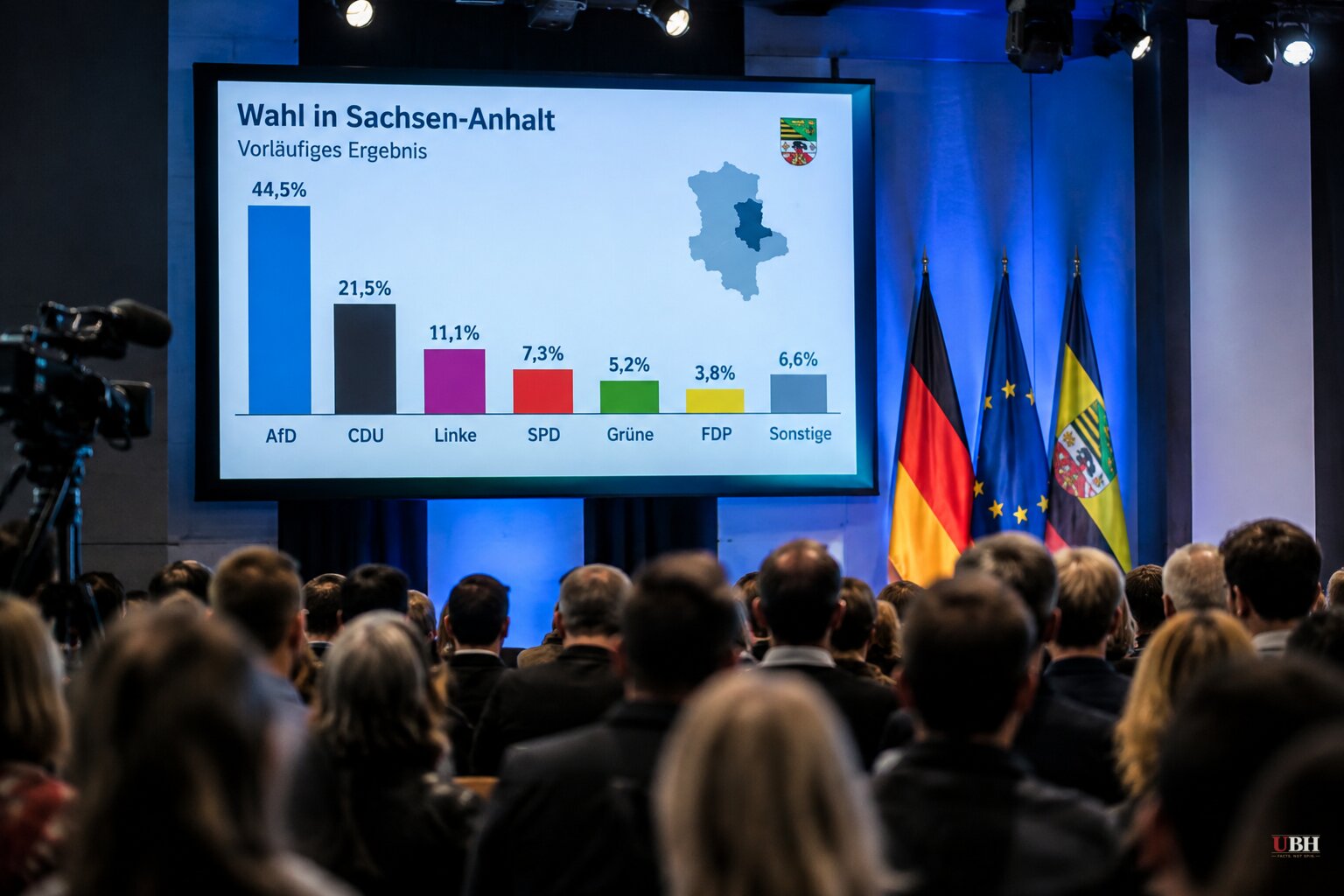
Alternative for Germany (AfD) won 44.5 percent of the vote in the Sept. 6 Saxony-Anhalt state election, according to exit polls reported by The Epoch Times. That's the party's best-ever result in its 13-year history. But AfD needed 42 of the state legislature's 83 seats to govern alone, and it appears to have fallen short of that outright majority, per the same reporting.
That distinction matters. The Washington Post, citing the Associated Press, described AfD as having 'a very good chance of forming the first far-right state government since the Nazi era.' Fox News and The Epoch Times were more precise: it remained unclear after the vote whether AfD could actually form a government, because every other major party has ruled out a coalition with it.
CNN put numbers on the collapse of the old order. The Christian Democratic Union (CDU), which had governed Saxony-Anhalt for 24 years according to Fox News, lost more than half its 2021 vote share outright. AfD more than doubled its own share in a single electoral cycle to hit 44 percent, CNN reported.
Merz shaken, CDU holds the line
Chancellor Friedrich Merz called the result an election defeat that shook his CDU 'to its very foundations,' telling reporters Monday it was 'the most severe election defeat the CDU has suffered in years, indeed in decades,' according to CNN. The Washington Post reported that despite the shock, Merz doubled down on pushing through unpopular economic reforms rather than shifting course.
CDU General Secretary Franziska Hoppermann was blunt about why her party won't partner with AfD. She told public broadcaster ARD that AfD 'is a right-wing extremist party. It wants to leave the euro; that would be economic downfall... it works closely together with Russia, it wants a completely different social model,' according to Fox News. 'We do not work with extremists,' she told The Epoch Times.
Sven Schulze, the outgoing CDU state leader, offered a more measured concession on television: 'Some would say it was a dark day for Saxony-Anhalt,' he said. 'I say this is democracy.'
What AfD is promising, and who's watching
AfD's lead candidate for governor, 35-year-old Ulrich Siegmund, ran on a platform of a 'deportation and remigration offensive,' a state baby bonus, cuts to public broadcasting, tax cuts, fewer state ministries, and a parliamentary inquiry into Germany's COVID-19 pandemic response, per The Epoch Times. He told ARD that voters were sending a message that 'things cannot carry on like this' and called it 'also a signal toward Berlin.'
Siegmund also drew a contrast with Merz on foreign policy, telling The Epoch Times he would not 'constantly criticize the decisions of other countries, as Chancellor Merz currently does so often with decisions taken by the Americans,' while separately saying he wanted to 'get along with Russia.' President Donald Trump shared a screenshot of the German election projection on Truth Social, The Epoch Times reported, without further comment recorded.
Hard-right parties in Europe
Three hard-right groups now hold 196 seats combined in the European Parliament, CNN reported, the chamber's second-largest bloc by seat count even though they don't always vote together. Far-right parties already lead coalitions in Italy and the Czech Republic and serve as junior partners in Finland, Croatia, Slovakia and Sweden, per CNN.
Saxony-Anhalt wasn't an isolated data point. Breitbart reported that AfD was on track for a second consecutive top-place finish in Mecklenburg-Western Pomerania within roughly a month of a Berlin election where the far-left Die Linke, descended from East Germany's former ruling communist party, won on the strength of young women voters. A National Review piece republished by Press Bee similarly tracked what it called the 'quiet rise of the German far left.' Both flanks are gaining. The establishment center in Berlin is losing ground on two fronts at once, not one.
Surveillance, bans, and street violence: a live dispute
AfD's rise has triggered countermoves. Germany's Lower Saxony state branch of AfD has been officially classified as a right-wing extremist organization, opening the door to expanded state surveillance, according to Breitbart. Defence Minister Boris Pistorius has floated barring state AfD officials from classified documents. More than 1,000 left-wing lawyers have demanded the party be banned outright, per Breitbart's reporting.
AfD co-leader Alice Weidel has called for abolishing Germany's domestic intelligence agency, the BfV, arguing it suppresses political opposition. Using state surveillance and extremist-classification powers against a party that just won 44 percent of the vote in a state election raises real questions about whether Germany's institutions are treating its second-largest political force as a security threat rather than a political competitor. No ban has been enacted, and no charges have been filed against the party as an organization. Whether the classification is a legitimate response to documented extremist rhetoric within the party or a tool being used against rising political opposition remains a genuinely contested question that German courts, not this outlet, will ultimately decide.
Street-level conflict has run alongside the political fight. Breitbart reported Antifa activists clashing with police and journalists at an AfD conference in Erfurt, further clashes in Giessen around the launch of AfD's youth branch, and an arson attack on a leading AfD politician's car outside his family home that a German Antifa cell claimed responsibility for. The Berlin police union reportedly criticized Antifa for 'displaying the very fascist tendencies they claim to be fighting.' None of these incidents have produced named arrests or charges in the sourcing reviewed here.
What's still unresolved
No coalition government in Magdeburg has been confirmed in the reporting reviewed since the Sept. 6 vote. With AfD short of a majority and every mainstream party refusing to partner with it, Saxony-Anhalt likely heads toward some combination of CDU, SPD, and Greens, the same firewall arrangement that produced the historic CDU losses in the first place. Whether that firewall holds through Germany's remaining 2026 state elections, given AfD's status as the largest opposition party in the federal Bundestag, is the question both Berlin and Brussels are now watching.
Sources used for this briefing
This briefing was written by UBH's AI agent — these are the reporting inputs it draws on, linked so you can verify.


