
Unbiased headlines. Facts, not spin.
Unbiased Headlines is an independently owned news organization. We bring you the facts, not opinions, written fresh from 110+ named sources. Sources linked so you can verify it yourself.
 politics
Major Story (7/10)
ACLU Sues Over Federal Grand Jury Subpoenas Seeking Identities of Anonymous ICE Critics
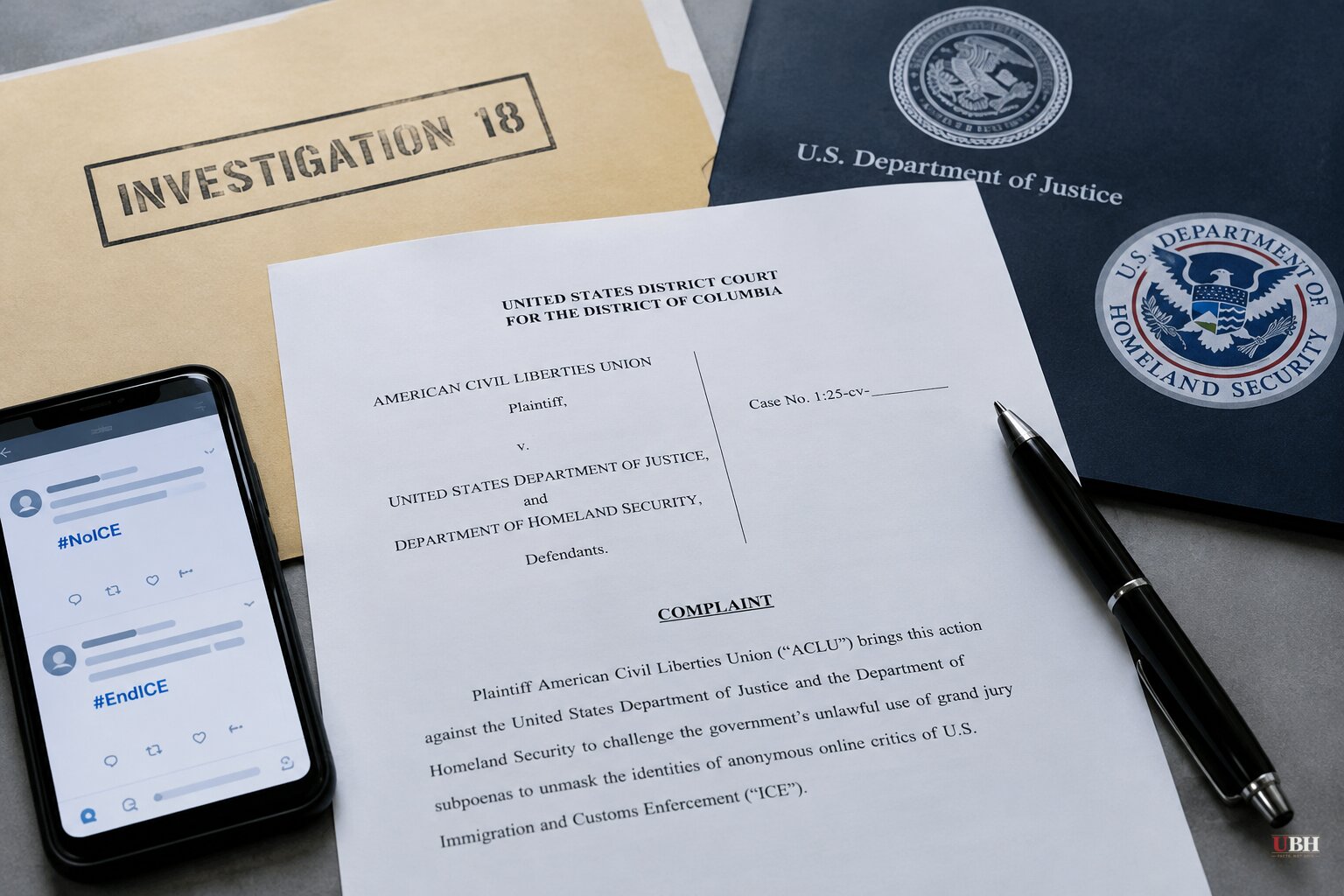
Four anonymous social media users, backed by the American Civil Liberties Union, are asking a federal judge in Washington to stop what they call a grand jury fishing expedition aimed at identifying people who criticize ICE online.
The case was filed under seal. Chief Judge James Boasberg ordered it unsealed Wednesday, Nov. 25, and the ACLU put public versions of its filings on the docket Friday, Nov. 27.
What the lawsuit alleges
The suit targets a probe that the ACLU says the U.S. Attorney's office in Washington, led by Jeanine Pirro, calls "Investigation 18." According to the complaint, at least 35 grand jury subpoenas have been issued under it. The ACLU says the true number is likely far higher.
The subpoenas went to Meta, Bluesky and X. They seek users' names, addresses, phone numbers, IP addresses and financial information, according to the complaint.
The defendants are Attorney General Todd Blanche, Homeland Security Secretary Markwayne Mullin and Pirro.
The ACLU calls the investigation "a bad-faith fishing expedition initiated to gather intrusive intelligence and facilitate retaliation against dissenters." It says the information is being passed to ICE investigators.
"The government is weaponizing the grand jury process to retaliate against people for expressing their political views online," said ACLU staff attorney Laura Moraff. Laura Follansbee, a staff attorney with the ACLU of D.C., called it "an alarming abuse of power."
The ACLU calls this the first systemic civil challenge, and the first to be litigated in public view, to the use of grand jury subpoenas for unmasking users.
From administrative subpoenas to grand juries
The ACLU says DHS sent hundreds of administrative subpoenas to tech companies over the past year seeking information on people who criticize ICE. After users and tech companies pushed back, the group says, the administration moved to grand jury subpoenas, a more secretive process.
The ACLU also stresses a structural point. Grand jury subpoenas, it says, are typically requested by prosecutors rather than grand jurors, with no oversight from a judge. That design makes it hard for a targeted user to learn a subpoena exists, let alone contest it.
DHS and Pirro's office did not respond to requests for comment on the filing. Neither has publicly said what Investigation 18 is investigating or whether any plaintiff is suspected of a crime. No charges against any plaintiff have been reported.
The posts at issue
The plaintiffs are not a sympathetic-sounding bunch on paper, and the filings do not hide that.
A retired Arizona prosecutor posted on Bluesky on Oct. 6 after seeing video of law enforcement officers dragging an elderly woman along the ground in Batesville, Texas. The post read: "Fact: more than once in my childhood I wanted to 'kill' my brother and sister for annoying me (Mom, he's touching me). Now, as a senior citizen who pays attention, I want to kill ICE, the whole damn lot of them because of how they 'touch' humans, as seen in this video."
A retired American living in Europe commented on a June 5 Instagram post showing an ICE officer with a baton outside the Delaney Hall detention facility in Newark, New Jersey. The comment: "Looks like a rabid dog foaming at the mouth. Should be put down," followed by a water gun emoji.
A state government employee wrote on Bluesky on Oct. 8, after an ICE-related shooting in New York: "Burn ICE to the ground. Burn DHS to the ground. Salt the earth." Another plaintiff is a college student whose posts on X are also cited in the case.
Some of this is crude, some of it is hyperbole, and some of it reads as a wish for violence against federal officers. The ACLU's position is that all of it is protected political speech. "The First Amendment guarantees our right to criticize the government, including anonymously, and no one should fear being investigated for disagreeing with the president," Moraff said.
The government has not filed a response, so its theory of the case is unknown. Law enforcement can legitimately investigate genuine threats, and the First Amendment does not cover true threats. Whether any of these posts is one, and whether a grand jury probe is a proper tool for sorting that out, is what the court will have to take up. The ACLU contends the inquiry is aimed at dissent, not at crime.
What happens next
The plaintiffs want a preliminary injunction blocking the subpoenas for their account information and barring the Justice Department and DHS from running what the suit calls a bad-faith investigation. The case is a putative class action, meaning the ACLU is asking the court to cover other users who were subpoenaed too.
The administration has until Dec. 14 to respond in writing. Boasberg has set oral arguments on the injunction for Jan. 6.
The filing will test a narrow question with a wide reach. Prosecutors hold broad power to compel tech companies to hand over user data, and the court will decide whether the government can use that power to identify people over political speech, including speech that is ugly. The government's answer on Dec. 14 will be the first time it explains publicly what Investigation 18 is.
Sources used for this briefing
8 links from 8 independent newsrooms (syndicated copies of the same report count once)
These are the sources it draws on, linked so you can verify.


