
Unbiased headlines. Facts, not spin.
Unbiased Headlines is an independently owned news organization. We bring you the facts, not opinions, written fresh from 110+ named sources. Sources linked so you can verify it yourself.
 politics
Major Story (8/10)
Abu Dhabi Talks End Day One After Four Hours: Zelensky Calls Them 'Constructive,' Lavrov Rejects a Ceasefire
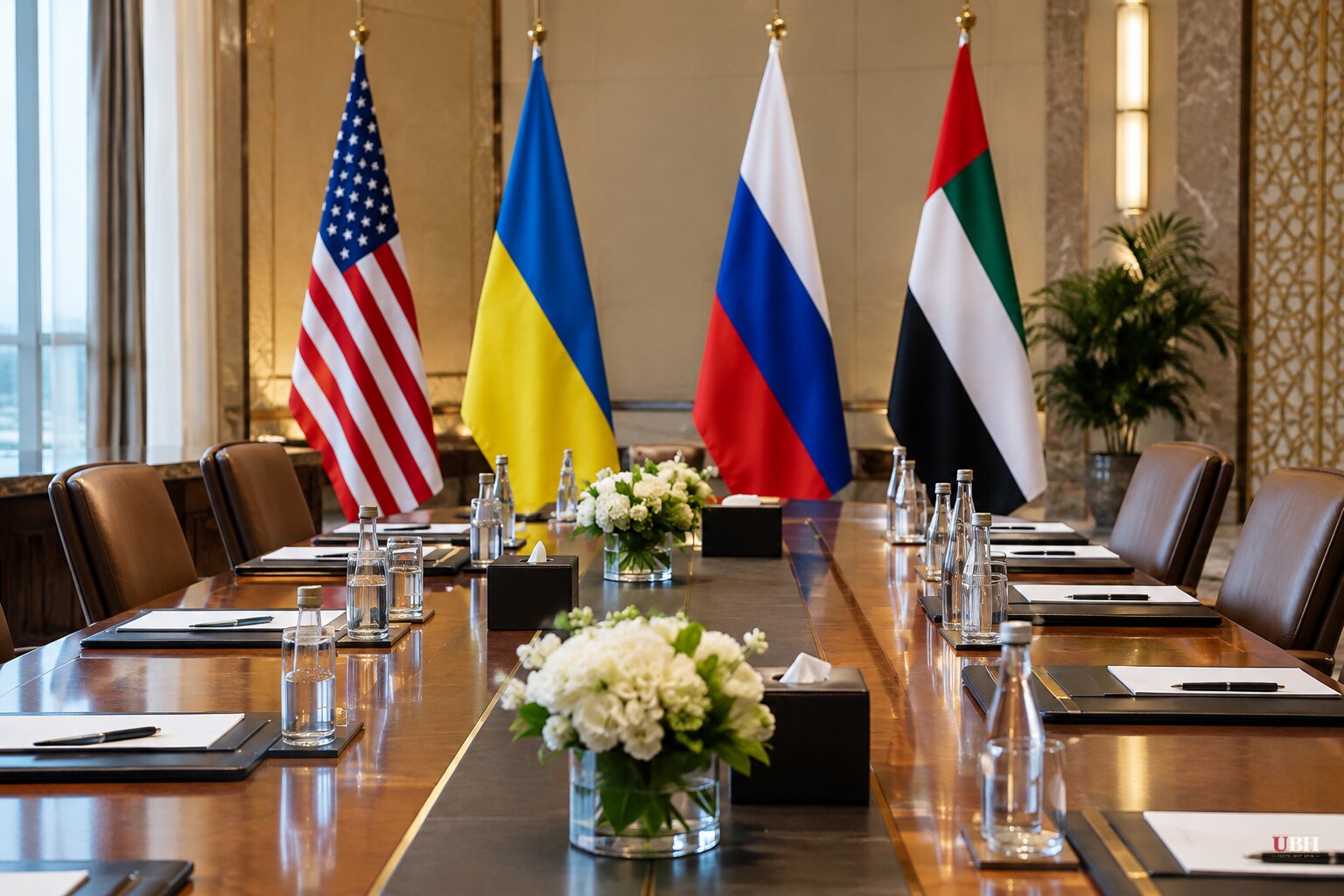
Since the three-way talks opened in Abu Dhabi on Tuesday, Nov. 10, the first of two scheduled days has ended after roughly four hours, with the U.S. and Ukraine calling it productive and Russia's top diplomat shutting the door on a ceasefire.
Russian and Ukrainian officials said little afterward. The public verdicts came from the people who were not in the room or were not the delegates.
President Volodymyr Zelensky, who was not at the talks, called the session "constructive and quite substantive." He said it dealt largely with humanitarian issues: prisoner exchanges, the return of Ukrainian civilians held in captivity, and children taken from the country. Security guarantees were also discussed, he said.
Secretary of State Marco Rubio, speaking in Paris at the Group of Seven meeting, called the talks "very productive." He added: "There's a lot of work to be done in that regard."
What the U.S. says has moved
Jared Kushner told delegates at the opening that Washington had "narrowed the gaps" between the two sides and hoped to move toward a "solution that hopefully ends the war." He offered no details. He also said he believed there were "some good ideas how to bridge" the differences.
A U.S. official speaking on the eve of the talks said Moscow and Kyiv had shown "a little bit of flexibility, privately" on who would control Ukraine's eastern regions after a war. The same official acknowledged the issue could not be settled without a broader discussion of a new security architecture. Neither side has said publicly that its position has changed.
The public positions remain far apart. Russia demands the parts of Donetsk that Ukraine still holds. Kyiv wants the current contact line frozen and says those areas are crucial to its security. The Kremlin has said control of all of the Donbas is a precondition for a deal, not a subject of negotiation, and that it will keep trying to take the rest by force if diplomacy does not hand it over.
Lavrov on ceasefire and the Europeans
Russian Foreign Minister Sergei Lavrov used the day to restate Moscow's limits. A truce, he said, would only let Kyiv regroup. "We will not agree to it." An unconditional ceasefire before negotiations is a proposal favored by EU officials, and Moscow has routinely rejected it.
Lavrov was equally dismissive of the European presence in the UAE. Their involvement is not a "promising approach," he said. "They flew to Abu Dhabi. Let them sit in a hotel there."
Representatives of the E4 (Britain, France, Germany and Italy), NATO and the European Commission are in Abu Dhabi and met the U.S. and Ukrainian delegations before the session. They are not part of the trilateral format. Kushner and Steve Witkoff also met Ukrainian, European and NATO officials on the sidelines.
Rubio acknowledged in Paris that Europeans "are a part of solving this problem for the long term." A U.S. official, however, said "the Russians have a bad taste in their mouth with the Europeans."
EU foreign policy chief Kaja Kallas said Monday she saw little sign that Russia was willing to negotiate in good faith. The Elysée Palace said before the talks began that peace in Ukraine and security in Europe are "inextricably linked."
Europe divided on how to engage
Former NATO Secretary-General Anders Fogh Rasmussen told Euronews that Europe is "begging for a place at the table" and must instead "make yourself indispensable by bringing assets to the table." He warned that if Europe does not change course, "we will be sleepwalking into a permanent war on the European continent."
Europe is also not speaking with one voice. Norwegian Prime Minister Jonas Gahr Støre and Finnish President Alexander Stubb initiated a 90-minute call with Vladimir Putin. Danish Prime Minister Mette Frederiksen said she was "very sceptical about this independent initiative by Norway and Finland. It was not coordinated with any of us."
The backdrop
President Trump told CBS's 60 Minutes before the talks that "we're very close to a deal" and that the war would end with "a little bit different shape Ukraine." He did not say what territory he meant or whether he envisioned formalizing Russian control, which Kyiv says it cannot accept.
Sam Greene, a professor at the Russia Institute at King's College London, wrote on Nov. 8 that for Putin negotiations are "potentially a means of winning" the war. Western policymakers, he wrote, should distinguish between Putin "wanting negotiations and Putin wanting to negotiate."
The Associated Press noted that the talks follow three earlier rounds this year that produced no significant breakthrough. It said the circumstances have shifted with the U.S. midterm results, pressure on Russia's wartime economy, and Moscow's escalating strikes on Ukraine's power grid as winter sets in. Democrats take control of Congress in January and could press for more support for Ukraine.
The delegations are expected to reconvene Wednesday morning local time. Whether either side moves off its public position on Donetsk, and whether Moscow will meet Europeans at any point, remain unanswered as day two begins.
Sources used for this briefing
8 links from 8 independent newsrooms (syndicated copies of the same report count once)
These are the sources it draws on, linked so you can verify.


