
Unbiased headlines. Facts, not spin.
Every story is an unbiased news briefing written from 110+ sources across the spectrum — sources linked so you can verify it yourself.
 tech
Low Interest (4/10)
July 27, 2026 at 12:55 AM
tech
Low Interest (4/10)
July 27, 2026 at 12:55 AM
A Robotics Startup Is Strapping Brain-Wave Headsets on Workers to Train AI Robots
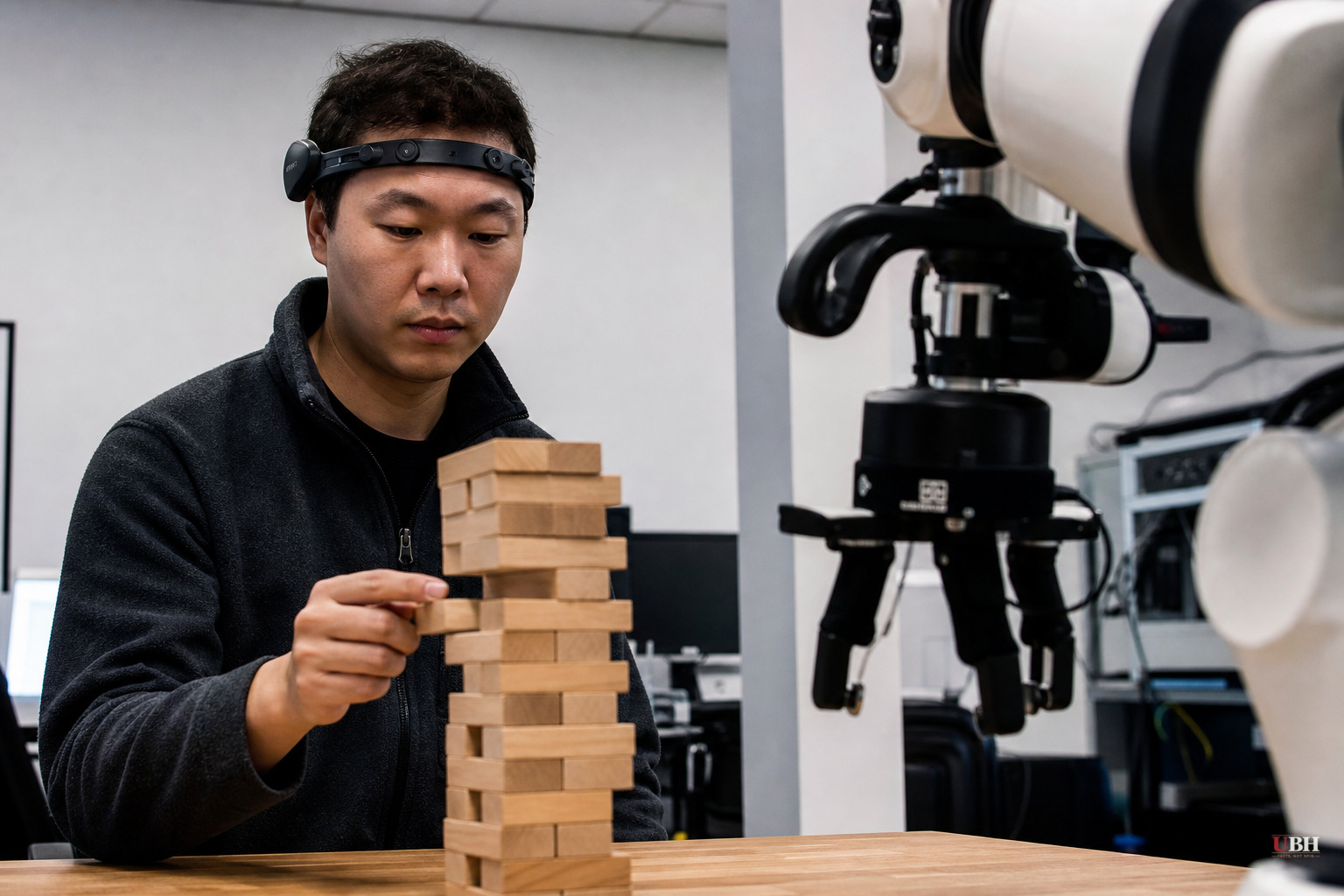
In a warehouse in San Leandro, California, a company called Encord is running an experiment that sounds more like a neuroscience lab than a tech startup. Workers, whom Encord calls "pilots," wear headsets fitted with cameras and brain-wave sensors while doing manual tasks. One demo, reported by TechCrunch, involves a pilot named Andrew Ceja carefully disassembling a Jenga tower.
The headset isn't just recording what he sees. It's measuring his brain activity, using technology built by Zander Labs, a German neuroscience startup. The goal is to detect mental states like error, intent, and surprise while a human performs a physical task, then tag that data and feed it into robotics models.
This is a trial, not a finished product. According to TechCrunch, Encord and Zander Labs are building an initial brain-wave-tagged data set, running it through customer robotics models, and evaluating whether it actually improves performance before deciding whether to scale it up. Nobody at either company has claimed it works yet.
Why Robots Can't Just Learn From YouTube
The reason this matters goes back to a basic problem in robotics. Large language models like ChatGPT got smart by training on the text of the entire internet. There's no equivalent library for teaching a machine how to physically manipulate objects.
Vineeth Velmurugan, Encord's head of robot learning, told TechCrunch that self-driving car companies collect their own physical data, but that approach is hard to scale to other industries. Training on video helps, but lacks the fidelity of real-world data collected directly from human motion.
Velmurugan, who previously worked at OpenAI's robot lab and at warehouse automation firm Berkshire Grey, estimated it would take a data set roughly five times the size of YouTube's entire video corpus to meaningfully break through the bottleneck. That number, cited by both TechCrunch and the Uzbek outlet zamin.uz, gives a sense of just how far behind physical AI is compared to language models.
Encord didn't start as a data-manufacturing company. It was built to help firms annotate and evaluate data they already had. But once robotics customers started attempting end-to-end learning for manipulation tasks, Encord's executives realized that the data simply does not exist. The company pivoted into producing it themselves.
What the Brain Waves Are Supposed to Do
Lucas Gehrke, a Zander Labs neuroscientist supervising the San Leandro work, explained that the amount of brain activity a person expends during a task offers a signal to model builders. It can signal to the model when a task is hard enough that a robot should switch to its highest-effort processing mode rather than a lighter, faster one.
In effect, the brain-wave data isn't training the robot to move a certain way. It's meant to tell the model when to try harder. That's a narrower and more modest claim than some coverage suggests.
The Uzbek outlet zamin.uz, republishing details from TechCrunch and ixbt.com, added color describing pilots performing tasks like pouring coffee and stacking poker chips as part of the broader data-collection effort, alongside the brain-wave trials. That detail underscores that the Jenga demo is just one small piece of a much larger data-manufacturing operation, most of which still relies on ordinary cameras and human labor, not neural sensors.
The Skeptical Read
There's a reasonable case for treating this whole thing cautiously. Brain-computer interface technology has a long history of overpromising. Consumer and research-grade EEG headsets, which is what's likely being used here given the setup described, pick up fairly coarse electrical signals through the skull. Distinguishing something as specific as "intent" versus "surprise" from that signal is a genuinely hard inference problem, and neuroscientists outside this project were not quoted assessing whether Zander Labs' classification claims hold up.
Encord itself is treating this as unproven. The company has not published results showing the brain-wave data improved model performance, and Velmurugan was not authorized to name which robotics firms are actually using Encord's data, according to TechCrunch. That's a meaningful gap: there's no independent verification yet that this approach beats simpler methods like leader-follower robotic rigs or plain egocentric video, both of which Encord also uses, as described by whalesbook.
Still, the underlying problem Encord is chasing is real and well-documented across the industry. Humanoid and warehouse robotics firms are capital-constrained not by chip supply or model design, but by the sheer absence of large-scale, high-fidelity physical interaction data. Whether brain waves turn out to be the fix or just an expensive dead end, that bottleneck isn't going away soon.
Encord says it will decide whether to scale the brain-wave program based on whether the trial data measurably improves customer robotics models. No timeline for that decision has been made public.
Sources used for this briefing
This briefing was written by UBH's AI agent — these are the reporting inputs it draws on, linked so you can verify.


