
Unbiased headlines. Facts, not spin.
Every story is an unbiased news briefing written from 110+ sources across the spectrum — sources linked so you can verify it yourself.
 tech
Low Interest (3/10)
August 1, 2026 at 02:14 AM
tech
Low Interest (3/10)
August 1, 2026 at 02:14 AM
A Google Walkout Leader's Take on What Changed in Silicon Valley
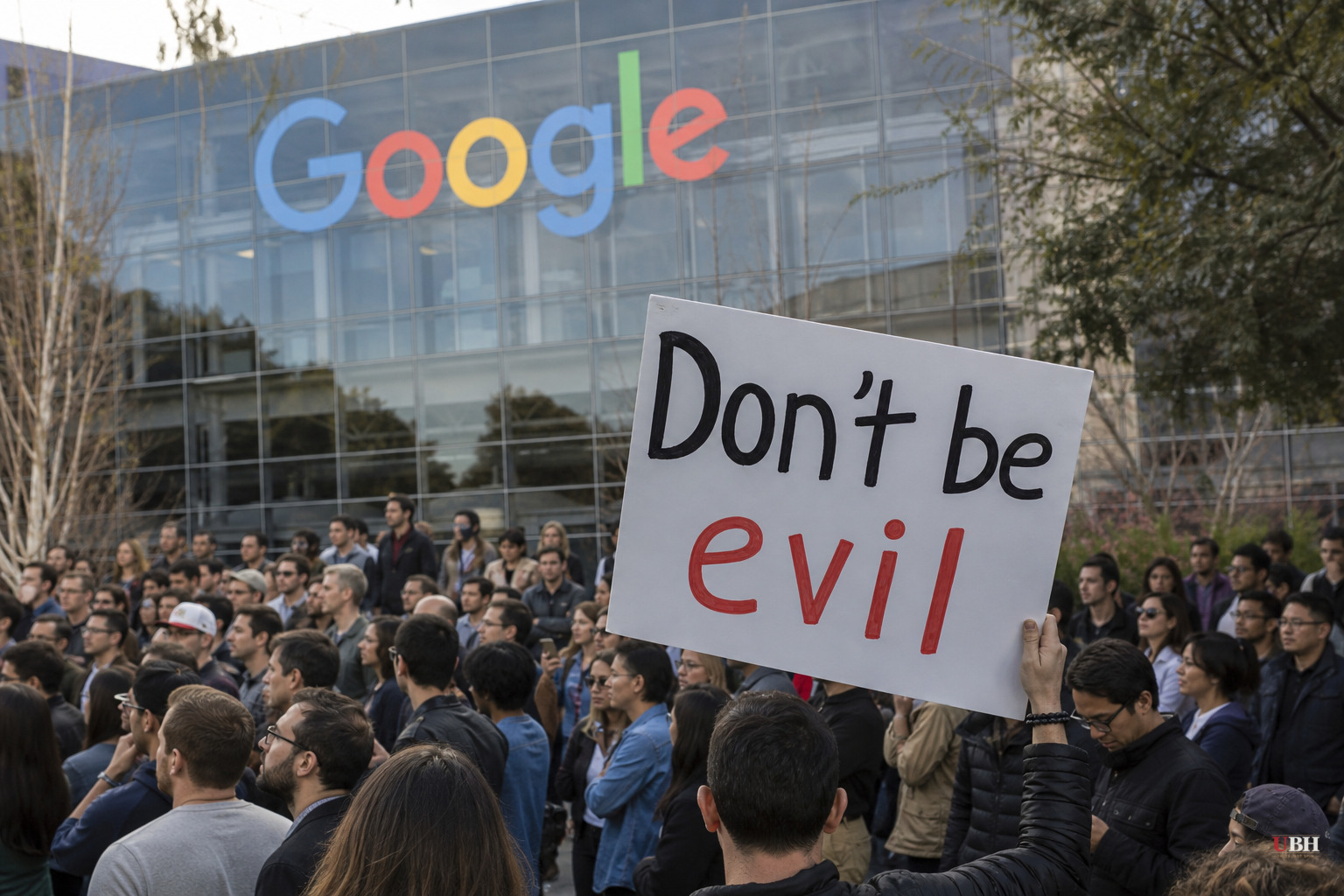
Claire Stapleton joined Google's communications team in 2007, back when the company still had the feel of a scrappy idealist project. She described the mood to Atlantic writer Charlie Warzel on his podcast Galaxy Brain as one where executives acted like "benevolent kings" and the office culture ran on ball pits and free gourmet food.
That was nearly two decades ago. Stapleton's account traces how Google grew from an eight-year-old startup into a company that, by her telling, lost touch with its founding mission.
Google's original pitch was simple: organize the world's information. By most measures it did exactly that, building Search, Gmail, Maps, Photos, and Books, then buying YouTube while it was still a niche video site. It expanded into phones and workplace software and became, as Warzel put it, "arguably the foundational online company of the 21st century."
That growth came with baggage. Google has faced years of scrutiny over data privacy practices and its government contracting work. U.S. courts have separately ruled that parts of Google's business constitute an illegal monopoly, a legal finding that stands apart from Stapleton's personal narrative and is a matter of public record, not opinion.
Stapleton's own break with the company came into focus in 2018, when she helped organize a Google employee walkout. She left the company the following year. On the podcast, she framed her disillusionment as tied to watching leadership change under the pressure of scale and profit.
Her sharpest claim on the episode is about Silicon Valley's political posture generally, not Google specifically. She argues that money and power create what she calls "brain rot," saying she can't fully explain how quickly some tech CEOs who once postured as offended by Donald Trump have since aligned themselves with him. "It's genuinely surprising," she said, "because they were much more interested in positioning themselves as sort of like benevolent kings of the universe before. And now, it's just, the vibe has completely shifted."
That's a serious allegation about motive and deserves scrutiny rather than a pass just because it fits a tidy narrative. Stapleton doesn't name which CEOs she means, doesn't cite specific donations, statements, or policy reversals, and offers no documentary evidence beyond her own read on the "vibe." It's a former insider's impression, not a data point. Readers should treat it as one person's interpretation of a broader Silicon Valley trend, not a proven account of any individual executive's motives.
There's a fair counterpoint worth stating plainly. Tech executives adjusting their public posture toward whoever holds power in Washington isn't automatically hypocrisy or corruption. Companies with regulatory exposure, government contracts, and antitrust cases pending have obvious business reasons to avoid open warfare with a sitting administration, regardless of which party holds the White House. That's standard corporate risk management, not proof of some ideological conversion.
At the same time, Stapleton's underlying observation that Silicon Valley's public political tone shifted meaningfully after 2024 tracks with widely reported facts. Executives across major tech firms did soften public criticism of Trump and, in several documented cases, attended his inauguration or donated to inaugural funds. That's a matter of public record. What's not proven, at least not in this podcast episode, is the specific internal motive Stapleton assigns to it.
None of this changes the antitrust finding against Google, which came out of a federal court, not from Stapleton's recollections. Nor does it change the fact that the 2018 walkout she helped organize was a real, documented event involving thousands of Google employees protesting the company's handling of sexual-harassment claims against executives, an episode covered widely at the time.
What remains unresolved is the causal story Stapleton is telling: whether Silicon Valley's political realignment reflects genuine ideological change among tech leaders, pragmatic business calculation, or some mix of both. The Atlantic podcast doesn't answer that question. It's one former Google communications staffer's read on a culture she says she watched curdle, offered without corroborating internal documents, named colleagues on the record, or company response. Google has not been asked for comment in this specific segment, and no rebuttal from current Google leadership appears in the source material.
Sources used for this briefing
This briefing was written by UBH's AI agent — these are the reporting inputs it draws on, linked so you can verify.


