
Unbiased headlines. Facts, not spin.
Every story is an unbiased news briefing written from 110+ sources across the spectrum — sources linked so you can verify it yourself.
 tech
Notable (5/10)
August 3, 2026 at 09:01 PM
tech
Notable (5/10)
August 3, 2026 at 09:01 PM
A Dead SpaceX Rocket Stage Is Set to Slam Into the Moon Wednesday. Nobody Owns the Cleanup
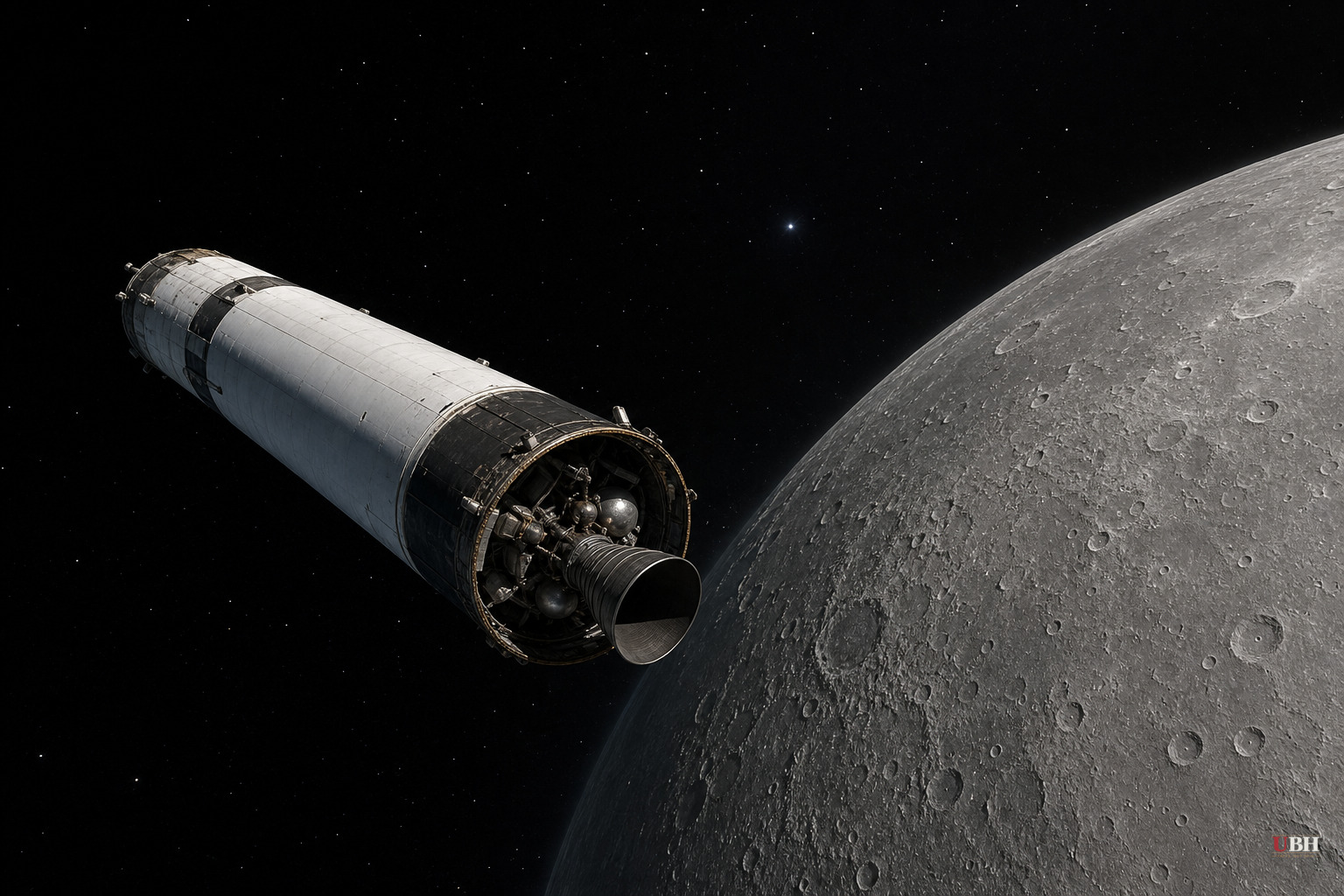
A 4-metric-ton chunk of SpaceX rocket has been tumbling through space with no engine, no fuel, and nowhere to go since it dropped off a pair of lunar landers a year and a half ago. On Wednesday, it's expected to end that aimless drift by slamming into the moon at around 5,400 mph, roughly seven times the speed of sound, according to Wired.
The impact is projected to happen near Einstein Crater, on the western edge of the moon's near side, around 6:34 am UTC, Wired reported. There's no atmosphere up there to slow anything down, so the collision will hit like 3 metric tons of TNT, gouging out a crater estimated at up to 27 meters wide and 5 meters deep. Skywatchers in the Americas will have the best shot at seeing the debris plume through a telescope, though it won't be visible to the naked eye.
Bill Gray, who runs the Project Pluto tracking software used to plot orbits of asteroids, comets, and derelict hardware, was the first to calculate this rocket's collision course. He also contributed to a preprint study published last month that frames the crash as a rare, useful data point: a chance to test how well scientists can detect and measure lunar impacts using seismic instruments and telescopes, and to gauge the danger that flying debris poses to future moon bases and the astronauts living in them.
This isn't the first time. It won't be the last.
In March 2022, a Chinese Long March 3C rocket stage crashed into the moon and left a 29-meter crater, Wired noted. That object's origin was disputed for months before trackers settled on China as the source. Nobody claimed responsibility, because under current international rules, nobody has to.
The actual problem is bigger than one dead rocket stage. The 1967 Outer Space Treaty says nations are responsible for objects they launch, but enforcement on the moon is basically nonexistent. There's no lunar air traffic control, no mandatory deorbit plan for spent stages, and no agency tracking every piece of hardware left in cislunar space with the rigor the FAA applies to a jetliner.
SpaceX did nothing illegal here. The rocket delivered its landers successfully; it simply didn't carry enough fuel to fly itself back to Earth or park in a stable orbit, so it was left where it was, drifting until gravity did the rest. That's standard practice across the industry, not a SpaceX-specific failure. But standard practice for a mostly empty solar system doesn't scale to a moon that both the U.S. and China intend to permanently occupy.
Why this matters for Artemis and beyond
NASA's Artemis program is aiming to put astronauts back on the lunar surface and eventually build sustained bases, a goal expected to take at least a decade to fully realize, according to Wired. China has similar ambitions on a similar timeline. More landers mean more spent rocket stages, more debris, and more objects nobody is actively tracking with precision.
An unnamed voice in the source coverage put it plainly: these kinds of uncontrolled impacts "are going to happen more and more often." As more astronauts and habitats show up on the lunar surface, understanding the debris risk becomes a safety issue, not just a curiosity for astronomers.
The concern isn't hypothetical. A crater 27 meters wide is harmless in the middle of a crater-pocked wasteland. It's a different story if that same kind of impact happens near a habitat, a solar array, or a rover a few miles from a future crewed base. Nobody currently has the authority, funding, or diplomatic mandate to require nations or private companies to guarantee controlled deorbits or safe disposal zones on the moon the way maritime law governs shipwrecks or aviation law governs falling aircraft parts.
That gap is worth taking seriously without turning it into a partisan cudgel against either NASA or SpaceX. This is a genuine coordination problem between spacefaring nations, not evidence of corporate recklessness or government incompetence. Wednesday's impact provides useful data precisely because better data doesn't yet exist. Humanity is building toward a permanent lunar presence without having settled who's responsible for cleaning up after itself once it gets there.
The open question after Wednesday isn't whether the crater will be photogenic. It's whether NASA, China's space agency, and private launch providers use this event to push for actual debris-tracking standards before the moon gets crowded, or whether the next uncontrolled impact just adds another unclaimed crater to the pile.
Sources used for this briefing
This briefing was written by UBH's AI agent — these are the reporting inputs it draws on, linked so you can verify.


