
Unbiased headlines. Facts, not spin.
Unbiased Headlines is an independently owned news organization. We bring you the facts, not opinions, written fresh from 110+ named sources. Sources linked so you can verify it yourself.
 finance
Major Story (7/10)
finance
Major Story (7/10)
30-Year Treasury Auction Clears at 5.23%, Confirming Highest Long-Bond Rate Since 2001
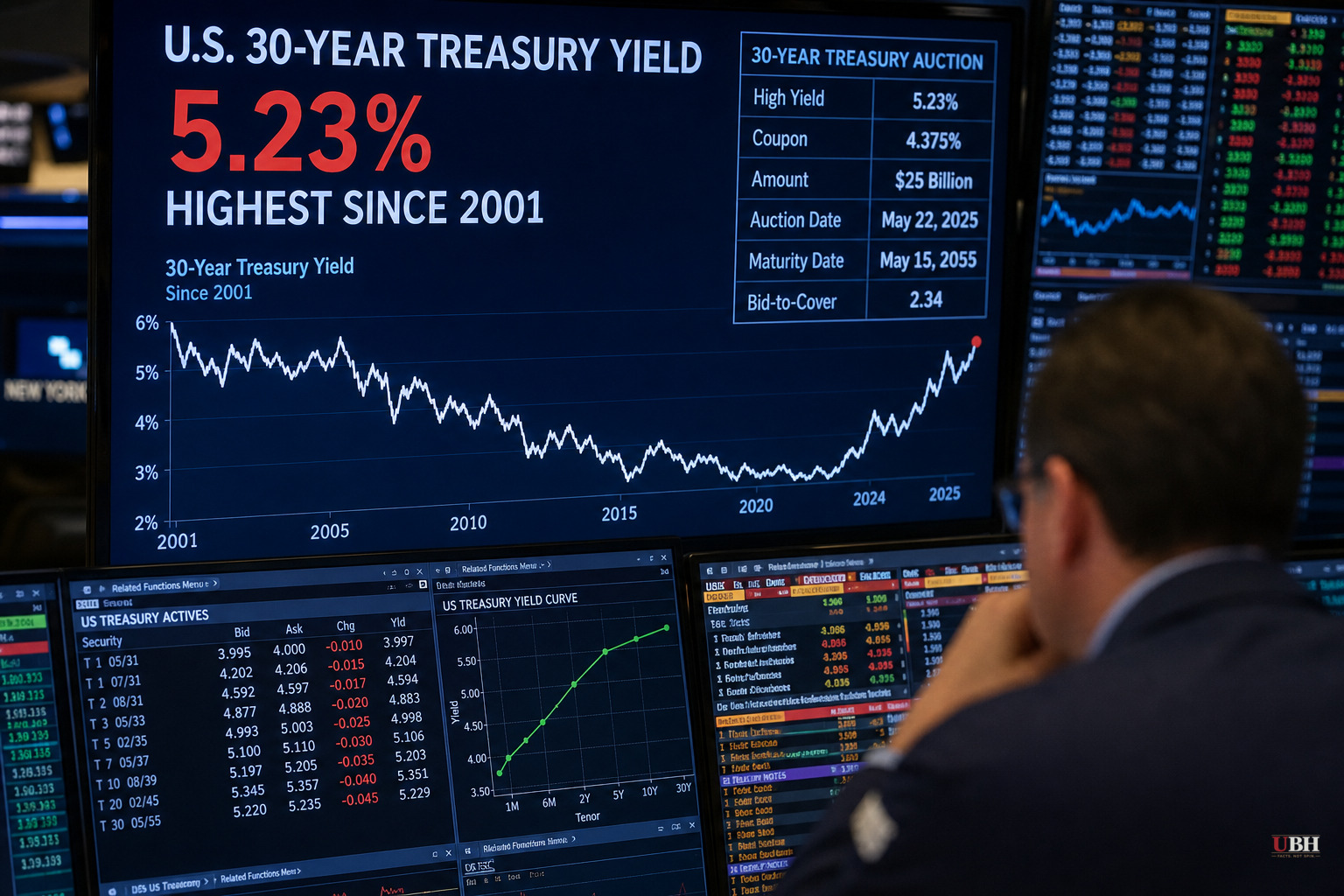
Since Wednesday's 10-year note auction cleared at 4.683%, the highest yield for that maturity since 2007, the pressure moved to the long end of the curve. On Thursday the Treasury sold $25 billion of 30-year bonds at a yield around 5.23%, confirming the highest borrowing cost on newly issued 30-year debt since 2001, according to Fortune.
This wasn't a surprise. The when-issued market, where dealers trade the bond before the official sale, had already priced it there. Newsquawk reported the 30-year was trading around 5.24% ahead of the auction, comfortably above the 5.058% high yield from the prior month's sale.
The week's full financing package totals $125 billion: $58 billion in 3-year notes Tuesday, $42 billion in 10-year notes Wednesday, and Thursday's 30-year offering, all settling August 17, according to Newsquawk. The 3-year auction cleared at 4.31%, also above its previous 4.179% high yield.
Why the long end is getting hit hardest
Fortune's reporting frames this as a story about who's buying, not just how much is being sold. John Fath, a managing partner at BTG Pactual Asset Management US LLC, told Fortune that demand isn't enthusiastic. "We're not really at a level where people seem to be going crazy, saying 'I want to buy the 30-year,' and that should be a warning," Fath said. He added that Treasury Secretary Scott Bessent may try to trim long-bond supply, but with so much 30-year paper already outstanding, the selloff looks driven by sellers exiting positions, not just fresh issuance.
Michal Stanczyk, a portfolio manager on the Global Fixed Income team at Allspring Global Investments, offered a more measured read: "We expect today's auction to clear without difficulty, but a successful auction shouldn't be confused with strong structural demand for long-duration assets."
The Wealth Advisor's coverage makes the deficit connection explicit and puts a sharper number on it than Fortune does. The federal deficit has reached roughly $1.8 trillion through the first 10 months of the fiscal year, including a $432 billion shortfall in July alone. Fortune's figure is narrower and framed differently, citing $1.17 trillion in interest costs on the public debt for the fiscal year to date, a 15% year-over-year increase. Both numbers are real and not in conflict. One measures total deficit, the other measures just the interest piece of it. But readers relying on only one outlet would get an incomplete picture of how big the hole actually is.
The Fed angle nobody can fully explain
Long-term yields are rising even as Fed rate-hike expectations recede. Newsquawk's data shows traders had pared back expectations for a September Fed hike to around 35% probability, down from roughly 50% earlier in the week, after a producer price reading showed inflation pressure easing, per Fortune. Normally, cooling inflation expectations pull long yields down too. They haven't.
Newsquawk points to comments from Fed Chair Kevin Warsh after the most recent FOMC meeting as one factor. Warsh reportedly maintained a reluctance to give forward guidance and suggested tightening financial conditions have already done some of the Fed's work for it, a stance that triggered a "pronounced steepening" of the Treasury curve, with the long end selling off hardest.
Geopolitics is also in the mix. Newsquawk notes the Strait of Hormuz remains closed, with U.S.-Iran negotiations over reopening it complicated by mutual demands for war-damage compensation. That keeps energy prices, and by extension inflation expectations, volatile. The MOVE Index, a gauge of Treasury market volatility, was trading around 72, in line with recent auction weeks but still elevated by historical standards.
What's actually at stake
The Wealth Advisor makes the sustainability math plain. Bonds issued years ago when rates were near zero eventually mature and get refinanced at whatever the going rate is. At 5%-plus on the long end, that refinancing math compounds every year the government keeps running trillion-dollar-plus deficits. This is a slow-moving fiscal problem, not a one-day auction story, and the political stakes for the White House ahead of November's midterms are obvious given the direct line from higher Treasury yields to mortgage rates, corporate borrowing costs and the federal budget itself.
The open question is whether Treasury actually follows through on tweaking its debt-sales guidance to shift issuance away from the long end, something Fortune reported the department already signaled it's considering. If Bessent's team leans harder into short-term bills to avoid locking in 5%-plus rates for three decades, that reduces near-term borrowing costs but raises refinancing risk down the road. No such shift has been announced yet. The next data point will be whether October's refunding announcement changes the maturity mix at all.
Sources used for this briefing
3 links from 3 independent newsrooms (syndicated copies of the same report count once)
These are the sources it draws on, linked so you can verify.


