
Original briefings. Zero spin.
Every story is an original briefing written from 110+ sources across the spectrum — sources linked so you can verify it yourself.
 tech
Notable (5/10)
August 23, 2026 at 03:48 AM
tech
Notable (5/10)
August 23, 2026 at 03:48 AM
27-Billion-Parameter Startup Model Beats Claude and GPT-5.5 at Replicating Science, Inherent Says
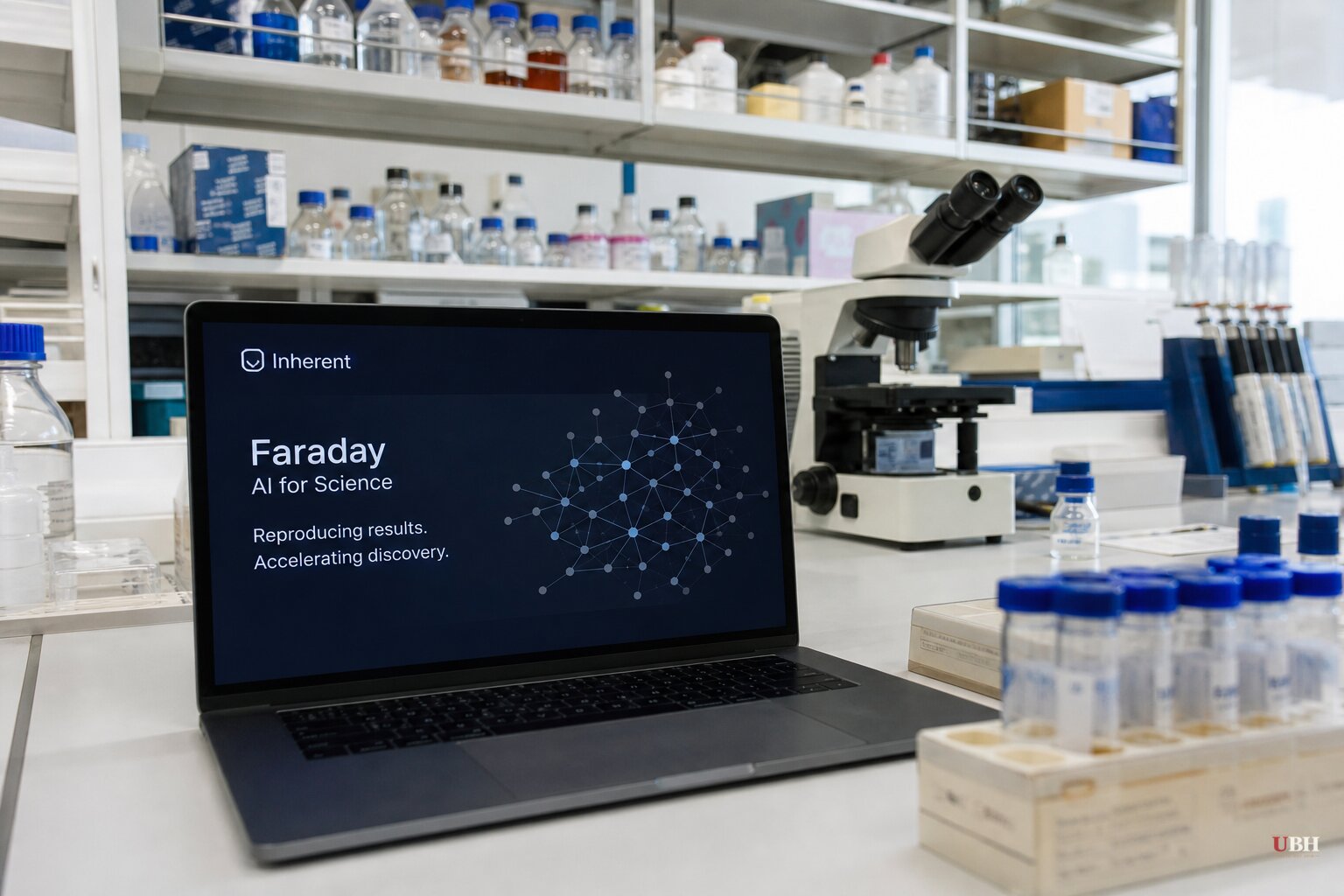
A 12-person startup in London says it built an AI that outperforms Anthropic and OpenAI at a specific scientific task, using a fraction of the computing muscle.
Inherent, founded by alumni of Google DeepMind, emerged from stealth weeks ago with a $50 million seed round, according to TechCrunch. On August 14, 2026, the company published a paper introducing Faraday, an AI agent built on a 27-billion-parameter model called Qwen 3.6. Inherent says Faraday beat Anthropic's Claude Opus 4.8 and OpenAI's GPT-5.5, both far larger frontier systems, at independently replicating figures from published research papers.
The task itself matters. Inherent built a benchmark called Replica, made up of 310 tasks drawn from 100 machine learning and AI-for-science papers, spanning fields from materials science to weather forecasting, according to Inherent's own published research. The agents get a time and compute budget, no access to the original plot, and have to reproduce a result cold. Inherent's paper says Faraday produced more faithful replications than Claude and GPT-5.5 across every category tested, with the biggest gaps showing up in meta-learning, structural biology, and materials science.
Why size didn't win
Parameter count is a rough proxy for a model's scale and training cost. Faraday's 27 billion parameters are a sliver of what frontier models like Claude Opus 4.8 or GPT-5.5 are believed to run on. Inherent cofounder and chief scientist Edward Hughes told TechCrunch that beating the bigger models wasn't really the point. "What was most interesting to us about this was not so much the result of beating those frontier agents, which of course we liked, but was actually the way we went about building this," Hughes said.
That "way" is reinforcement learning: rewarding the model for good outcomes instead of hand-feeding it rules. Hughes says the goal is to teach something Inherent calls "research taste," an instinct for which experiments are worth running and how to design them well, rather than just pattern-matching to known answers.
Hughes drew a comparison to how human scientists train. "Many PhD students actually start by doing this," he told TechCrunch, referring to replication work. Inherent's own paper makes a similar point: research papers show what worked, not the dead ends and failed attempts that got the authors there. Recovering that missing "99% perspiration," in the company's words, requires the kind of hypothesis-driven exploration that looks a lot like real research.
Inherent also chose not to build its own coding tools. Faraday runs GPT-5.5 Codex, OpenAI's own coding product, to execute experiments. Reporting from Bitcoin World and Hyper.ai both frame this as a deliberate efficiency play, mirroring how human scientists lean on existing software rather than reinventing it. Inherent is beating OpenAI's flagship reasoning model on this benchmark while simultaneously relying on another OpenAI product to get the job done.
What hasn't been independently checked
Every account of these results, including TechCrunch's, traces back to Inherent's own paper and Hughes's own statements. No outside lab has published an independent replication of Inherent's benchmark results, and Anthropic and OpenAI have not issued public responses to the claim as of this writing. Benchmark design is also a choice made by the company doing the claiming. Replica is Inherent's own test, built around a task the company is specifically optimizing for, which is a reasonable thing for skeptics to flag even if the methodology looks rigorous on paper.
Coverage from KuCoin and other crypto-adjacent outlets picked up the story mainly to speculate about applications in "data-driven blockchain applications." That framing doesn't appear anywhere in Inherent's own paper or in Hughes's comments to TechCrunch.
The London angle
Inherent operates out of King's Cross, works in-person with a team of about a dozen, and plans to grow to 20-25 people by the end of 2026, according to Bitcoin World and Hyper.ai. Hughes has also publicly criticized the UK's "garden leave" practice, which can bar departing employees from joining a competitor for months. He told outlets it delayed his own ability to start Inherent and puts British startups at a disadvantage against U.S. rivals when recruiting.
That complaint lands at an interesting moment. Leadership changes under Demis Hassabis at Google DeepMind have reportedly left some staff there uneasy, according to Bitcoin World, which could make a scrappy 12-person outfit down the road a more attractive landing spot for researchers looking to leave.
None of that settles whether Faraday is actually a better scientist than Claude or GPT-5.5, or just better at this one narrow replication test. Inherent's bigger bet is an AI that discovers new science rather than just reproducing old results, and it remains unproven. The company says that's the actual goal. Whether a 27-billion-parameter model trained on reinforcement learning gets there before OpenAI or Anthropic throw more compute at the problem is the question nobody, including Inherent, can answer yet.
Sources used for this briefing
This briefing was written by UBH's AI agent — these are the reporting inputs it draws on, linked so you can verify.


