
Unbiased headlines. Facts, not spin.
Unbiased Headlines is an independently owned news organization. We bring you the facts, not opinions, written fresh from 110+ named sources. Sources linked so you can verify it yourself.
 economy
Breaking / Critical (9/10)
economy
Breaking / Critical (9/10)
10-Year Yield Hits 5.304% After 3.7% CPI as Fed Rate-Hike Odds for October Jump
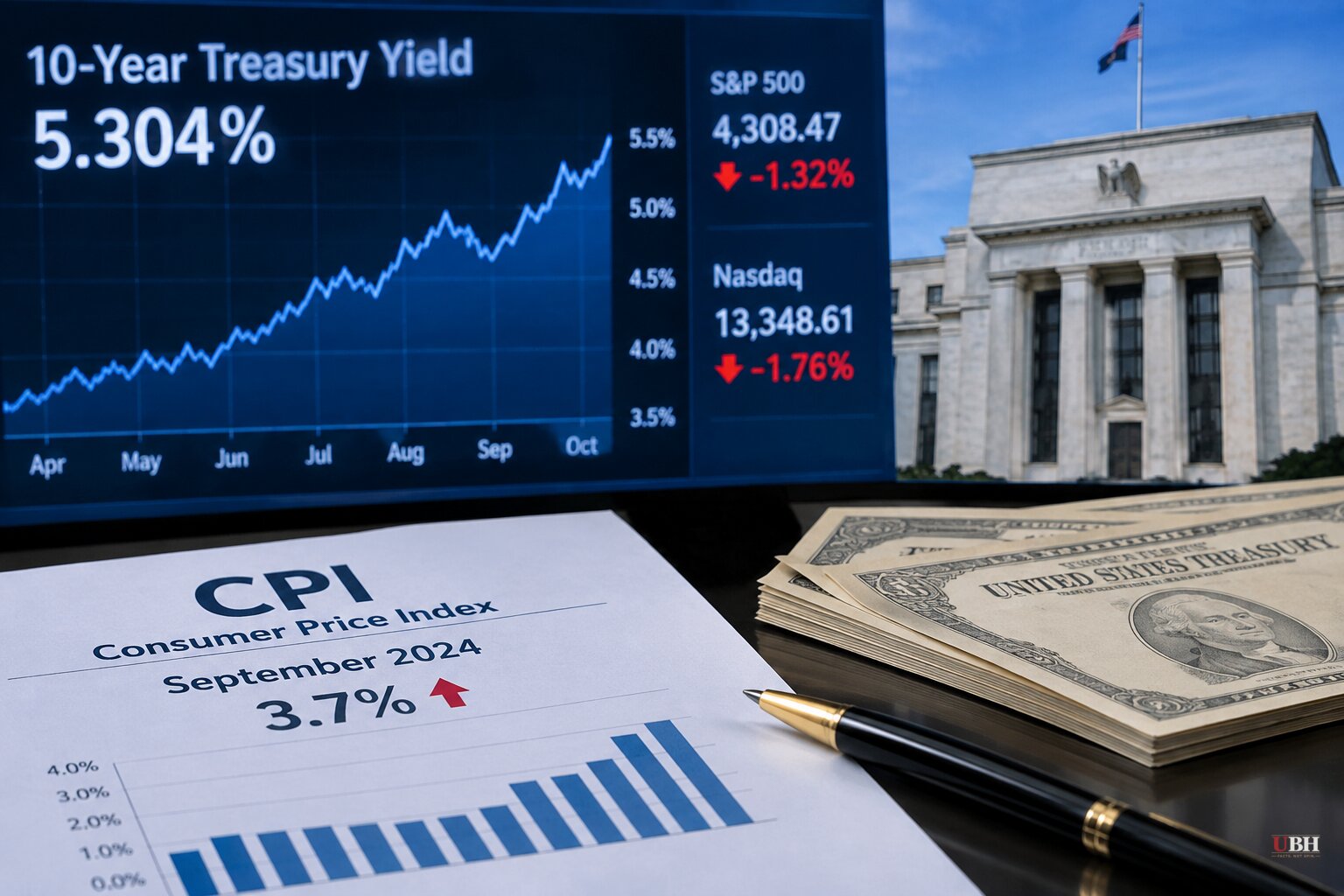
Since the Federal Reserve raised rates in September for the first time since 2023, inflation has kept climbing. The Bureau of Labor Statistics reported Wednesday, Oct. 14, that the Consumer Price Index rose 3.7% over the 12 months through September, up from 3.4% in August and above the 3.6% economists expected. Wall Street's answer came within minutes.
Bonds and stocks react
Treasury yields jumped as traders bet the Fed would move sooner than planned. The two-year yield, the most sensitive to rate expectations, rose 13 basis points to 4.92%. The benchmark 10-year climbed 9 basis points to 5.304%. The 30-year added 5 basis points to 5.61%.
Both the 10-year and 30-year had touched 24-year highs of 5.365% and 5.733% before pulling back after well-received government bond auctions, according to Quartz's market recap.
Stocks opened lower. The Nasdaq started the session down 0.6% and the S&P 500 off 0.4%. The dollar index rose 0.55% to 102.75, an 18-month high. Gold fell 1.6% to $4,088 an ounce.
October moves onto the table
Before the report, markets largely expected the Fed to wait until December for its next hike, First American senior economist Sam Williamson said. That assumption is now shaky. The Fed's policy rate sits at 3.75% to 4%, and its next decision is about two weeks away.
Olu Sonola, head of U.S. economics at Fitch Ratings, said the report is "flashing red for the Fed." In her words: "Energy pushed the headline number higher, as expected, but the real problem is that core inflation remains stuck above 3%." She said a hike at the end of the month is "now firmly on the table, but December remains the more likely move."
The 3% figure she cites matches the Fed's preferred gauge. Core PCE inflation was 3.0% in August. Core CPI is running lower at 2.6%, which Reuters notes reflects different basket weights.
Core is the problem
The case that this is only a gas-pump story gets harder with the core numbers. Core CPI, which strips out food and energy, rose 0.3% in September against a 0.2% forecast. The annual core rate hit 2.6%, above the 2.5% consensus and up from 2.4% in August.
James McCann, senior economist at Edward Jones, flagged that core is up 3.4% annualized over the past three months. He pointed to "broad based price increase for autos, air fares, education and recreation." The BLS data show airline fares up 1.2% on the month, used cars and trucks up 0.7%, recreation up 0.5% and education up 0.6%. Shelter rose 0.4%.
Gasoline still did the heavy lifting on the headline. The BLS gasoline index rose 9.1% in September and accounted for more than half of the monthly increase. Energy is up 20.4% over 12 months, with gasoline up 34.2%. Food was flat on the month and is up 2.5% on the year.
The skeptics
Not everyone thinks this changes the Fed's path much. Robert Pavlik, senior portfolio manager at Dakota Wealth in Fairfield, Connecticut, said the market "was preparing for it already." He added: "Nobody really believes that the Federal Reserve is in an interest-rate hiking cycle. They think this is just a few rate hikes, and we're over and done with."
McCann also said the Fed "won't panic in the face of these numbers."
The Fed's own projections cut against a quick finish. FOMC members said earlier this month that inflation may not return to 2% until 2029, and their median projection put it at 3.7% in the fourth quarter. September's reading already sits at that level.
What the housing and bond markets face
Williamson said a faster Fed would keep mortgage rates elevated and could worsen the lock-in effect that is holding down housing inventory. A 10-year yield above 5.3% is the benchmark that mortgage pricing follows.
Deutsche Bank analysts noted the timing problem for policymakers. The Fed meets before it sees the PCE readings it officially targets, which arrive the day after the next decision. "Any surprises either way will help shape the narrative going into the next Fed meeting," the bank's analysts said.
That leaves the Fed deciding on CPI data alone. The next CPI report, covering October, is scheduled for Tuesday, Nov. 10.
Sources used for this briefing
8 links from 7 independent newsrooms (syndicated copies of the same report count once)
These are the sources it draws on, linked so you can verify.


