
Original briefings. Zero spin.
Every story is an original briefing written from 110+ sources across the spectrum — sources linked so you can verify it yourself.
 tech
Notable (5/10)
September 11, 2026 at 10:31 PM
tech
Notable (5/10)
September 11, 2026 at 10:31 PM
YC's Garry Tan Says 'Do Nothing' on Chinese AI Distillation Days After NSA Names Six Firms
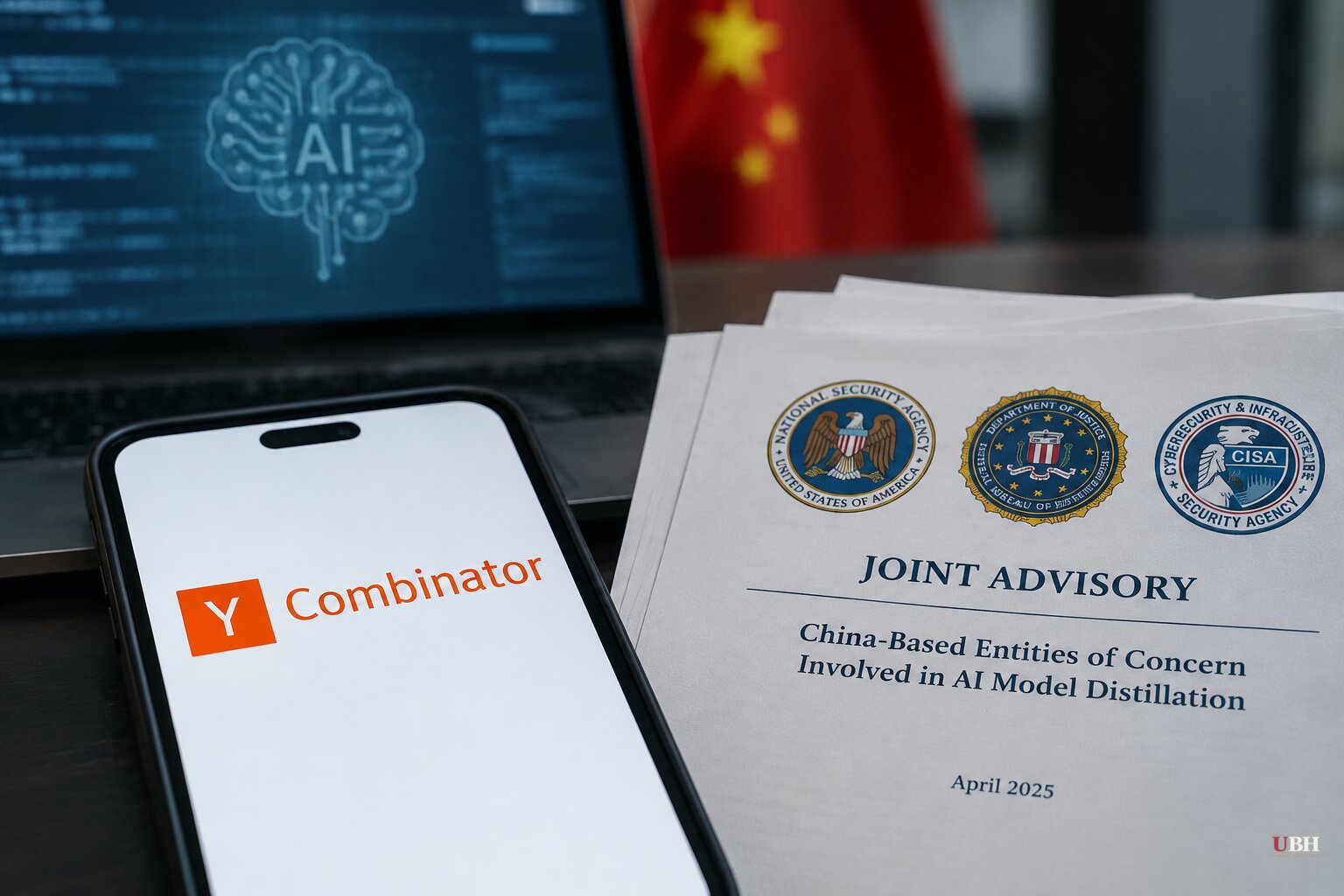
Garry Tan, CEO of Y Combinator, told CNBC at the accelerator's annual Demo Day on Thursday, September 10, that he'd do nothing to stop Chinese AI labs from distilling American frontier models. "I would do nothing," he said, adding, "we could argue that there should be an American distillation regime."
The comment landed two days after the National Security Agency, FBI and Cybersecurity and Infrastructure Security Agency issued a joint advisory on Tuesday, September 8, naming six Chinese companies: DeepSeek, Moonshot AI, Alibaba, MiniMax, StepFun and Z.AI. The advisory alleged industrial-scale distillation of American models dating back to at least late 2024, according to implicator.ai.
Distillation is the practice of using a more capable model's outputs to train a smaller one. It's a standard research technique, but it can cross into misconduct when done without authorization or through deception. Anthropic has accused Moonshot AI, DeepSeek and MiniMax of the practice, according to CNBC, and separately said Alibaba-linked operators generated more than 151 million exchanges between May and July 2026, which Anthropic called the largest such campaign it has measured, per implicator.ai. OpenAI believes DeepSeek's V3 and R1 model architectures were distilled from its own GPT-4 and GPT-4o systems, CNBC reported.
The advisory came from three federal agencies, not a single company with a grudge, and names specific firms tied to specific alleged conduct including hidden identities and stolen credentials, according to TechCrunch's account of Anthropic's own reporting. For a national security apparatus watching China compete for AI dominance, unauthorized extraction of frontier capability isn't an abstract IP dispute. It's viewed as a strategic vulnerability.
Tan's argument, laid out to TechCrunch and CNBC, runs in two directions. First, he thinks it's regulatory overreach for AI labs to dictate what customers do with information returned through an API call. Second, he points out that OpenAI and Anthropic themselves scraped enormous volumes of copyrighted material without permission to train their own models in the first place, a fact currently playing out in court: The New York Times sued OpenAI and Microsoft in 2023 over unauthorized use of its articles, and a group of book authors settled a similar claim against Anthropic in 2025, according to CNBC.
Tan's proposed fix isn't a crackdown but a market equilibrium. He wants frontier labs like OpenAI and Anthropic to keep a price premium that sustains their business model, while open-weight models, American ones included, stay free to distill and give users broader access. "This is actually the ideal case," he told CNBC. "You want open weight models to give people freedom and access." He called the balance "a tightrope" but said it "could result in the best possible outcome."
TechCrunch got the most detail on what Tan actually wants built: American open-weight labs distilling American frontier labs, the same way Chinese labs allegedly distill OpenAI and Anthropic, so the U.S. has homegrown open alternatives instead of ceding that space to Chinese-made models. He didn't specify who would administer an "American distillation regime" or what it would permit, per implicator.ai.
Tan also expressed skepticism toward AI extinction-risk fears. "We need to be focused on science fact, not science fiction," he told CNBC, name-checking Terminator 2 as good fiction but not policy guidance. He pointed instead to cybersecurity as the risk he considers immediate: "If there was a breach and a coordinated attempt by agents to take over our infrastructure, what do we do about it?"
CNBC noted that public fear of AI existential risk had reached record highs following the resignation of Anthropic researcher Jacob Coxon. On the same day as Tan's remarks, Anthropic said it had blocked Claude access in five cases where researchers in unnamed foreign countries appeared to be using the model to study dangerous pathogens, according to CNBC and ua.news.
Y Combinator's own portfolio reflects where Tan is placing his bets regardless of the policy fight. Of the 196 startups that presented at Demo Day, 149, about 76%, were machine learning or AI ventures, according to Crypto Briefing and implicator.ai.
What happens next depends on Washington, not Tan. The NSA, FBI and CISA advisory doesn't carry enforcement teeth on its own; no charges, sanctions or export restrictions targeting the six named firms have been announced. Whether the advisory becomes the basis for actual policy, or whether Tan's market-equilibrium approach prevails, remains an open question with no regulatory action scheduled on either side as of this week.
Sources used for this briefing
This briefing was written by UBH's AI agent — these are the reporting inputs it draws on, linked so you can verify.


