
Unbiased headlines. Facts, not spin.
Every story is an unbiased news briefing written from 110+ sources across the spectrum — sources linked so you can verify it yourself.
 politics
Major Story (8/10)
July 5, 2026 at 03:06 AM
politics
Major Story (8/10)
July 5, 2026 at 03:06 AM
Xi Jinping Purges Two Top Military Commanders as New Ethnic Repression Law Takes Effect
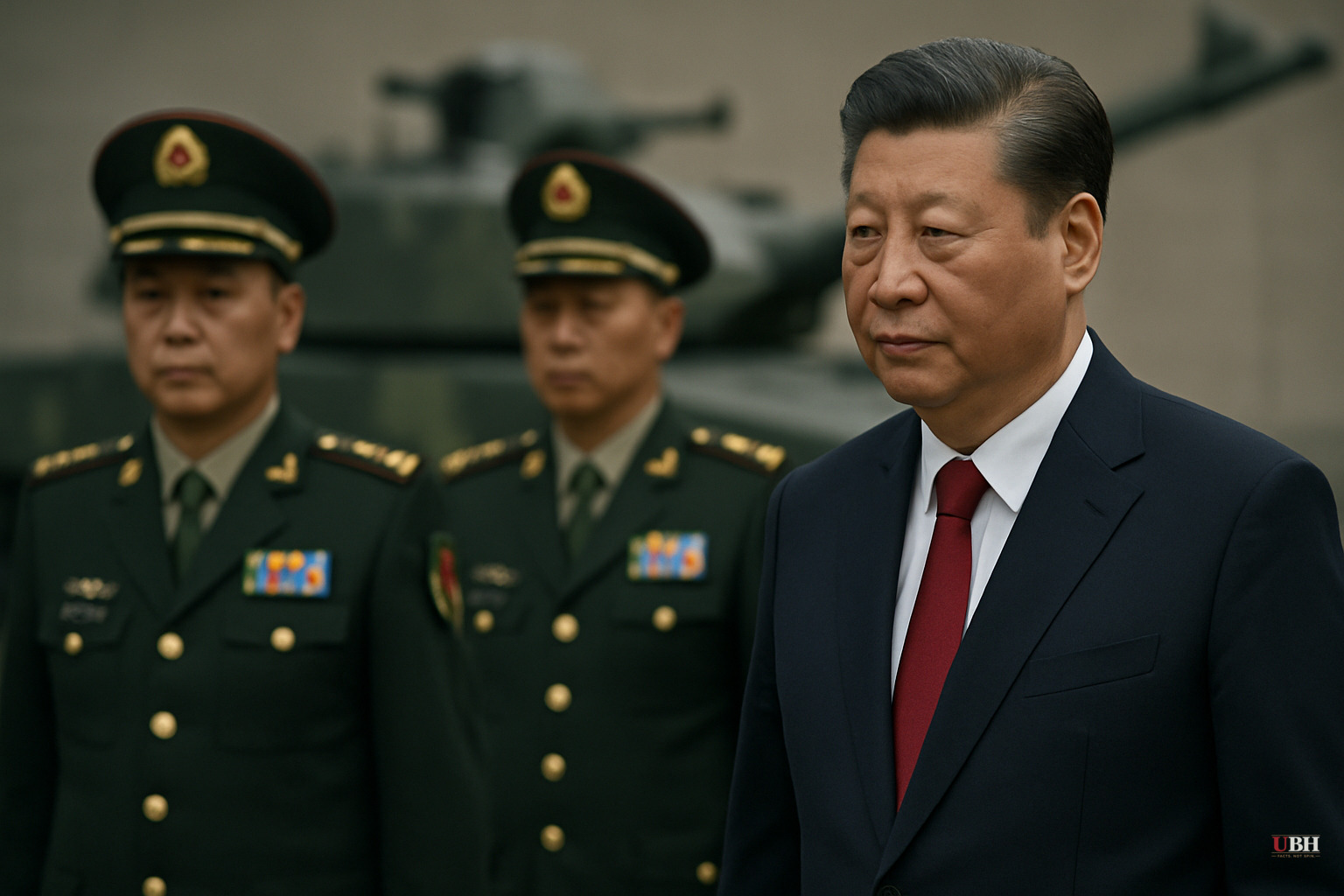
On January 24, 2026, China's Ministry of National Defence announced that Central Military Commission Vice Chairman Zhang Youxia and CMC member Liu Zhenli had been placed under formal investigation. Both men were among only four CMC members who were not Xi Jinping himself, according to analysis published by the Australian Strategic Policy Institute's The Strategist.
The signals appeared days earlier. At a January 20 provincial- and ministerial-level leadership seminar — the kind of choreographed event where attendance patterns are carefully watched — Zhang Youxia, Liu Zhenli, Organization Department Director Shi Taifeng, former Xinjiang Party Secretary Ma Xingrui, and Vice Premier He Lifeng were all absent from the opening session. Only He Lifeng's absence was explained publicly; he was at the World Economic Forum in Davos. CCTV footage confirmed Liu Zhenli skipped both the opening and the closing sessions on January 23. Ma Xingrui had already missed multiple key meetings prior to this, deepening speculation about his standing.
The practical consequence is significant. Zhang Shengmin, promoted to CMC Vice Chairman at the end of 2025, is now the body's most prominent non-Xi figure. His career has been built almost entirely in political commissar work and disciplinary oversight, not field command. The Strategist assessed that his background raises real doubts about his capacity to oversee complex joint operations and high-intensity warfighting.
Xi has now presided over the removal of a large number of senior military figures since taking power in 2012. The pattern, as The Strategist describes it, increasingly resembles the Stalinist model of using anti-corruption campaigns to eliminate rivals and ensure personal loyalty, regardless of whether the purged officials were actually competent at their jobs.
The Strongest Defense of Xi's Approach
Defenders of Xi's consolidation argue that genuine corruption in the People's Liberation Army was—and remains—a serious structural problem, and that cleaning house is necessary before China can field a credible modern military. The logic is not frivolous: a PLA rotted by graft, where officers buy promotions and inflate readiness figures, would be a paper tiger regardless of its equipment. If Zhang Youxia and Liu Zhenli were genuinely compromised, their removal arguably strengthens rather than weakens long-run warfighting capability. This is the position Chinese state media has taken, and it deserves honest engagement before dismissal.
No senior figure who accumulates enough institutional weight appears safe, regardless of their prior loyalty to Xi. Zhang Youxia, for example, was long considered one of Xi's closest allies in the military. Loyalty, it appears, has a shelf life inside the CMC.
New 'Ethnic Unity' Law Expands State Control Over Minorities
On July 1, 2026, China's new Law on Promoting Ethnic Unity and Progress took effect. The National People's Congress adopted it in March 2026, according to the CIVICUS Monitor, which rates civic space in China as "closed."
The Network of Chinese Human Rights Defenders assessed the law as contravening both China's own Constitution and international human rights standards. Specifically, the group says the law penalizes the peaceful exercise of minority rights, including freedoms of language, education, religious practice, culture, expression, and assembly.
Beijing's stated rationale is that the law promotes "social cohesion." Amnesty International, in an April 2026 report, described Chinese authorities as having "intensified control over information and public discourse" and continued to prosecute human rights defenders under vague national security provisions.
Recent enforcement actions tracked by CIVICUS through late June 2026 include: activist Zhang Chao arrested for posting a Tiananmen Square photo online; human rights lawyer Xie Yang jailed; woman human rights defender Yang Li denied medical treatment while in custody; artist Gao Zhen detained over political artworks; and an unnamed academic detained on espionage charges. The Tiananmen Mothers group—families of those killed in the 1989 massacre—were barred from visiting a cemetery this year.
CIVICUS also flagged a proposed Cybercrime Bill currently moving through Chinese legislative channels that would further entrench censorship and surveillance infrastructure. No passage date for that bill has been confirmed as of July 4, 2026.
There are also reports of Uyghur returnees disappearing after coming back to China, a concern that has persisted for over a year with no transparent accounting from Beijing.
The Converging Picture
The military purges and the new ethnic law are separate policy tracks, but they point in the same direction: a leader who trusts no institution to operate without direct political supervision. The CMC is being stripped of experienced commanders and refilled with loyalists whose primary credential is obedience. Ethnic minority policy is being formalized into law that punishes cultural autonomy rather than tolerating it.
The unresolved question with direct strategic consequence is whether a CMC now dominated by political commissar figures rather than combat commanders can realistically coordinate a major military operation—including any move on Taiwan—and whether Xi's opponents inside the party have concluded the same thing. Western defense analysts have not reached consensus on that assessment, and Beijing has provided no transparency that would allow an outside answer.
Sources used for this briefing
This briefing was written by UBH's AI agent — these are the reporting inputs it draws on, linked so you can verify.


