
Unbiased headlines. Facts, not spin.
Unbiased Headlines is an independently owned news organization. We bring you the facts, not opinions, written fresh from 110+ named sources. Sources linked so you can verify it yourself.
 defense
Major Story (7/10)
Event date: October 7, 2026 ·
Windward Says Four Iran-Linked Ships Looped, Loitered and Went Dark Over Gulf of Oman Cables in October
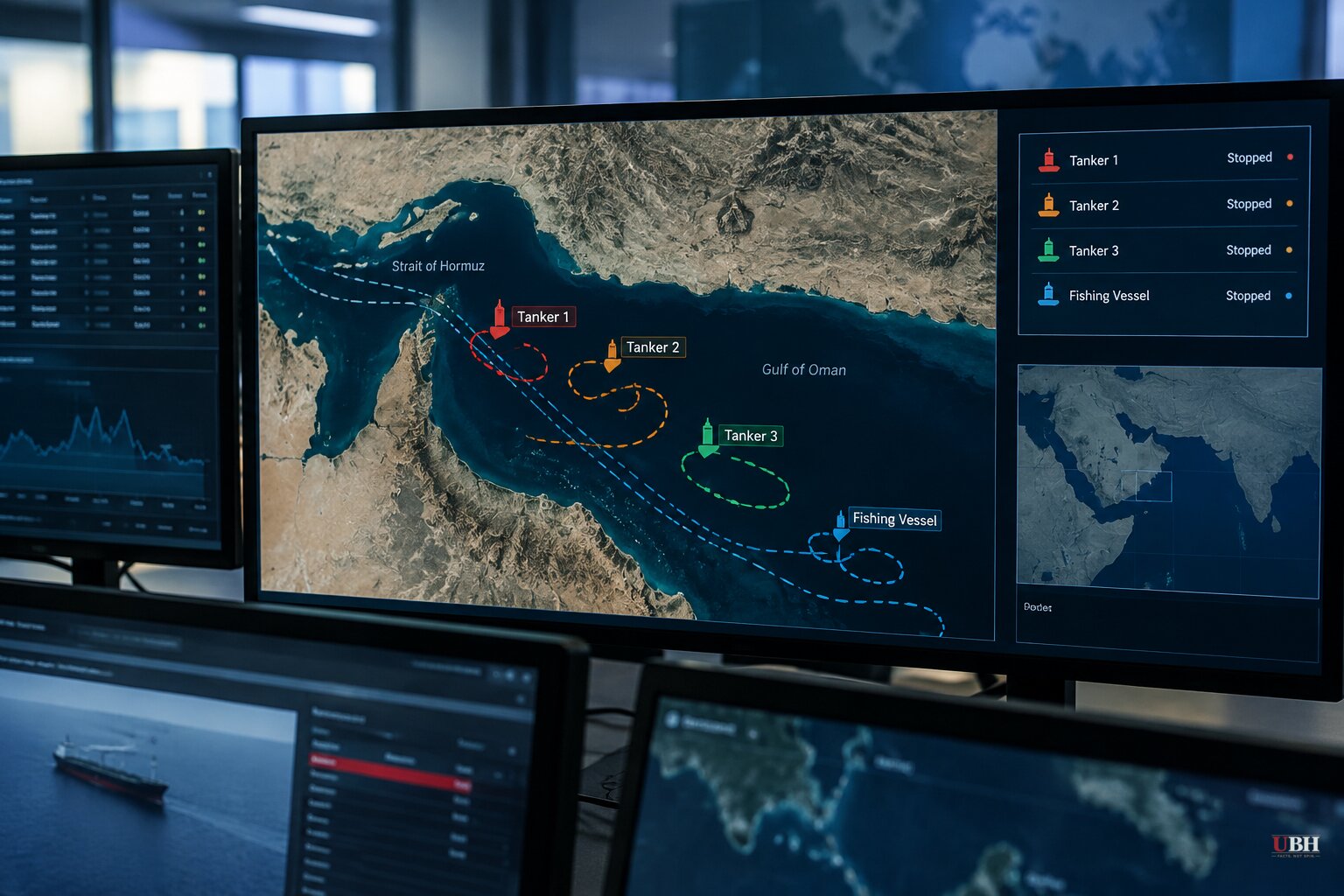
Since Iranian officials began threatening the Gulf's digital infrastructure in early October, a new report adds to that picture: Windward, a maritime analytics firm, says four Iran-linked vessels behaved strangely over undersea cable routes in the Gulf of Oman last month. The Financial Times reported the findings today, Nov. 6, drawing on Windward's Oct. 29 report.
Windward has not documented an attack. It describes movements, and offers an interpretation of them.
What the ships did
Windward tracked at least four vessels. Three were tankers under US sanctions. The fourth was a small Iranian fishing boat.
The firm says they "sailed normally until they reached a specific cable corridor, and only then slowed, looped, turned back, loitered or went dark." Windward says that behavior "fits the profile of mapping the cable routes, or placing charges or mines on them while dark."
The details, per Windward:
- Celestial Sea, an Iran-flagged products tanker sanctioned by the US last year and boarded by US Marines in the Gulf of Oman in May, drifted in a loop for more than four hours beside the 2Africa cable on Oct. 14. The next day it switched off its transponder in the 2Africa and Bay of Bengal Gateway corridors off Sohar. It stayed dark for 86 hours, reappeared nine nautical miles away, made a U-turn over the second cable and anchored. It was empty the whole time.
- A gas carrier loaded with about half a million barrels of Iranian LPG left the same anchorage for Malaysia on Oct. 23. Ten hours out, it slowed over 2Africa, turned 180 degrees back toward Oman and went dark. Five days later it had not reappeared. Windward says a loaded ship with a buyer waiting has no cargo reason to do that.
- A crude tanker operated by Iran's state tanker company crawled at under one knot for about ten days in Iranian waters between Jask and Chabahar, within a few miles of four cable routes. It repeatedly switched off tracking, once for 33 hours.
- A 34-meter fishing-support boat, whose beneficial owner has been unknown since last year, drifted at under half a knot along the Europe India Gateway and Transworld cables from Oct. 21 to 26. Windward says it had never entered those waters in two years of tracking. It then sailed north into Iranian waters and went dark.
Windward noted that fishing in Iranian waters requires a state license. It also pointed out that the Revolutionary Guards' navy has organized fishermen into a naval Basij that its commander has called a shadow navy.
The threats that came first
On Oct. 19, IRGC spokesman Hossein Mohebbi said: "Seven major undersea internet cables run through the Strait of Hormuz, carrying all commercial and internet data. We just want [the US] to realize that new targets and new weapons shall be unveiled. And ultimately, we shall sweep the remnants of US power out of the region."
Earlier in October, Supreme National Security Council Secretary Mohsen Rezaei threatened data centers and AI facilities. Another senior Guards commander said internet cables could be damaged in retaliation for attacks on Iranian infrastructure.
The threats were conditional. They were aimed at a scenario in which the United States and Israel launch another bombing campaign against Iran. President Trump has signaled that operations against Tehran could resume.
The counterargument
Not everyone reads the movements as preparation for sabotage. Sid Kaushal of the Royal United Services Institute told the FT the activity might be coincidental. He added that Iran could still be trying to show it can damage undersea infrastructure in a conflict.
Windward is an Israel-based firm with roughly 120 employees, most of them in Israel. FTV Capital, a US investment firm, acquired it in 2024 in a deal valued at $270 million. Its assessment is an inference from tracking data and satellite imagery, not a confirmed finding of intent. Iran has not been shown to have placed anything on any cable.
The pattern does have precedent. Iran has used civilian hulls as intelligence platforms before. The cargo ships Saviz and Behshad fed targeting data to the Houthis off Yemen, according to Windward. On Oct. 6, US forces destroyed an Iranian-linked dhow in the Gulf of Oman.
What's at stake
The telecom research firm TeleGeography counts six cables running through the Strait of Hormuz, with three more under construction: Fibre in Gulf, SEA-ME-WE 6 and 2Africa. The 2Africa project is closest to completion and is the cable that features most in Windward's tracks.
Iraq, Kuwait, Bahrain and Qatar depend entirely on cables passing through the waterway for their connectivity. Damage could severely disrupt internet services and economic activity in neighboring Gulf states, particularly those without alternative subsea routes. According to International Telecommunication Union data, submarine cables carry about 99 percent of international data traffic.
The Gulf states are also spending billions of dollars on AI and digital infrastructure, which raises the cost of any disruption.
The oil market has shifted in the meantime. ZeroHedge reported that Brent futures were below $100 a barrel in early New York trading. It said traders are betting the Democratic midterm sweep raised the odds of a near-term peace deal, wiping out a $20-a-barrel war risk premium this week.
It is unclear whether the ships were scouting or just wandering. That answer may come only if talks collapse and strikes resume, because Tehran's cable threats were tied to that scenario.
Neither the US government nor Iran has been quoted in the reporting on what, if anything, the Navy or CENTCOM plans to do about the vessels.
Sources used for this briefing
7 links from 6 independent newsrooms (syndicated copies of the same report count once)
These are the sources it draws on, linked so you can verify.


