
Unbiased headlines. Facts, not spin.
Unbiased Headlines is an independently owned news organization. We bring you the facts, not opinions, written fresh from 110+ named sources. Sources linked so you can verify it yourself.
 politics
Major Story (7/10)
politics
Major Story (7/10)
White Powder Letters Hit Election Offices in Louisiana and Oklahoma; Ohio Mailing Intercepted, FBI Investigating
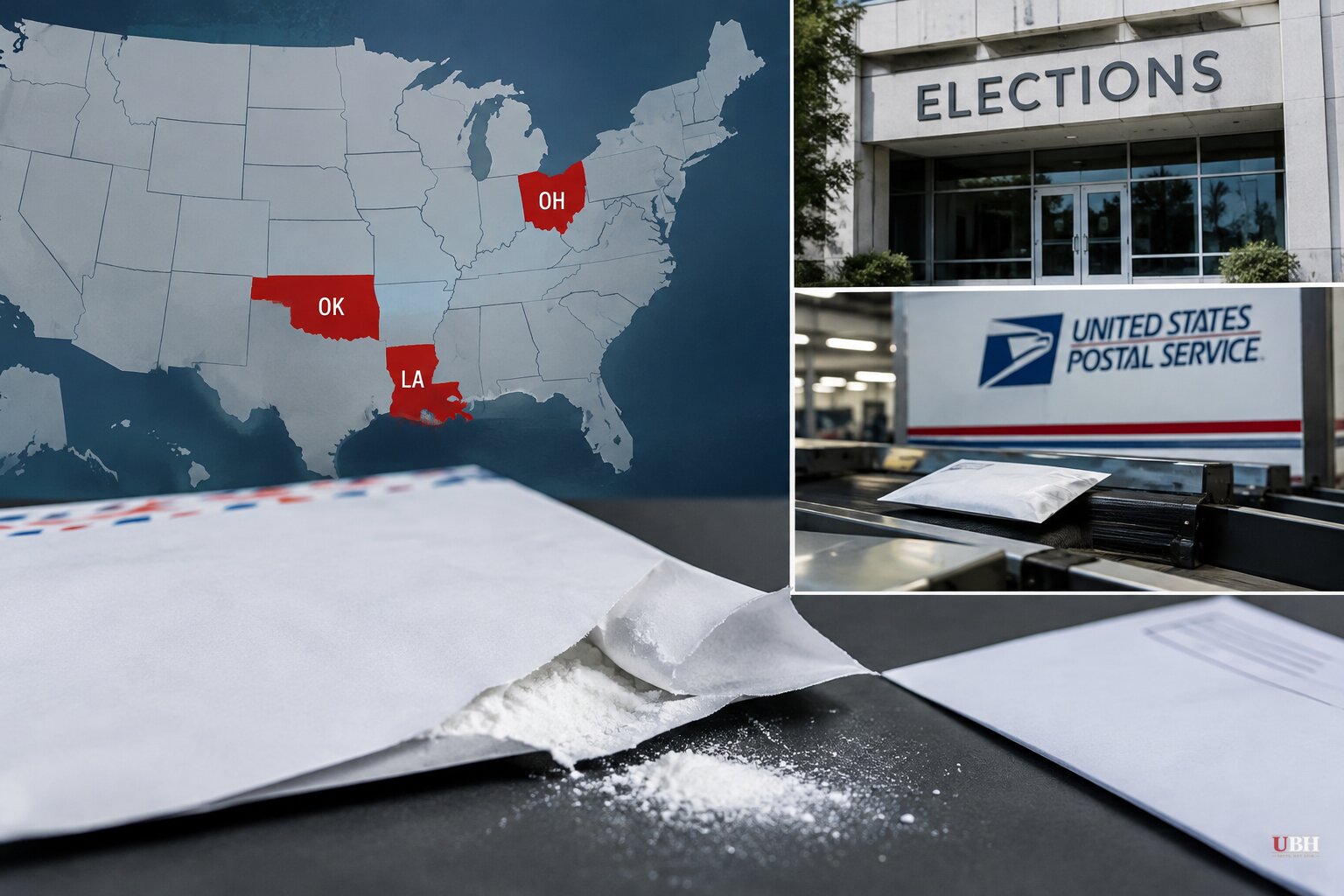
Three state election offices were targeted with suspicious white powder mailings this week, less than three weeks before the Nov. 3 midterm elections.
Louisiana and Oklahoma received envelopes on Tuesday, Oct. 13. Ohio Secretary of State Frank LaRose said Wednesday, Oct. 14, that U.S. Postal Service investigators intercepted a letter addressed to his office before it was delivered.
No one has been reported harmed in any of the incidents.
What happened in each state
Louisiana. Secretary of State Nancy Landry said an Elections Division employee opened a package at about 12:20 p.m. CDT Tuesday and found white powder inside. The Baton Rouge office was closed for the rest of the day. Spokesperson Trey Williams said the employee was taken to an emergency room "as a precaution" and left uninjured. He said law enforcement did not find evidence of "harmful substances" and that the event "did not impact any election operations."
Louisiana State Police spokesperson Jacob Pucheu said troopers recovered the substance and submitted it to the FBI crime lab for testing. No employees have reported injuries or adverse health effects, he said.
Oklahoma. The State Election Board said an envelope with "suspicious white powder" arrived Tuesday morning at its office inside the state Capitol in Oklahoma City. The Oklahoma Highway Patrol was notified immediately and the office was evacuated. Board Secretary Paul Ziriax said the Oklahoma City Fire Department and the Oklahoma National Guard also responded.
Ziriax thanked the responders and said no board staff were harmed. The board has not said what the powder was.
Ohio. LaRose said his office was the "intended recipient" of a letter containing "a powdery white substance." Postal Service investigators stopped it. He said those investigators are "dealing with similar mailings sent to election officials in multiple states," and that the FBI is handling the matter. He told county boards of elections to stay vigilant in the days ahead.
The federal response
In a statement Wednesday night, the FBI said "a series of suspicious mailings" went to "various addresses nationwide, including Secretary of State offices and their related election offices."
"Some of the letters contained an unknown substance and we are working closely with our law enforcement partners to respond to each incident," the bureau said. It added that it is working to identify "the individual or individuals responsible." The FBI declined to confirm which locations received letters. The U.S. Postal Inspection Service is also investigating.
No suspect has been named and no charges have been announced. The FBI has not said what the substances were, or whether the letters are linked beyond their similar appearance and timing.
Not the first time
This has happened before. Powder-containing packages were sent to election officials in at least six states in the weeks before the 2024 presidential election.
The National Association of Secretaries of State and the National Association of State Election Directors issued a joint statement Wednesday saying they were "deeply concerned by these incidents." They said threats against election officials and workers "have no place in our democracy" and that those who run elections "should never fear for their safety while carrying out their essential duties."
John Cohen, a former acting undersecretary for intelligence and analysis at the Department of Homeland Security, offered a mixed assessment. "The bad news is that the threat is rapidly evolving, dynamic, technologically enabled and dangerous," he told CNN. "The good news is that state and local officials are better prepared than ever to address these threats."
Elections are still on schedule
Officials in both affected states say the mailings have not disrupted election work. Ziriax said the incident "does not impact our ability to conduct elections." Louisiana's office said the same of its operations.
The practical problem is for the people who open the mail. Election offices are small, public-facing and handle a heavy volume of envelopes from voters, counties and vendors. Staff at those offices, many of them career civil servants rather than elected officials, are the ones who handled the envelopes.
The postal interception in Ohio, a state with a competitive U.S. Senate race on the November ballot, shows screening can catch a package before it reaches a desk. It did not catch the ones that reached Baton Rouge and Oklahoma City.
The open questions are specific. The FBI lab results on the Louisiana sample have not been released. Investigators have not said how many other addresses nationwide received letters, or whether other election offices will report finding more in the days ahead. LaRose has already asked Ohio's county boards to watch for them.
Sources used for this briefing
7 links from 6 independent newsrooms (syndicated copies of the same report count once)
These are the sources it draws on, linked so you can verify.


