
Unbiased headlines. Facts, not spin.
Unbiased Headlines is an independently owned news organization. We bring you the facts, not opinions, written fresh from 110+ named sources. Sources linked so you can verify it yourself.
 politics
Major Story (7/10)
Event date: October 23, 2026 ·
Wedgewood Polls admits faking survey data; New York Times pulled 15 polls, Decision Desk HQ removed 17
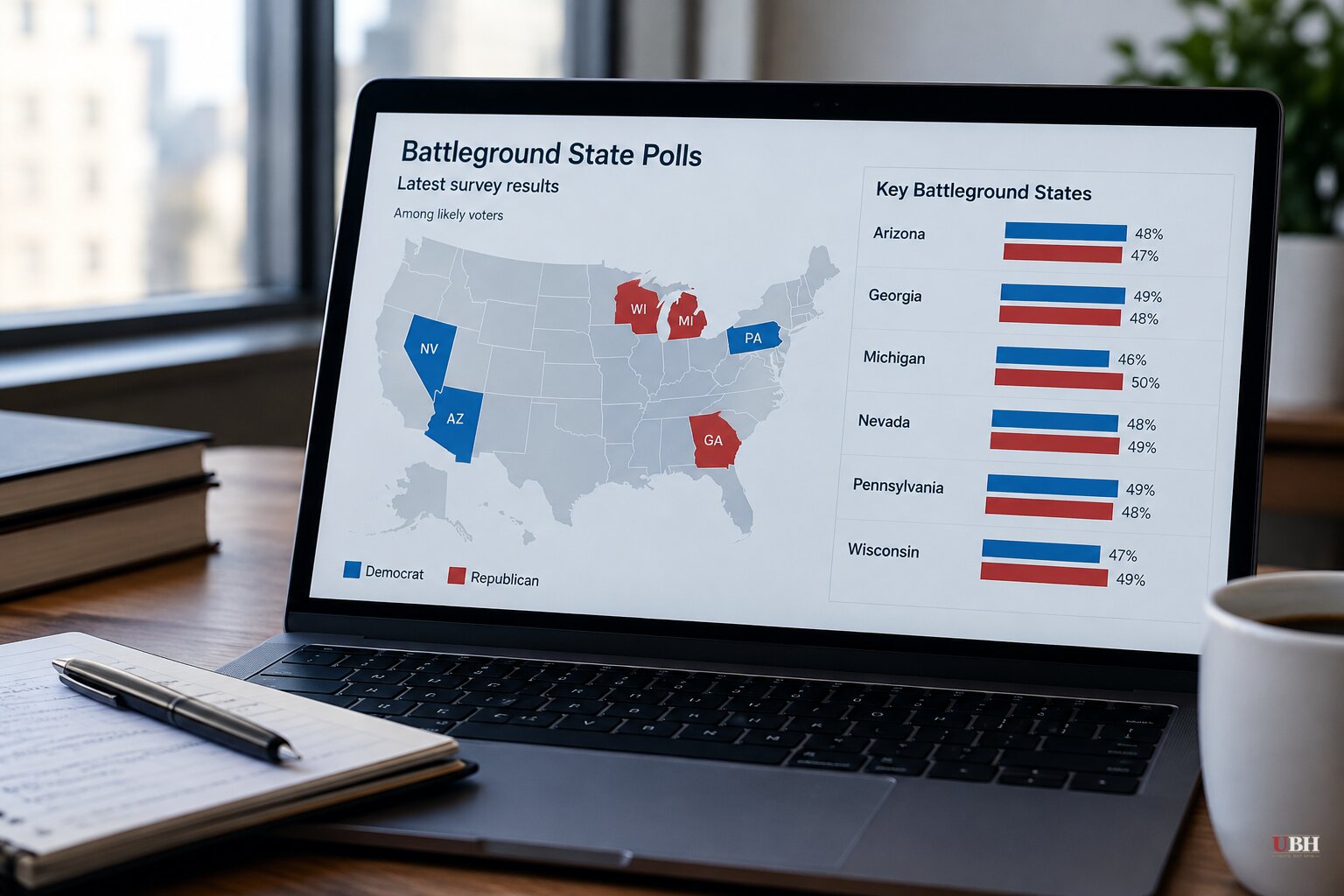
On Tuesday, Oct. 20, at 3:19 p.m. Pacific, Wedgewood Polls posted a statement on X saying its data was fake. The firm, which launched in June 2026, called its work "an experimental project to demonstrate the vulnerabilities, lack of oversight, and overall low barrier to entry in the modern political polling industry."
Its own test question: "How easy is it for an entirely fabricated polling firm to gain traction, be taken seriously, and expose how little scrutiny exists in media and public commentary?" Its answer: "Far too easy."
Eleven days later, the damage is still being counted. Election Day is Nov. 3.
What got through
Wedgewood claimed credit for at least 18 polls this year. They covered Texas, Ohio, Michigan, Kansas, Maine, Georgia, Iowa, Mississippi and Nebraska.
The New York Times said it listed 15 Wedgewood surveys between June and October before removing them. The Times said Wedgewood had supplied information about its personnel, methodology and funding during vetting. It also said the polls were not part of its presidential approval or national congressional averages.
Decision Desk HQ removed 17 Wedgewood polls from its race-level lists and averages. The firm's numbers were also cited on air by MS NOW, according to Wedgewood's own statement.
The unraveling began with FiftyPlusOne, a forecasting and aggregation site. Its researchers flagged inconsistencies in Wedgewood's raw data and in technical identifiers tied to survey responses, then approached the firm for an explanation. The admission followed.
The Michigan fallout
The most concrete harm claimed so far comes from Michigan's Democratic Senate primary. A Wedgewood poll in late June showed Mallory McMorrow dropping into single digits in a three-way race with Abdul El-Sayed and Rep. Haley Stevens.
McMorrow said it contradicted her campaign's internal numbers. After the admission she wrote on X: "Donations dried up. Volunteers were devastated and pleading for guidance on what to do. Reporters hounded me with calls to drop out."
"Sure, a point was proven. Polling is broken," she added. "But tens of thousands of people poured their hearts, time, energy, hard-earned money into something they believed in."
Jennifer Holdsworth, who ran a super PAC backing McMorrow, said donors used the poll to pull back funding "at a time we were being outspent by $80 million."
Those are the campaign's own accounts. No source has established how much money was lost or whether the outcome would have changed. El-Sayed's campaign cited Wedgewood's numbers during the primary. He advanced and is now in a tight general-election race with former Rep. Mike Rogers, a Republican.
In Wisconsin, the aggregator Political Polls cited Wedgewood in the governor's race, showing Democratic socialist Francesca Hong ahead of Republican Rep. Tom Tiffany. Hong later lost her Democratic primary to the establishment-backed candidate.
"Social experiment" under challenge
Wedgewood says it never meant to influence an election. G. Elliott Morris, the data journalist who took part in the FiftyPlusOne investigation, rejects that account.
"We were investigating Wedgewood for faking their data," Morris said. "They are trying to cover up for their fraud with the 'we were doing a social experiment' excuse."
The sequence supports his point on timing. The confession came after the inquiry started, not before. A report from Ynet also says Wedgewood solicited donations to fund what it presented as real polling. That claim rests on that single report, and Wedgewood has not been quoted addressing it.
Wedgewood is not the first. In August, Median Strategies admitted it had faked polls on the Wisconsin Democratic governor's primary, the Nevada governor's race and the Los Angeles mayoral race. Mayor Karen Bass had touted one of those polls as proof her re-election campaign was gaining momentum. Median used nearly the same "social experiment" language.
Researchers at the University of Washington's Center for an Informed Public also note that a third firm, SoCal Strategies, has scrubbed its online presence after FiftyPlusOne scrutiny. Individuals alleged to be behind Wedgewood claimed prior ties to SoCal. That link is an allegation, not an established fact.
The FCC steps in
On Oct. 21, FCC Chairman Brendan Carr posted on X that "there has been a significant surge in entirely Fake Polls and Suppression Polls designed to do nothing more than interfere with the regular functioning of the electoral process."
He said journalists and broadcasters had amplified them "without informing the public that those Polls lack a scientific, accurate, or even real basis." He warned that broadcast licenses prohibit "News Distortion" and "Broadcast Hoaxes," and said stations could add context to polls they had already covered.
Carr has used the same public-interest language before. On March 14 he threatened to strip broadcasters of licenses over what he called false reporting on the war with Iran. Whether a poll that a station got wrong in good faith counts as a hoax under FCC rules is an open question. Carr's post did not settle it.
The Center for an Informed Public tracked how the story moved on X. It found the confession spread the evening of Oct. 20, then surged again the next day with help from right-wing influencers and Republican political figures. Al Jazeera quoted experts warning that unmasked fake pollsters can be used to cast doubt on legitimate election data.
What comes next
The trackers removed the bad data only after the admission, and Wedgewood's X account has been deleted. Voters go to the polls Tuesday, Nov. 3. Whether any other firm in the aggregators' databases gets pulled before then depends on what FiftyPlusOne and others find next.
Sources used for this briefing
7 links from 7 independent newsrooms (syndicated copies of the same report count once)
These are the sources it draws on, linked so you can verify.


