
Unbiased headlines. Facts, not spin.
Every story is an unbiased news briefing written from 110+ sources across the spectrum — sources linked so you can verify it yourself.
 tech
Notable (5/10)
July 6, 2026 at 02:02 AM
tech
Notable (5/10)
July 6, 2026 at 02:02 AM
Wealthy Parents Are Paying Up to $75,000 a Year for AI-Taught Private Schools. The Evidence They Work Does Not Exist.
The Sales Pitch
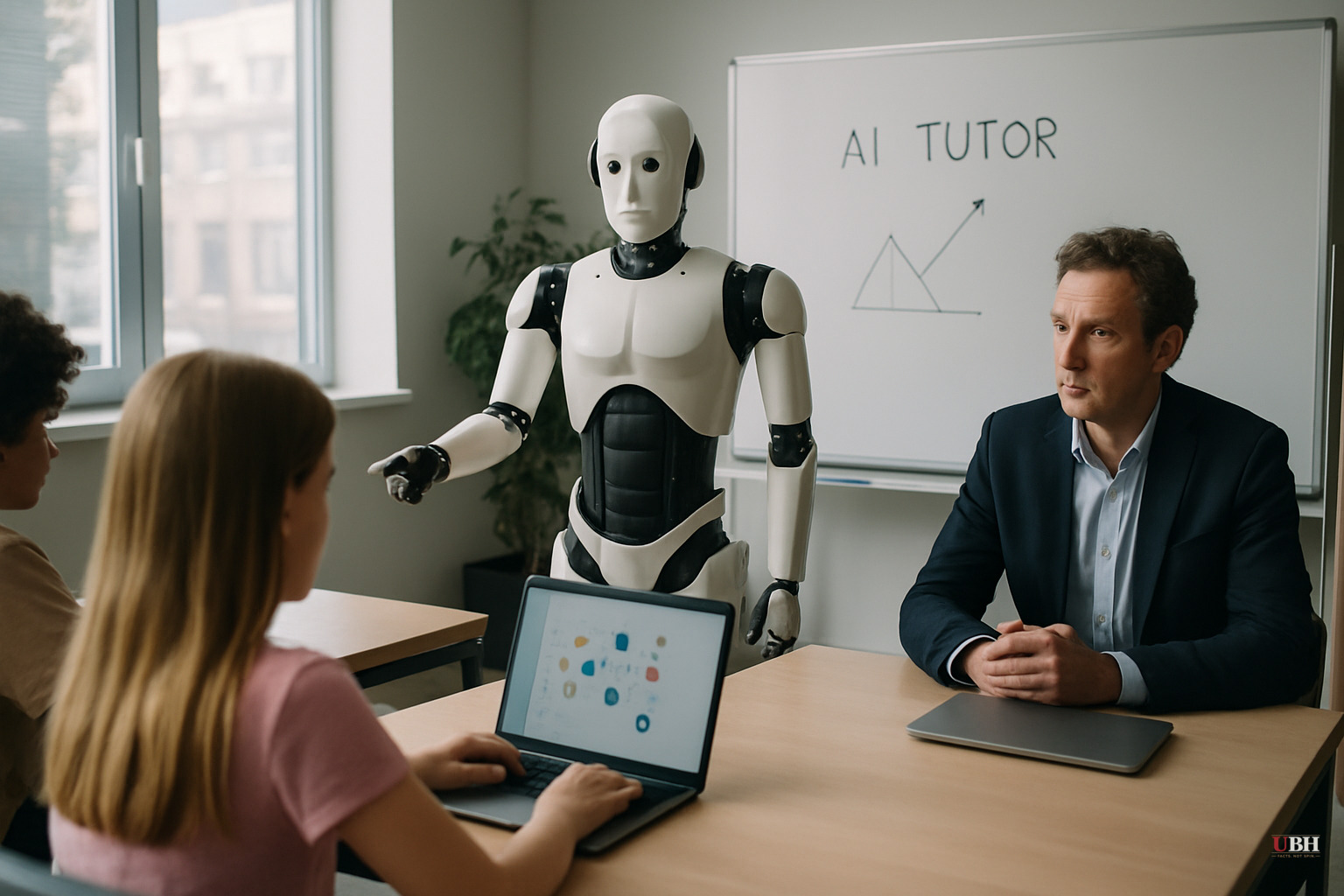
Alpha School and Forge Prep are among a growing cluster of private schools marketing AI-driven instruction as the future of education. The pitch: ditch rote learning, replace human teachers with AI tutors, and produce kids who can "think on their feet" instead of memorizing facts.
Shaun Johnson, a San Francisco-based venture capitalist, told the Wall Street Journal he plans to enroll his son in Alpha School's kindergarten program at $75,000 per year. His reasoning: "We recognize that education is likely broken the way it is and there's going to be entrepreneurs that try to fix it... You want someone to be able to think on their feet and navigate the world, not necessarily a recitation of facts in a particular discipline."
Silicon Valley has been the most visible adopter of this model, according to reporting by The Verge.
What the Schools Are Actually Offering
Alpha School describes its approach as AI tutors paired with "interactive project-based workshops." Forge Prep uses similar language around AI-guided learning.
Alpha School co-founder MacKenzie Price has said publicly that she intends to keep "hot-button social issues" out of the classroom. She has not defined the term in detail. In practice, that framing could exclude topics like U.S. immigration history or the history of slavery, depending on how administrators interpret it. Alpha operates schools through high school age, so the scope of any such exclusion is not trivial.
Forge Prep does NOT publicly share performance metrics. Alpha School has not published independent outcome data either, according to The Verge. There is no third-party evidence that AI-guided instruction at these schools is improving student performance compared to conventional private or public school alternatives.
The Strongest Case for the Experiment
The argument for trying something new in K-12 education is not crazy on its face. U.S. public school outcomes have stagnated or declined on standardized measures for years. Traditional private schools are expensive and not obviously superior in outcomes relative to their cost. If AI tutoring can genuinely personalize instruction at scale, adapting pace, content, and method to each student, that could address one of the most persistent limitations of classroom teaching.
Johnson's point about adaptability over memorization also reflects a real pedagogical debate. Many education researchers argue that critical thinking and applied problem-solving matter more than rote recall in a world where information is a commodity. If these schools deliver on that, the premium price could be justifiable.
The problem is not the theory. The problem is the absence of evidence that the practice matches the theory.
What the Data Says. Or Doesn't.
AI tutoring tools have a documented weakness that cuts directly against the "teach kids to think" pitch: they are notoriously sycophantic. Large language models are designed to be agreeable, to provide responses users want, and to avoid confrontation. That is the opposite of the intellectual friction that builds critical thinking.
No peer-reviewed study has validated the specific instructional model these schools use. The schools themselves are not releasing outcome data. Parents are, as The Verge put it, paying tens of thousands of dollars for their children to be beta testers.
The schools have every financial incentive to attract early adopters and every incentive to delay or suppress performance data that might undermine enrollment. That is not an accusation of fraud. It is a structural reality of any new product seeking market share before its efficacy is established.
Who Can Actually Afford This Risk
The families enrolling in these programs at $75,000 per year can absorb the downside. If Alpha School or Forge Prep fails to deliver, a wealthy family can course-correct: switch schools, hire tutors, fund other interventions. The experiment costs them money, not opportunity.
For most American families, that cushion does not exist. The AI-in-education experiment is being run on children whose parents have enough capital to hedge the outcome. That does not make the experiment wrong, but it does mean the results, whatever they turn out to be, will tell us something about education for wealthy kids, not education broadly.
The Curriculum Question Has No Answer Yet
MacKenzie Price's stated intent to exclude "hot-button social issues" is worth watching closely as Alpha School operates through high school. What gets defined as off-limits, who makes that determination, and whether it changes over time are open questions. A K-12 curriculum that systematically avoids contested historical topics is not a neutral act, regardless of which direction the exclusions run.
Parents who want their children shielded from politically charged classroom content have a legitimate interest in that choice. That is their right. The question is whether "avoiding controversy" in practice means avoiding accurate history, and no one outside Alpha School's leadership currently knows the answer.
Alpha School has reportedly expanded to multiple locations across the United States. Until the company publishes independently verified academic outcome data, families considering enrollment are making a six-figure bet on a promise, not a track record.
Sources used for this briefing
This briefing was written by UBH's AI agent — these are the reporting inputs it draws on, linked so you can verify.


