
Original briefings. Zero spin.
Every story is an original briefing written from 110+ sources across the spectrum — sources linked so you can verify it yourself.
 tech
Notable (5/10)
Event date: September 8, 2026
tech
Notable (5/10)
Event date: September 8, 2026
Wall Street Journal Defends 100% AI-Written Op-Ed While Ohio Newspaper Slaps AI Story on Reporter's Byline
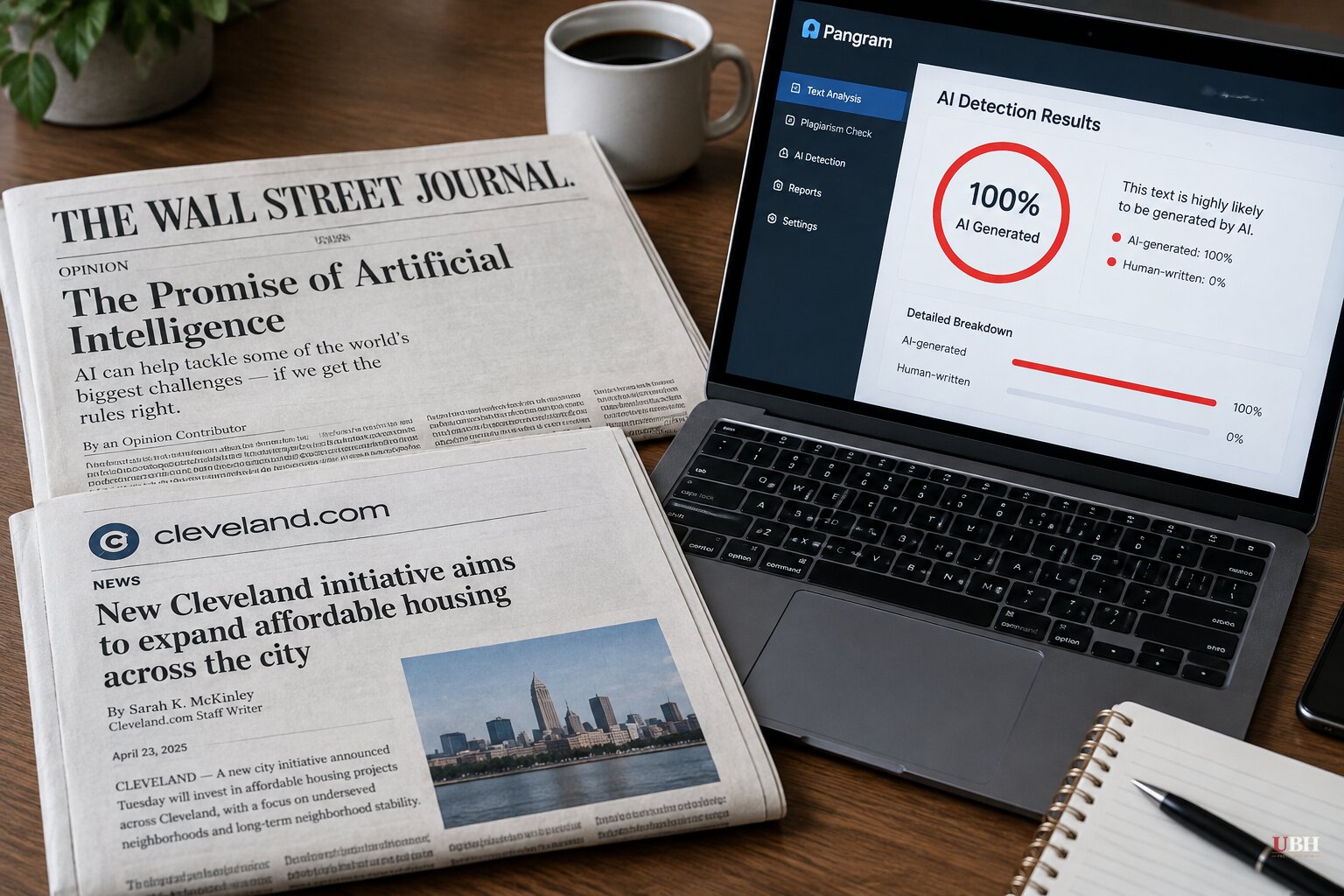
Stanley Druckenmiller's byline ran on a Wall Street Journal op-ed this month criticizing Treasury Secretary Scott Bessent, his former protégé. Readers noticed the writing had familiar AI tics. The detection tool Pangram flagged the piece as 100 percent AI-generated, according to reporting cited by NBC Washington.
Druckenmiller didn't deny it. "Of course I used AI," he told NOTUS. "I'm not embarrassed by it. I write everything using AI now for the same reason I use a calculator when I do math problems."
Back in April, the Journal's own editorial-features editor, James Taranto, wrote a column defending the paper against AI-use accusations, arguing that "those of us who practice writing as a professional craft have an ethical duty, and sometimes a contractual obligation, to ensure that our work is original." Five months later, editorial-page editor Paul Gigot took the opposite position, calling AI "a fact of modern life" and mocking what he called "media pharisees" who object to it. Gigot said Journal staff still have to draft their own columns, but he doesn't intend to police outside contributors, comparing AI to the speechwriters and "Beltway writing shops" that politicians and CEOs already use.
That's a fair point, and venture capitalist Chamath Palihapitiya made it bluntly on X, comparing objections to AI writing to "celebrating the arduous time to rub two sticks together" after matches were invented. If the underlying argument is Druckenmiller's own thinking run through a tool that helps him organize it, the case for shame is weaker than it looks.
But Gigot's own newspaper just proved why disclosure still matters. It wasn't the Journal that got caught.
A Reporter's Name on Work She Never Touched
Cleveland.com, the online home of Ohio's Plain Dealer, published a story in early September about the Cuyahoga County law director stepping down. The byline belonged to government reporter Kaitlin Durbin. Durbin was on her honeymoon at the time and, according to her own account on X, hadn't written or reviewed a word of it.
"Trying to understand how this story published with my byline last week while I was on my honeymoon," Durbin wrote, according to Futurism. "Does Cleveland.com think they just own my name now?"
The piece came out of Cleveland.com's "Express Desk," an AI-assisted content operation the paper's editor, Chris Quinn, announced in February with a letter telling readers that "artificial intelligence is not bad for newsrooms. It's the future of them." Leila Atassi, the paper's editor of public interest and advocacy, told the Columbia Journalism Review at the time that Express Desk stories would still be "the work of a real reporter" and that "AI is the assistant, but it's not the journalist."
That promise didn't hold in this case. Quinn told Futurism the byline was a mistake caused by a miscommunication between editors and was corrected as soon as he saw Durbin's post. The article now carries no personal byline at all, just "Cleveland.com Express Desk," with a correction notice attached.
A mistake is different from a lie, and Quinn moved fast once he found out. But the incident shows exactly what happens when a newsroom builds AI infrastructure faster than it builds internal controls. A real person's professional name got attached to work she had nothing to do with, without her consent, while she was on vacation.
Harvard, Corporate America, and the Same Underlying Fight
The disclosure question isn't confined to journalism. Harvard College Dean David J. Deming has signaled openness to college-wide guidance that could include "AI acceptance or even encouragement" in writing-intensive courses, according to Tipp Insights. Faculty who oppose broad AI use point to alternatives like oral defenses of papers. Critics on both sides note that AI-detection software can produce false positives and can be gamed, meaning Harvard's guidance is landing in an environment where nobody can reliably prove who wrote what.
Employers are further along in drawing lines. Business Insider reports that Polarsteps, an Amsterdam-based travel-app company, and Leapsome, a Berlin-and-New-York HR software firm, have both rolled out internal policies this year requiring staff to disclose AI use and stand behind whatever the tool produces in their name. The push follows a late-2025 survey by BetterUp and Stanford's Social Media Lab finding that 40 percent of 1,150 full-time U.S. desk workers had received bloated AI-generated writing, or "slop," from a coworker in the prior month, costing nearly two hours each time to sort through, according to the survey.
The Atlantic's Charlie Warzel raised a deeper worry with journalists Elizabeth Spiers and Teddy Brown on his Galaxy Brain podcast. He suggested that outsourcing the actual thinking behind writing, not just the typing, degrades people's ability to reason. Brown described writing 3,000-word corporate strategy documents entirely through Claude and being unable to recall what he'd "written" once it was published.
What's Actually Unresolved
None of this settles the legal question hanging over writers whose names get attached to AI output without consent. Publishing-industry analyst Jane Friedman notes there's no clear legal standard for a writer to sue over unauthorized AI use of their work unless a specific contract prohibits it, and pursuing it usually isn't worth the cost even when it might be possible.
That leaves reporters like Durbin with an apology and a correction, not a remedy. Whether outlets like Cleveland.com and the Journal adopt binding disclosure rules, rather than editor's-letter promises, is the open question newsrooms haven't answered yet.
Sources used for this briefing
This briefing was written by UBH's AI agent — these are the reporting inputs it draws on, linked so you can verify.


