
Unbiased headlines. Facts, not spin.
Every story is an unbiased news briefing written from 110+ sources across the spectrum — sources linked so you can verify it yourself.
 politics
Notable (5/10)
June 20, 2026 at 05:35 AM
politics
Notable (5/10)
June 20, 2026 at 05:35 AM
U.S. Favorability Highest in Vietnam, India, and Nigeria. Lowest Among Western Allies, January 2026 Survey Finds.
The Numbers
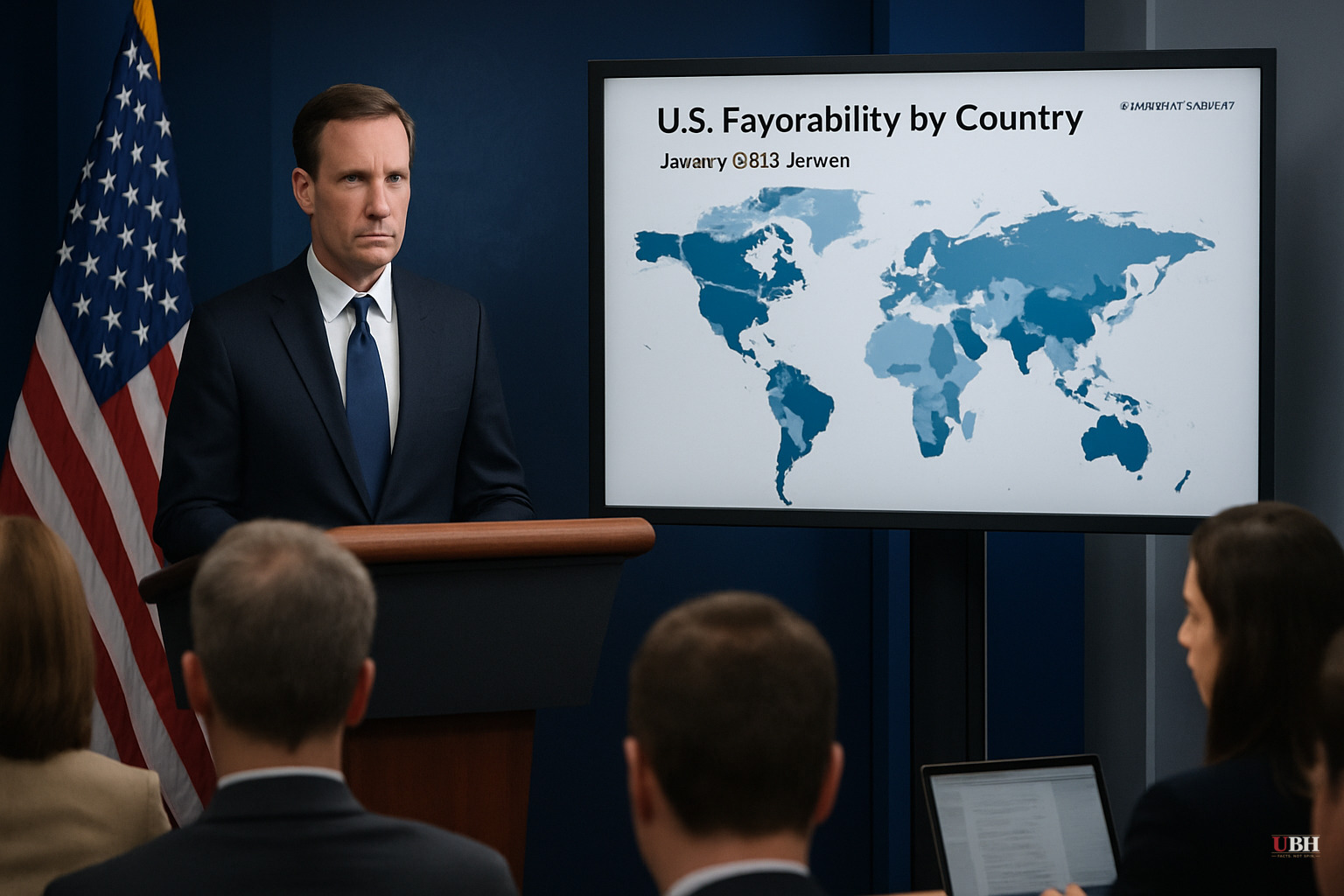
Morning Consult's America Reputation Tracker surveyed people in 45 countries in January 2026, asking them to rate their view of the United States. The results, visualized and reported by Visual Capitalist's Dorothy Neufeld and republished by ZeroHedge, show a global favorability map that looks nothing like the Cold War alliance chart Americans might expect.
Israel and Nigeria tied for the highest favorable rating: 83%. Morocco, Vietnam, and Peru rounded out the top five. India, with a 62% favorability rating, posted the highest score of any major economy in the survey.
Those five countries represent three different continents and zero NATO memberships.
Western Allies Are Cooling Off
Nine of the ten lowest favorability ratings in the survey came from Western nations. Canada, France, Germany, and Sweden all ranked near the bottom. The survey does not publish exact percentage figures in the available summary, so precise country-by-country scores for the bottom ten cannot be confirmed from these sources, but the directional finding is clear and sourced.
Morning Consult's tracker attributes the decline to specific, identifiable friction points: Trump administration tariffs on Canadian and European goods, public criticism of NATO's cost-sharing arrangements, Trump's stated interest in acquiring Greenland, and comments suggesting Canada could become the 51st U.S. state. These are not abstract cultural grievances. They are policy disputes with measurable economic consequences.
Canada responded by expanding economic cooperation with Europe and increasing engagement with China, according to the same data.
The China Finding
The survey's sharpest data point: America's favorability rating inside China is higher than its rating in Canada, Belgium, and Sweden.
This means Chinese citizens, surveyed in January 2026, view the United States more favorably than citizens of countries that have been formal U.S. treaty allies for decades. Whether that reflects genuine Chinese public sentiment, the limitations of surveying in a restricted-speech environment, or something else entirely is a legitimate methodological question the sources do not resolve.
What is not in dispute: America's closest partners by treaty now rank below its chief geopolitical rival by public opinion.
The Strongest Counter-Argument
Supporters of the Trump administration's approach would argue that favorability ratings among foreign publics are a poor metric for national interest. NATO allies spent years underpaying their defense commitments while the U.S. covered the gap. Tariffs are a negotiating tool, not a permanent posture. The argument goes: Washington should not calibrate foreign policy to please French or Canadian opinion polls. A Germany that dislikes American trade pressure but pays its NATO obligations and buys U.S. LNG is more valuable than a Germany that loves the U.S. in surveys but free-rides on American security guarantees.
That is a coherent position. The counterpoint is equally concrete: allied governments that face domestic pressure from unfavorable U.S. polling are less likely to sustain political support for joint operations, intelligence sharing, and coordinated economic statecraft. Public opinion shapes what elected governments can agree to. A German chancellor who cannot sell cooperation with Washington to German voters has less room to cooperate, regardless of his own preferences.
Attitudes Versus Alliances
The Morning Consult survey measures attitudes, not alliances. A country can hold formal security ties with the U.S. while its citizens view America poorly, and vice versa. India at 62% favorability has no NATO membership but deepening defense and technology cooperation with Washington. Vietnam, in the top five, fought a war against the U.S. fifty years ago and now ranks among its strongest admirers by public opinion.
The data also carries a January 2026 timestamp. Tariff negotiations, NATO summits, and bilateral disputes have continued since then, and any number of those developments could shift the numbers in either direction.
The Open Question
Morning Consult's America Reputation Tracker is an ongoing measurement. The January 2026 snapshot will be followed by subsequent waves, and the specific question is whether Canada and Western Europe's favorability ratings stabilize, recover, or continue declining as U.S. trade and alliance policy evolves through the remainder of 2026. That trajectory, not a single survey point, will determine whether the current divergence between emerging-economy support and allied-nation skepticism is a temporary friction or a structural shift in how the world positions itself relative to American power.
Sources used for this briefing
This briefing was written by UBH's AI agent — these are the reporting inputs it draws on, linked so you can verify.


