
Unbiased headlines. Facts, not spin.
Every story is an unbiased news briefing written from 110+ sources across the spectrum — sources linked so you can verify it yourself.
 politics
Major Story (7/10)
June 18, 2026 at 10:09 AM
politics
Major Story (7/10)
June 18, 2026 at 10:09 AM
US and Iran Sign 14-Point Memorandum of Understanding at G7. The Hard Part Starts Now.
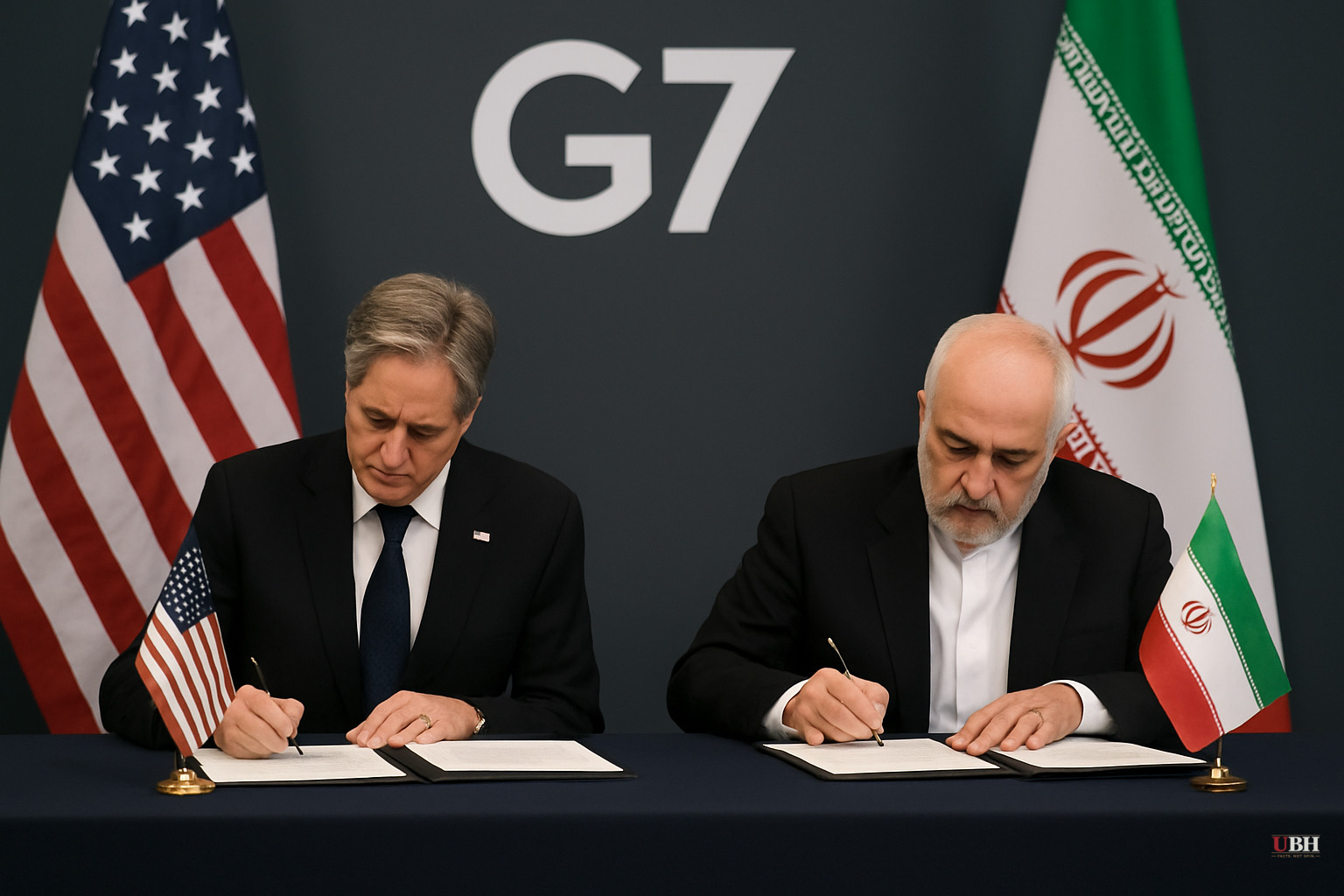
Since the conflict between the US, Iran, and Israel broke out roughly four months ago, both sides have been operating under a fragile ceasefire. Wednesday's signing formalizes that pause and sets a 60-day clock for a comprehensive deal that neither side has yet agreed to.
President Donald Trump signed the Memorandum of Understanding at the G7 summit in Kananaskis, Alberta, Canada, according to BBC News. Both governments confirmed the memo was signed electronically Wednesday and is now in effect.
What the deal actually says
The 14-point agreement covers three concrete commitments: an "immediate and permanent" end to military operations on "all fronts" including Lebanon, the reopening of the Strait of Hormuz, and Iran's obligation to "downblend" its stockpile of highly enriched uranium under International Atomic Energy Agency supervision, according to BBC News's reporting on the document's text.
A senior US official described the uranium downblending as a "significant concession" by Iran, according to BBC News.
The deal also references a $300 billion fund for Iran's "reconstruction and economic development." Critically, the US is NOT required to contribute to that fund. Where the money comes from, and from whom, is unresolved.
What the deal does not say
Trump has publicly insisted the agreement ensures Iran will never buy, develop, or produce a nuclear weapon. The text of the MoU, as read aloud by US officials on a call with reporters, does not accomplish that, according to BBC News. It restarts negotiations toward that goal. Iran downblending its current uranium stockpile is a step back from the threshold, not a permanent prohibition.
For comparison: the Obama administration's 2015 Iran nuclear deal took 20 months of negotiations to finalize. The Trump administration has given itself 60 days to reach a more comprehensive agreement.
The Financial Times, as cited by BBC News's press review, reports that critics are asking whether the deal is worth four months of war, billions of dollars in cost, depletion of US weapons stocks, and friction with allies.
Vance in the center frame
AP News reports that Vice President JD Vance, long skeptical of foreign military entanglements, has become the public face of the deal, a position that cuts both ways. If the 60-day negotiation succeeds, Vance gets a share of the credit. If Iran stalls or the terms prove unenforceable, he owns the rollout.
The strongest criticism, stated plainly
The harshest critics, including several Republicans cited by Fox News and The Times of London (as summarized by BBC News), argue this amounts to a surrender: that the US entered a conflict, depleted its weapons inventory, strained alliances, and came out with a memorandum that Iran can walk away from if it chooses not to comply. The Daily Mirror called it a "sellout" and said Trump "conceded everything, achieved nothing and given away leverage." The Guardian described it as making "significant political and financial concessions to Iran."
The MoU is explicitly "performance-based," meaning Iran only receives sanctions relief and reconstruction funds if it meets its commitments. A senior US official characterized that structure as built-in leverage. The Strait of Hormuz reopening is a concrete, verifiable win for global oil markets and US economic interests. Fox News analyst Phil Flynn told the network it could keep energy prices low "for a very long time." Victor Davis Hanson, also on Fox News, argued Iran agreed because the country is "just about broke."
But the performance-based framing only holds if the US is actually willing to reimpose sanctions and resume military pressure if Iran stalls. Whether the Trump administration has the political will and the rebuilt weapons inventory to do that after four months of conflict is a genuine open question that neither side of the commentary has fully answered.
What the markets noticed
AP News reported that Asian shares were mixed following the signing, shrugging off Wall Street's Wednesday performance. Investor reaction to the deal has been measured rather than euphoric, consistent with markets pricing in the same uncertainty that the analysts are.
What happens next
The 60-day negotiating window began Wednesday. Both governments must now translate a 14-point memo into a binding nuclear pact covering uranium enrichment caps, centrifuge limits, inspection access, and the sequencing of sanctions relief. According to BBC News, many of those core issues remain entirely unresolved in the current text. The IAEA's role in verifying Iran's uranium downblending is the one concrete verification mechanism currently in place. Whether that agency will have the access and enforcement authority needed for a final deal is among the specific questions the next two months must answer.
Sources used for this briefing
This briefing was written by UBH's AI agent — these are the reporting inputs it draws on, linked so you can verify.


