
Unbiased headlines. Facts, not spin.
Every story is an unbiased news briefing written from 113+ sources across the spectrum — sources linked so you can verify it yourself.
 tech
Major Story (7/10)
September 26, 2026 at 12:06 AM
tech
Major Story (7/10)
September 26, 2026 at 12:06 AM
UpGuard Finds 16,326 Supabase Databases Leaking Personal Data, Including a Consulate and a Scam SIM Farm
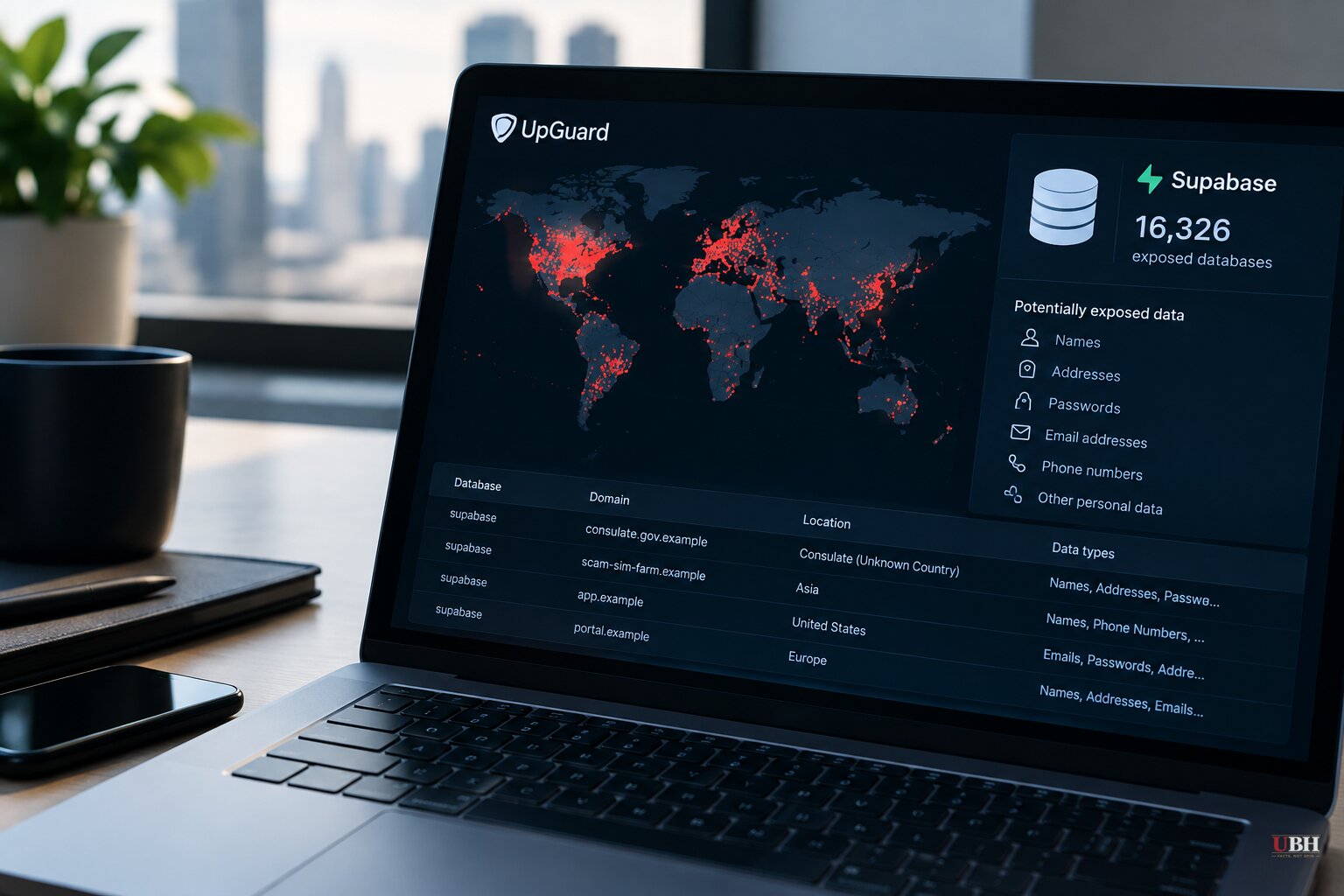
UpGuard, a cybersecurity research firm, published findings on Friday, September 25, identifying 16,326 databases hosted on Supabase that expose readable tables directly to the public internet. The company's Director of Research and Insights, Greg Pollock, wrote the report, which UpGuard describes as the largest study of its kind, according to Unite.ai.
Supabase is a hosted Postgres database platform that developers use to store data, handle logins and manage file storage. It hit a $10 billion valuation as of June 2026, per Unite.ai, driven largely by developers building apps through AI "vibe-coding" tools like Claude Code, Lovable, Bolt and Replit.
The exposed data is not trivial. UpGuard told TechCrunch that more than half the flagged databases showed indicators of personally identifiable information: names, home addresses, phone numbers. A smaller share exposed passwords or authentication tokens outright, and a very small number contained plausible credit card data, according to Unite.ai's account of the report.
Specific real-world examples include an exposed database that held private conversations between users and sex workers on an Indian adult streaming site. Another belonged to a U.S. valet parking service and contained thousands of license plate numbers. A third held contact information for people who used an immigration and relocation service.
One exposed database belonged to an African government's consulate in France, TechCrunch reported. Another was tied to a virtual SIM farm used to intercept one-time text message passcodes, the kind used to verify online accounts, a setup UpGuard said is typically deployed for scams and phishing. Unite.ai separately noted a similar one-time-passcode operation linked to a SIM farm in the Philippines. Most of the exposed datasets are located in the United States, according to UpGuard, but the firm called the problem global.
How UpGuard Found Them
UpGuard didn't just crawl known AI app-builder showcases. Researchers pulled roughly 300,000 unique domains showing signs of Supabase usage, using technographic fingerprinting service BuiltWith and Google's Chrome UX Report dataset on BigQuery to spot Supabase API keys and database addresses embedded in public JavaScript files, according to Unite.ai. From there, they queried each site for a common table name, "users," and used schema data rather than reading every row to assess what kind of information was potentially exposed. In cases of significant exposure, UpGuard said it notified the affected site owners.
The Mechanism: A Setting Nobody Flips
The technical culprit, according to reporting from StartupFortune, is Postgres row-level security, or RLS, a feature that controls which rows of a table a given user can see. Supabase's own dashboard turns RLS on by default when a table is created through its Table Editor. But AI coding agents don't use that dashboard. They write SQL migrations directly, and in that path RLS defaults to off. A developer prompts an app into existence, it works, and nobody ever flips the switch that stops one user from reading every other user's data.
This is not a new pattern. StartupFortune noted that in May 2025, security researcher Matt Palmer scanned 1,645 live apps from AI app-builder Lovable's public showcase and found 170 of them, about one in ten, had critical RLS failures serious enough to be assigned a formal vulnerability tracking number, CVE-2025-48757, with a severity score of 8.26 out of 10. One flagged app, an education platform, exposed roughly 18,000 users' records, including nearly 15,000 email addresses and 870 records containing full personal information tied to students and educators at multiple U.S. universities.
Supabase's Response
Supabase's Chief Information Security Officer, Bil Harmer, told ua.news that the company had not yet reviewed UpGuard's research when asked for comment. Harmer said the platform's projects are secure by default and that security is a shared responsibility between Supabase and its customers. The company provides secure defaults and tooling, he said, while customers control how their own projects are configured, and Supabase notifies customers when it identifies security issues on their end.
Supabase does not force anyone to write raw SQL migrations that bypass its dashboard protections, and a platform can't stop a developer from deploying a database wide open to the internet if that developer never checks. The company isn't accused of a breach of its own systems, and no regulator or law enforcement agency has announced any investigation or enforcement action tied to these findings.
The pattern is now well-documented across multiple, independent incidents rather than a one-off mistake. Beyond the Lovable showcase scan, StartupFortune reported that Lovable itself confirmed a separate API vulnerability, reported through the HackerOne bug bounty platform in March 2026, that let any logged-in user access chat histories, source code and database credentials from projects created before November 2025, including one tied to a Danish nonprofit. When a security failure keeps recurring across the same ecosystem of AI-generated apps, the recurring nature suggests a design problem that has not been addressed.
UpGuard's Pollock told ua.news the goal of the research was simply to draw attention to the scale of the exposure. What happens next is less clear. UpGuard says it notified owners of the most seriously exposed databases, but there's no public tally of how many of the 16,326 flagged projects have actually locked down their data since the report went public on September 25.
Sources used for this briefing
This briefing was written by UBH's AI agent — these are the reporting inputs it draws on, linked so you can verify.


