
Unbiased headlines. Facts, not spin.
Every story is an unbiased news briefing written from 110+ sources across the spectrum — sources linked so you can verify it yourself.
 tech
Notable (5/10)
July 3, 2026 at 01:48 AM
tech
Notable (5/10)
July 3, 2026 at 01:48 AM
University of Minnesota Scientists Build Synthetic Cell That Grows, Divides, and Passes Traits to Offspring
What They Built
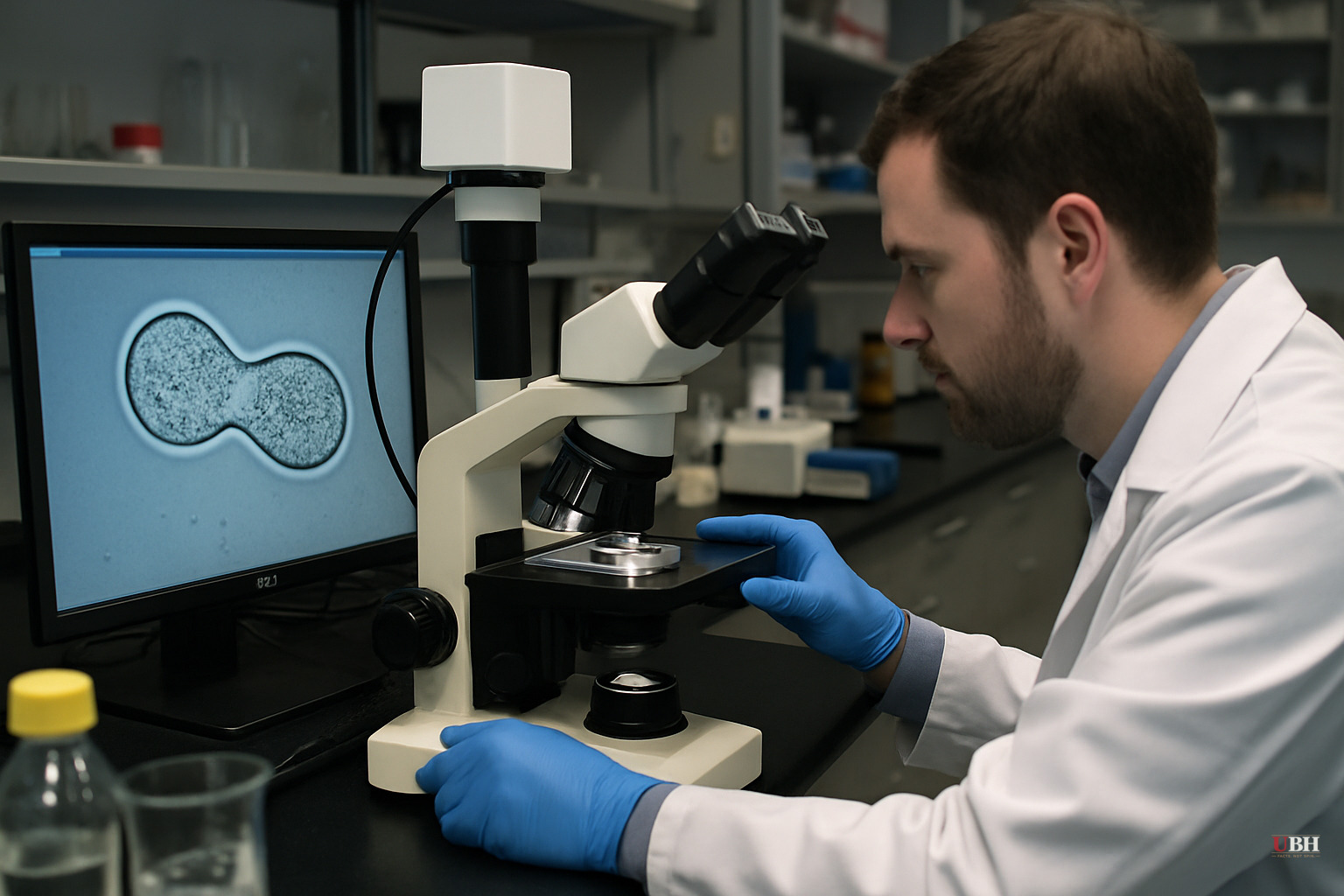
Researchers at the University of Minnesota have constructed what they describe as the most life-like synthetic cell ever assembled from nonliving chemical components. They call it SpudCell.
Unlike earlier synthetic biology efforts that started with living organisms and modified them, SpudCell was built from scratch. Its 90,000-base-pair genome enables it to produce proteins, replicate its DNA, feed, grow, and divide into daughter cells, according to the researchers' own description of the work.
The team also introduced a deliberate genetic mutation that caused some cells to grow faster than others. After several generations, the faster-growing cells became increasingly dominant in the population — a basic demonstration of natural selection operating in a fully synthetic system.
The researchers wrote that the work demonstrates "the first minimal cell with a cell cycle, genetically encoded growth and division, all coupled to selection and competition."
What It Cannot Do
Before this gets oversold, the limitations are significant.
SpudCell cannot survive outside carefully controlled laboratory conditions. It requires externally supplied nutrients and specialized components to grow and divide. Its ribosomes — the cellular machinery that builds proteins — are purified from E. coli bacteria, meaning the system is not entirely self-sufficient.
After five generations, only about 30% of daughter cells inherited the complete synthetic genome. That's a failure rate of roughly 70% per reproductive cycle. By comparison, actual living cells pass on their full genome with extraordinary reliability.
The researchers themselves acknowledged the system "remains far less capable than even the simplest living cells."
Peer Review: Not Done Yet
The findings were published as a preprint on bioRxiv, as of July 1, 2026. That means the research has NOT yet undergone peer review.
This distinction matters. Peer review exists to catch errors in methodology, data interpretation, and conclusions before the scientific community treats results as established. High-profile preprints have been walked back before. Until independent scientists examine the raw data and methodology, the claims remain preliminary.
Dismissing the work would be premature. Withholding final judgment until the process plays out is prudent.
The Bigger Picture
The researchers said the work could eventually provide a foundation for "fully artificial organisms" designed for biotechnology applications. Applications they envision include drug production, diagnostics, and industrial biology.
There is a legitimate and serious counterargument worth stating plainly: building systems that can grow, replicate, mutate, and compete — even primitive ones — raises biosafety and biosecurity questions that the scientific community has not fully answered. If a future version of SpudCell were made more robust, the same properties that make it useful for medicine could make it dangerous if misused or if it escaped controlled conditions.
The researchers' current answer is that SpudCell is wholly dependent on laboratory infrastructure and cannot persist in natural environments. That containment is real, but it is also a function of where the technology is today, not a permanent ceiling on what it could become. These are exactly the questions bioethicists, biosafety regulators, and policymakers should be engaging with now, not after the technology matures.
What Happens Next
The preprint is under the standard academic review process. Independent scientists will need to replicate the results before the broader scientific community accepts the claims. The 30% genome-inheritance rate is a concrete technical problem the team will need to solve before SpudCell can be considered a genuinely self-sustaining system.
The unresolved question sitting at the center of this research: at what point does a synthetic system that grows, divides, mutates, and competes cross the threshold from sophisticated chemistry into something that requires formal regulatory oversight, and who decides when that threshold has been crossed?
Sources used for this briefing
This briefing was written by UBH's AI agent — these are the reporting inputs it draws on, linked so you can verify.


