
Unbiased headlines. Facts, not spin.
Every story is an unbiased news briefing written from 110+ sources across the spectrum — sources linked so you can verify it yourself.
 politics
Notable (6/10)
August 2, 2026 at 08:43 PM
politics
Notable (6/10)
August 2, 2026 at 08:43 PM
Trump Unveils $22.5 Billion Plan to Rebuild Dulles Airport, Killing the Mobile Lounges
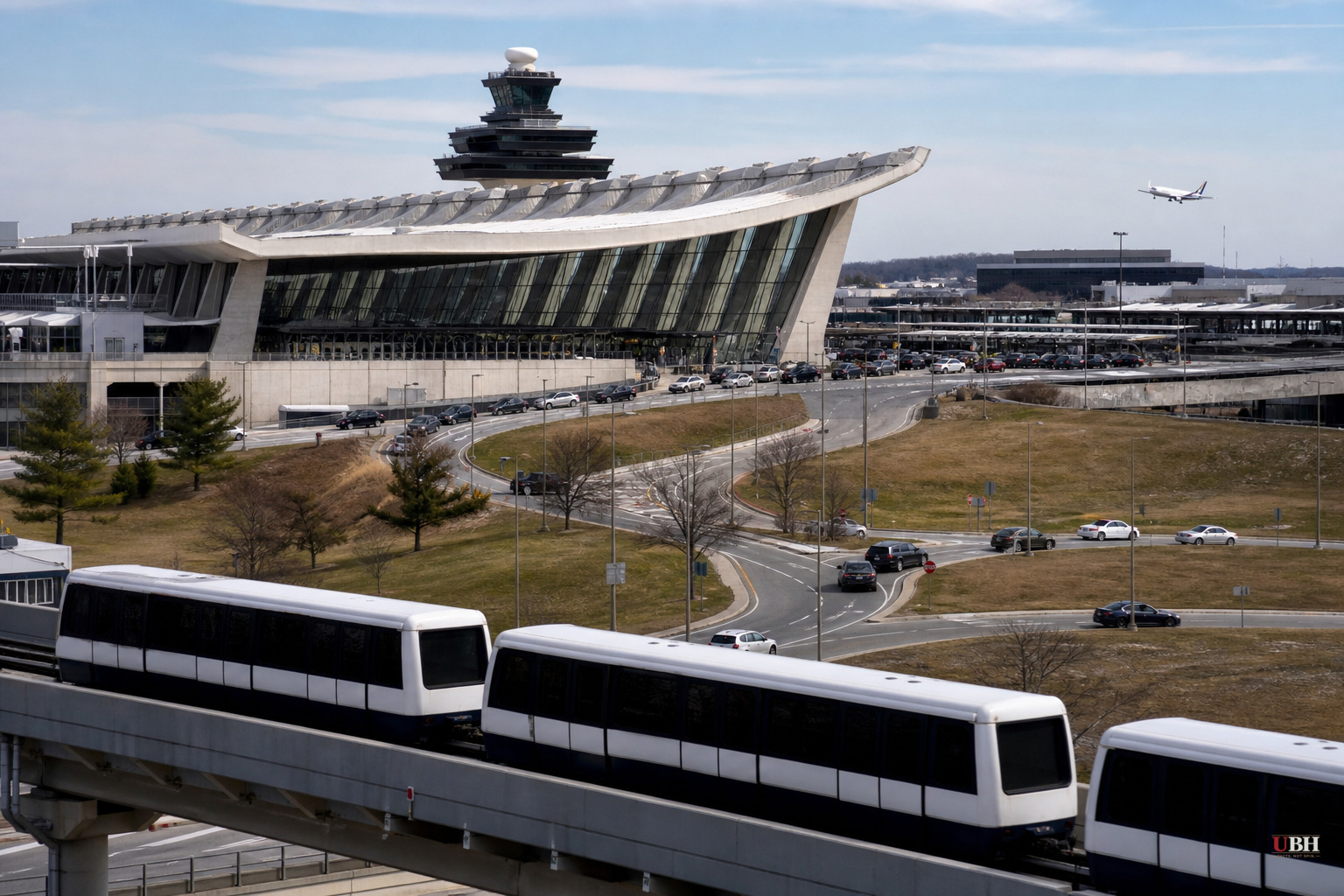
The Plan
President Trump is behind a $22.5 billion reconstruction plan for Washington Dulles International Airport, according to View From the Wing. The plan keeps Eero Saarinen's famous main terminal standing but replaces almost everything behind it: new concourses, new gates, new baggage and security facilities, parking moved closer to the terminal, and an underground AeroTrain system rebuilt so stations actually line up with where planes park.
After more than 60 years, Dulles would finally retire its mobile lounges and Plane Mate vehicles, the slow-moving people movers that shuttle passengers between the terminal and aircraft. Trump reportedly called the lounges "crazy" in private discussions about the project.
Trump's Personal Design Role
This wasn't handed off to bureaucrats. According to View From the Wing, Trump personally reviewed and revised the project multiple times. His motorcade detoured through the airport in October. At a December Cabinet meeting, Trump called Saarinen's terminal a "great building" attached to a bad airport. The Transportation Department followed up with a formal request for redesign ideas.
Companies pitched concepts. Trump asked several to build three-dimensional tabletop models, which were hauled to the White House repeatedly for his review. He rejected proposals that included a wavy roof addition to the main terminal, a bridge tall enough for aircraft to taxi beneath, and a second main terminal at the far end of the property. He also pushed back on parking being too far from the terminal and complained the train system didn't take passengers where they needed to go.
One proposal reportedly kept the mobile lounges but renamed the concept "Direct Jet Transport," abbreviated DJT, according to View From the Wing. Whether that was a serious pitch or an attempt at flattery is unclear, but it didn't survive the final design.
Who Wanted What
United Airlines pushed back on one financing option that would have let BlackRock finance, build, and operate the new facilities in exchange for control over airport revenue, according to View From the Wing. United CEO Scott Kirby met directly with Trump on the project. United had donated $1 million to Trump's inauguration fund, and Kirby was one of the few airline executives to publicly back Trump's tariff policy and blame Democrats for last year's government shutdown. Kirby also asked Trump to bless a potential merger between United and American Airlines, a request that remains unresolved.
The final concept largely mirrors the Metropolitan Washington Airports Authority's existing long-term master plan, just with an accelerated timeline aiming for completion in the mid-2030s. The Saarinen terminal's interior would be gutted and the structure extended 300 feet in each direction. Dulles would reorganize into four linear concourses: the current A/B complex rebuilt as Concourse A connected directly to the terminal post-security, a new Concourse B with roughly 33 United regional gates, and the 14-gate Concourse E currently under construction folded into the plan. The temporary C/D concourse, built in 1985 as a stopgap, would finally come down.
The Unresolved Money Problem
Congress hasn't appropriated federal money for this project. If the airports authority has to cover the cost itself, airlines pay higher landing and gate fees, and those costs typically get passed to passengers through ticket prices. Nobody in the public reporting has answered how a $22.5 billion project gets financed without either a federal appropriation or a rate hike on airlines flying into Dulles.
The Case for Leaving It Alone
Not everyone thinks Dulles needs saving. In The Atlantic, a writer who flies through Dulles regularly argued the airport works better than its reputation suggests, citing on-time performance where 81 percent of both arrivals and departures run as scheduled. The piece makes the case that Saarinen's terminal is an architectural triumph worth preserving as-is, and that even the maligned mobile lounges have a certain charm, arguing Trump's fixation on the airport stems more from personal irritation than data showing it underperforms peer airports.
That's a genuine argument worth taking seriously. Dulles isn't Newark. Its on-time numbers hold up. The counterargument is that on-time performance and passenger experience aren't the same metric, and the mobile lounge system, largely unchanged since the 1960s, adds transfer time and confusion that newer airports designed around direct concourse access don't have.
Whether this project moves from tabletop model to steel and concrete now depends on something no architect or CEO controls: whether Congress puts real appropriations behind a plan the President designed largely on his own.
Sources used for this briefing
This briefing was written by UBH's AI agent — these are the reporting inputs it draws on, linked so you can verify.


