
Unbiased headlines. Facts, not spin.
Unbiased Headlines is an independently owned news organization. We bring you the facts, not opinions, written fresh from 110+ named sources. Sources linked so you can verify it yourself.
 politics
Notable (6/10)
politics
Notable (6/10)
Trump Says He Directed DOJ to Seek Death Penalty for Killers of Police Officers and Firefighters
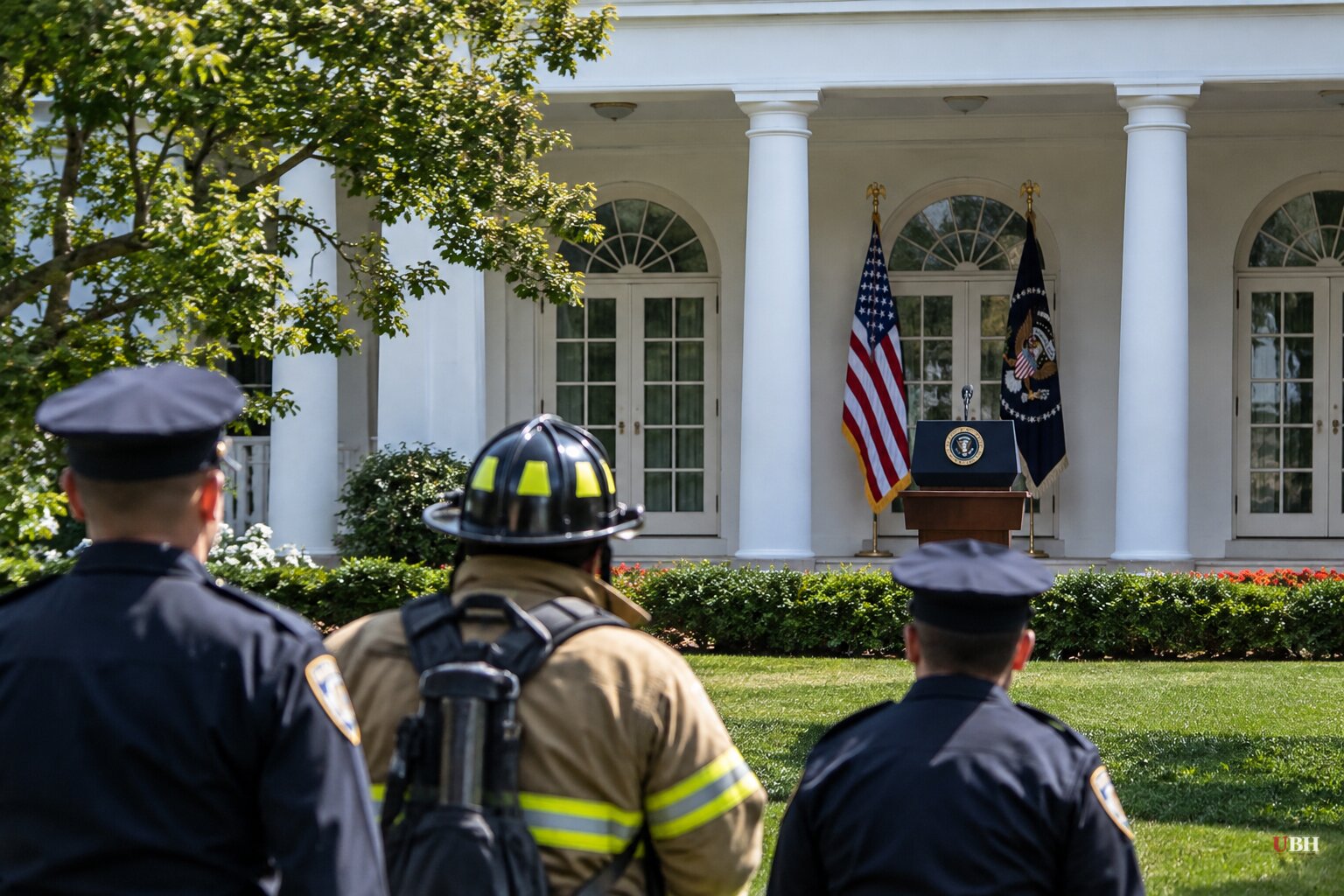
President Donald Trump said Thursday, Oct. 15, that he has directed the Justice Department to seek the death penalty for anyone convicted of killing a police officer or a firefighter.
He made the announcement at a Rose Garden luncheon for law enforcement and fire service groups. "We're bringing the death penalty back for anybody that kills a police officer, by the way, or anybody in law enforcement," Trump said.
The firefighter piece is the new part. "They're on the ladder and they get shot at and nobody ever talks about that," Trump said. He told Attorney General Todd Blanche that seeking capital punishment would deter such attacks. "You'll see, shootings will stop very quickly," he said.
What is new and what is not
The police-officer directive is not new. A Jan. 20, 2025, executive order already told the attorney general to pursue federal jurisdiction and seek the death penalty, consistent with applicable law, in federal capital cases involving the murder of a law enforcement officer.
Trump also called for a mandatory death penalty for killers of police officers in his March 4, 2025, address to Congress, and urged lawmakers to make it permanent.
What Trump added Thursday is firefighters. He announced it from the podium. He did not detail how the Justice Department would carry it out.
The jurisdiction problem
A president can direct federal prosecutors. He cannot rewrite state murder law. Federal capital charges generally apply only to specific federal offenses or crimes within federal jurisdiction, while state homicide prosecutions are governed by each state's own statutes.
Most killings of local police officers and firefighters are state cases. The map of state death penalty law is uneven:
- 27 states allow capital punishment.
- 23 states and Washington, D.C., have abolished it.
- California, Pennsylvania, Oregon and Ohio still have the penalty on the books but have executive holds on its use, so it cannot be applied there.
Many states already treat killing a law enforcement officer as a capital offense when aggravating circumstances are present.
The numbers
The U.S. Fire Administration reports that 30 on-duty firefighters have been shot and killed by gunfire in the United States since 1990. That is roughly one a year.
FBI statistics put the number of officers killed intentionally by firearms or other weapons at about 50 a year on average.
No source cited at the event offered data showing that a death penalty directive deters attacks on first responders. Trump's prediction that shootings will stop quickly is his own.
On the death penalty more broadly, Corinna Lain, author of Secrets of the Killing State, has said states "have been pushing this rock of Sisyphus uphill" and are "spending millions of dollars, and yet they're having botched executions." She was speaking to NPR in the context of Tennessee's failed lethal injection of Christa Pike.
The room and the rhetoric
The luncheon drew the International Association of Fire Fighters, the National Volunteer Fire Council, the Fraternal Order of Police, the National Sheriffs' Association, the National Association of Police Organizations, the Federal Law Enforcement Officers Association and the National Border Patrol Council.
Border Patrol Council president Paul Perez told Trump that first responders have "never had the support or leadership from any administration that we have from you."
Volunteer Fire Council chairman Steve Hirsch presented Trump with a firefighter helmet and offered a blessing for his protection. Trump replied that he could have used it in Butler, Pennsylvania, a reference to the July 2024 assassination attempt at his rally, where former volunteer fire chief Corey Comperatore was killed.
Describing firefighters shot at in some neighborhoods, Trump also said, "You ought to blow up the damn place." He did not elaborate on what he meant.
Other federal executions in the pipeline
The federal and military systems are also moving on existing death sentences. Pentagon spokesperson Sean Parnell announced that Trump approved the execution by firing squad of Nidal Hasan, the former Army psychiatrist who killed 13 people at Fort Hood in 2009. Army Secretary Adam Telle's order sets it for Dec. 3 at Fort Hood.
It would be the first U.S. military execution in more than six decades and the first by firing squad since World War II.
Robin Maher, executive director of the Death Penalty Information Center, said the president's approval "does not mean that his execution will be imminent." Hasan can delay it with a habeas corpus appeal in federal court. Ronald Gray, whose sentence President George W. Bush approved in 2008, is still on military death row.
What comes next
The open questions are procedural. The Justice Department has to decide whether to issue formal guidance covering firefighter killings, and which cases fall under federal jurisdiction at all. Any federal capital prosecution would still have to clear the courts, where appeals routinely run for years.
Sources used for this briefing
7 links from 7 independent newsrooms (syndicated copies of the same report count once)
These are the sources it draws on, linked so you can verify.


