
Unbiased headlines. Facts, not spin.
Unbiased Headlines is an independently owned news organization. We bring you the facts, not opinions, written fresh from 110+ named sources. Sources linked so you can verify it yourself.
 politics
Major Story (7/10)
Event date: October 8, 2026 ·
politics
Major Story (7/10)
Event date: October 8, 2026 ·
Trump Cancels Livestream of Nidal Hasan's Firing Squad Execution; Dec. 3 Date Stands
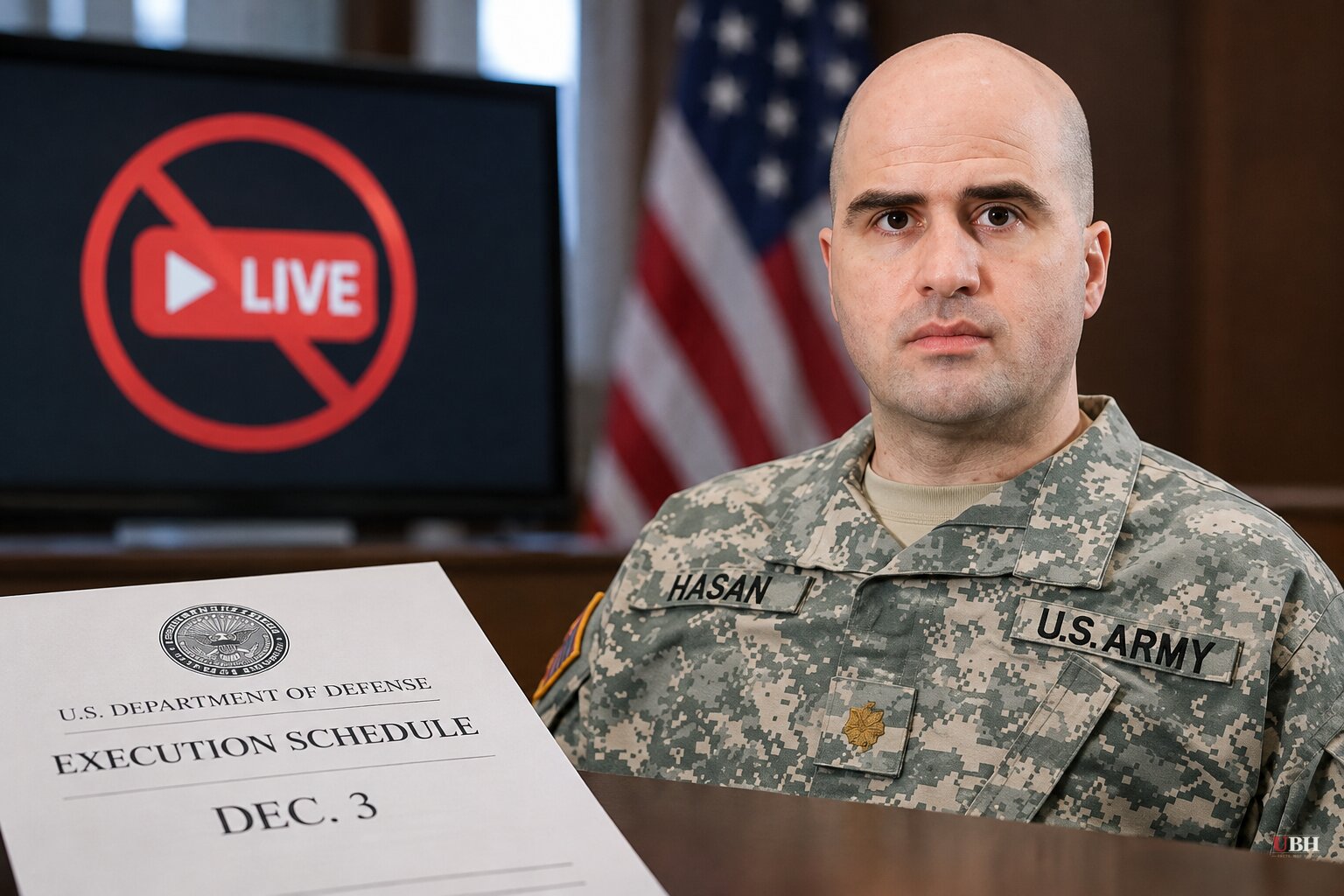
Since Defense Secretary Pete Hegseth announced last week that Fort Hood shooter Nidal Hasan would die by firing squad on Dec. 3 and that the public would be able to watch, the plan drew objections from both parties. Today, Oct. 15, President Trump killed the livestream.
"He will die, as scheduled, by firing squad, but this event will not be streamed," Trump wrote on Truth Social.
Trump's reversal
Trump did not say he had been wrong. He wrote that streaming the execution "might have been a strong deterrent for the World to witness how America deals with Terrorists and SCUM like Hasan," but that "many very good and well meaning people would rather not watch him die, through streaming, or through any other visual device."
He said immediate family members of the 13 people Hasan killed in the Nov. 5, 2009 attack can attend in person if they choose. "They deserve to witness JUSTICE!" he wrote.
The turn is sharp. Last Friday Trump said he "absolutely" approved of the livestream, while adding that the Pentagon was still "making a determination." He also said he did not care how Hasan went "as long as he goes."
Hegseth announced the plan in an interview with activist Jack Posobiec. "We'll make sure that people are able to watch it, that it's public, because people need to understand that there's serious consequences for these types of things," he said. He also said the execution would take place at 1 p.m. Central on Dec. 3 at the Texas installation, the same hour as the 2009 shooting.
The pushback
Vice President JD Vance had already distanced himself. Asked earlier this month how a public execution fit with his Christian faith, he said, "I don't know that that's actually going to happen," and added that if it were livestreamed, "I'm not going to be watching it."
House Speaker Mike Johnson told CBS News the risk was that "you would create a video that would be a recruiting tool for future terrorists."
The criticism crossed party lines. Sen. Elissa Slotkin, a Michigan Democrat, wrote on X today: "Good. So sick to have ever considered this." Sen. John Curtis, a Republican, said "this is the right move, both for the loved ones of the victims and for the country." Last week Curtis warned that broadcasting an execution "cultivates an appetite for executions as a form of entertainment" and is "not an effective deterrent."
The United Nations called the plans "abhorrent." Axios reported earlier this week, citing four people who had spoken with Trump, that the president had private misgivings about the Pentagon's plan. CBS News reported Tuesday that administration officials were leaning against streaming.
What a livestream would have meant
The last known public execution in the United States was the 1936 hanging of Rainey Bethea in Kentucky, which an estimated 20,000 people attended, according to the Death Penalty Information Center. Amnesty International counted public executions in only two countries last year: 11 in Iran and six in Afghanistan.
Some experts argued a livestream could violate U.S. law barring transmission of obscene, indecent or graphic material, and that minors could not be kept from watching. Others said the legal path to challenge it was narrow.
The supporters' argument, as Hegseth and Trump framed it, was deterrence and public accountability. Critics, including Curtis, said no evidence supports that theory. Trump himself used the conditional, saying a stream "might have been" a deterrent.
The execution itself
The Dec. 3 date stands. Military law requires the president to approve any court-martial death sentence, and Trump has done so. It also requires appellate review.
If carried out, it would be the first military execution since 1961, when Army Private John Bennett was hanged. It would be the first by firing squad since 1945, according to the Death Penalty Information Center.
The method itself drew a separate challenge. Writing in The Hill, a medical expert who has testified in execution-method cases argued that the firing squad's reputation as quick and humane is unearned. The writer noted that the military had adopted lethal injection and that the switch to shooting came without explanation. The writer also said Hasan, paralyzed from the waist down since being shot during the 2009 attack, will likely be seated when he is shot. Hegseth, asked why a firing squad, answered: "No-brainer."
Hasan admitted in court that he was the gunman. At his 2013 court-martial he said he believed he was protecting Muslims and the Taliban in Afghanistan from the U.S. military. Thirteen people were killed and 32 wounded.
What is still open
The Pentagon has not said how in-person viewing will work for victims' families, including how many relatives may attend or how they will be selected. With the livestream gone, that is now the only way anyone outside the military will see the execution. Trump's post answers the public-viewing question and leaves the logistics to be announced before Dec. 3.
Sources used for this briefing
9 links from 9 independent newsrooms (syndicated copies of the same report count once)
These are the sources it draws on, linked so you can verify.


