
Unbiased headlines. Facts, not spin.
Every story is an unbiased news briefing written from 110+ sources across the spectrum — sources linked so you can verify it yourself.
 politics
Low Interest (4/10)
June 18, 2026 at 12:01 PM
politics
Low Interest (4/10)
June 18, 2026 at 12:01 PM
Three Major Race Analysts Now Rate North Carolina Senate as Leans Democrat, but the State Has Fooled Them Before
The Numbers Are Real. So Is the Track Record.
Former Democratic Gov. Roy Cooper holds an 11.1-point lead over Republican Michael Whatley in the race for the open North Carolina Senate seat, according to the May 2026 Carolina Journal Poll of 600 likely voters. Cooper is at 49.8%, Whatley at 38.7%, and that gap has been widening, up from a 7.8-point Cooper advantage in March.
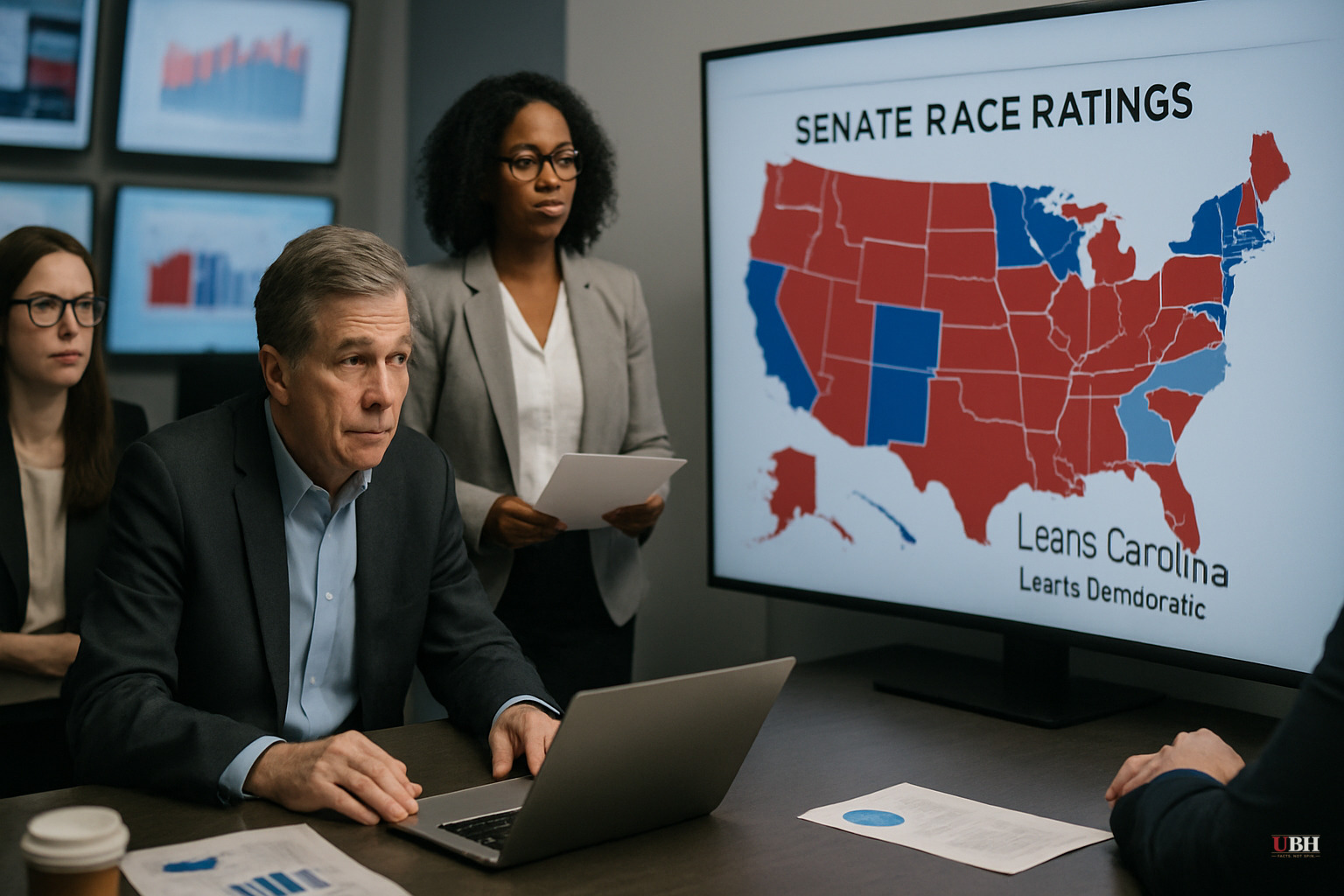
Three of the most watched nonpartisan race-rating organizations have responded accordingly. The Cook Political Report moved the race to "leans Democrat" in April. Sabato's Crystal Ball followed. The University of Virginia's Center for Politics made the same shift in June, according to the Raleigh News & Observer.
When the Center for Politics, Cook, and Sabato agree, campaigns notice.
Who These Candidates Are
Cooper spent 24 years in North Carolina statewide office, most recently two terms as governor from 2017 to 2025. He was on television nearly every day during the COVID-19 pandemic. 52.7% of North Carolina voters either have no opinion of Whatley or have never heard of him, per the Carolina Journal Poll. Among women aged 18-34, that number is 64% who say they've never heard of Whatley.
Whatley served as chair of the Republican National Committee and the North Carolina GOP. Cooper's campaign manager Jeff Allen described him to McClatchy as "the Big Oil and Utilities lobbyist" and a "DC insider." Whatley's camp has not denied the RNC and lobbying background; their argument is that national analysts have been wrong about North Carolina before.
On that last point, Whatley's spokesman DJ Griffin has a case to make: "Every cycle dating back for more than a decade, national 'experts' and national journalists try to prop up Democrat Senators in NC, and every year those Democrats lose on Election Day."
The Pattern That Should Give Democrats Pause
North Carolina has not elected a Democrat to the U.S. Senate since 2008, when Kay Hagan beat incumbent Sen. Elizabeth Dole. The state handed Donald Trump a 3.2-point win in the 2024 presidential race while simultaneously giving Democrat Josh Stein a 14-point win in the governor's race against a Republican nominee, Mark Robinson, who had been severely damaged by controversy.
In 2020, Democratic Senate nominee Cal Cunningham led in most public polls for most of the year. He lost by about 1.5 points, hurt by a personal scandal and Trump's coattails, according to the Center for Politics. Sound familiar?
Andy Jackson, director of the Civitas Center for Public Integrity at the John Locke Foundation, put the risk plainly to Carolina Journal: "While I expect the roughly 10% advantage Cooper currently has in the polls to close as we get closer to Election Day, he still has a clear advantage. If Whatley can tie Cooper to the national Democratic Party, he can make this race much more competitive."
That is Whatley's entire strategic path: make Roy Cooper run as a Democrat first and a North Carolinian second.
Why the Favorable Environment Is Real Too
Cooper's lead isn't just name recognition. The Carolina Journal Poll found Trump's approval in North Carolina at 41.5% — his lowest since beginning his second term — with 56.6% disapproving. A majority of North Carolinians say the country is on the wrong track.
Down the ballot, Democrats are running ahead across the board in the same poll: 47.5% to 41.3% for state legislative races, 48.2% to 44.5% for congressional races. Democratic Gov. Josh Stein sits at 50.1% approval with only 32.3% disapproving.
Donald Bryson, CEO of the John Locke Foundation and publisher of Carolina Journal, described the environment accurately: "Republicans are fighting headwinds: President Trump's approval is underwater, while a majority of North Carolinians say the country is on the wrong track."
Cooper's favorability among Black voters is particularly strong, at 76% among Black women and 74% among Black men in the Carolina Journal data. His numbers are underwater with white men: 49% unfavorable, 41% favorable.
The Split-Ticket Factor
As CNBC reported, North Carolina has a documented split-ticket tradition that sets it apart from most states. The same voters who elected Trump in 2024 elected Stein by 14 points. The Council of State — the state's 10 elected executive offices — is split evenly, five Democrats and five Republicans.
Chris Cooper, a political science professor at Western Carolina University with no relation to the candidate, told the News & Observer that the ratings shift reinforces cautious optimism for the Cooper campaign but added that Whatley's team will argue the analysts are wrong and anything can happen.
That caution is warranted. The Center for Politics noted that Cooper polling near 50% — rather than stuck in the mid-40s where earlier Democratic Senate candidates stalled — is the specific data point that drove the ratings change. Getting above 50 in polling is a different situation than being stuck at 46 hoping for late breaks.
The Unresolved Question
Sen. Thom Tillis's seat is competitive enough that its outcome could affect which party controls the Senate majority after November 2026. Whether Whatley's strategy — nationalizing the race and tying Cooper to an unpopular Democratic brand — can compress a double-digit polling gap in five months is the central question neither the polls nor the ratings changes can answer yet. North Carolina has granted that kind of late compression before.
Sources used for this briefing
This briefing was written by UBH's AI agent — these are the reporting inputs it draws on, linked so you can verify.


