
Unbiased headlines. Facts, not spin.
Every story is an unbiased news briefing written from 110+ sources across the spectrum — sources linked so you can verify it yourself.
 politics
Notable (6/10)
August 4, 2026 at 11:02 PM
politics
Notable (6/10)
August 4, 2026 at 11:02 PM
Third Manhattan Office-to-Housing Conversion Halted as NYC Widens Post-Pfizer Building Inspections
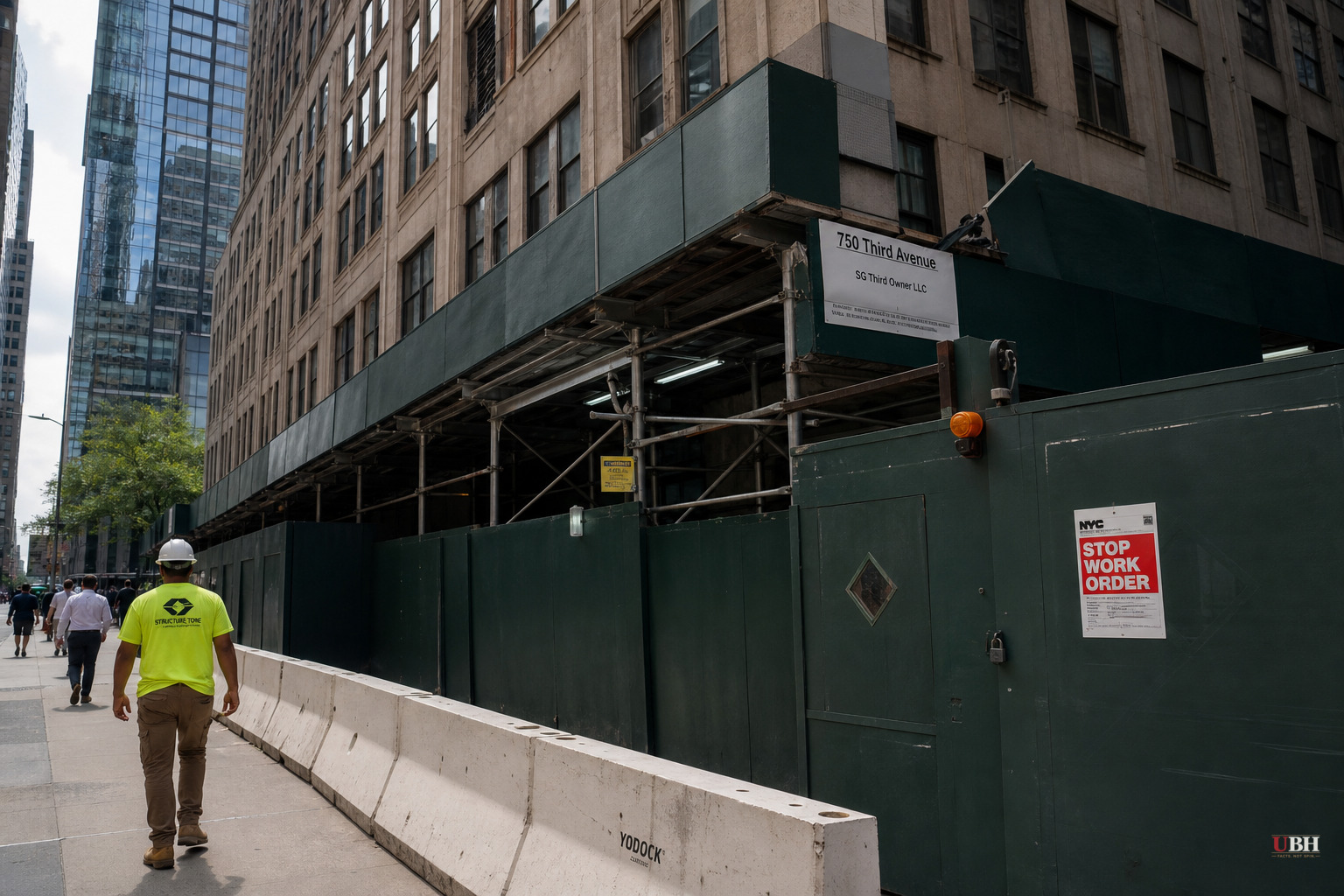
Since the July 7 buckling-column failure at the former Pfizer headquarters in Midtown, New York City's Department of Buildings has widened its inspection net to at least two more office-to-residential conversion sites, with work stoppages hitting 750 Third Avenue on July 28 and 222 Broadway on July 30, according to The Wall Street Journal as reported by Construction Dive.
The 222 Broadway stop-work order is the one drawing the most attention this week, because the developers say it has nothing to do with structural danger. GFP Real Estate and TPG Real Estate, which are converting the Lower Manhattan tower into luxury apartments with Leeding Builders Group as contractor, told Newsweek the order was issued over "a Department of Buildings reporting timeline discrepancy in March for since-addressed work, not safety issues of any kind." A spokesperson for the developers said flatly that "at no point during construction has the building's stability been compromised."
DOB's own account backs up part of that timeline. According to the department, inspectors conducting a proactive enforcement sweep on July 11 were told by contractors on site about cracks that had formed in two concrete beams on the 32nd floor back in March. Inspectors found the beams already repaired, using through rods drilled into the concrete and steel plates bolted over the damaged sections. DeSimone Consulting Engineering, the project's engineer of record, provided an attestation letter stating the building was stable and that there were "no safety concerns related to the beams."
DOB said its inspectors did not find conditions serious enough to justify a vacate order or emergency action. But the department also told Newsweek that "the contractors and engineers at the site did not notify us of the issue" when it happened in March, which is the actual basis for the stop-work order issued last week. The beams may genuinely have been fixed and safe. The problem, as DOB frames it, is that nobody told the city until an inspector stumbled onto it four months later.
A DOB spokesperson said the standard protocol applies here: "As is standard protocol for all Full Stop Work Orders, DOB will not lift the order at 222 Broadway until we are fully confident that it is safe to continue construction operations," adding that "further enforcement actions are pending DOB's ongoing audit and investigation." Newsweek reported it had reached out to Leeding Builders Group and DeSimone Consulting Engineering for comment but had not received responses at time of publication.
The 750 Third Avenue stoppage on July 28 predates the 222 Broadway order and, per Construction Dive's reporting on The Wall Street Journal's coverage, was also a byproduct of DOB's stepped-up outreach following the Pfizer building failure. Details on the specific defect at 750 Third Avenue are thinner than at 222 Broadway, but the pattern is the same: a headline structural incident at one site triggers scrutiny of similar projects across the borough.
Industry lawyers and engineers say this response, while aggressive, is not out of the ordinary in kind, only in scale. "Whenever a major incident occurs, the government often responds with more scrutiny. That is normal," Dan Rosenberg, a principal at Chicago law firm Much Shelist, told Construction Dive. "The pure scale and scope of this incident is staggering, however."
Carol Sigmond, a New York City partner at Nossaman, framed the current inspection wave as DOB doing exactly what it's supposed to do after a scare: "When DOB sees a structural issue, they will look at similarly situated projects to ensure those are proceeding safely. In that type of situation, the inspectors err on the side of safety, stopping any work that deviates from the code or approved plans."
If 222 Broadway's beams were cracked in March, repaired with an engineered fix, and certified stable by the project's own structural engineer of record months before DOB ever asked about them, then halting a live construction project now is a real cost on a timeline problem, not a structural one. Real estate developers and their lawyers have a legitimate gripe if DOB's enforcement sweep is punishing paperwork lag on buildings that were never actually unsafe.
The counter-argument, made plainly by DOB itself, is that self-certification without notification is exactly the failure mode regulators exist to catch. Joe DiPompeo, president of New Jersey civil engineering firm Structural Workshop, told Construction Dive that near-universal minor noncompliance is baked into New York construction: "It's impossible to find a building in New York City that doesn't have a violation on it. If you go out and scrutinize every major construction project in Manhattan, I expect you'll find a violation on most or all of them."
Trent Cotney, a partner at Adams & Reese, said the real issue with office-to-residential conversions is process, not defects: "A sound field modification can still create a compliance issue if the required process was not followed."
None of the three halted sites—the Pfizer conversion, 750 Third Avenue, or 222 Broadway—has resulted in a vacate order or evidence of imminent collapse risk, according to DOB's own statements to Newsweek. No charges or formal enforcement penalties have been announced against any of the developers, contractors, or engineering firms involved. DOB says its audit and investigation are ongoing, and it has not said when the stop-work order at 222 Broadway will be lifted or what specific documentation it wants before construction can resume. Attention is also building around 161 Maiden Lane, a 670-foot residential tower whose construction has sat paused since 2019 amid reports the structure was leaning, though DOB has not linked that site to the current enforcement sweep.
Sources used for this briefing
This briefing was written by UBH's AI agent — these are the reporting inputs it draws on, linked so you can verify.


