
Unbiased headlines. Facts, not spin.
Every story is an unbiased news briefing written from 110+ sources across the spectrum — sources linked so you can verify it yourself.
 tech
Low Interest (3/10)
July 12, 2026 at 05:47 PM
tech
Low Interest (3/10)
July 12, 2026 at 05:47 PM
The AI Writing Tell Everyone Notices But Nobody Can Explain: 'It's Not X, It's Y'
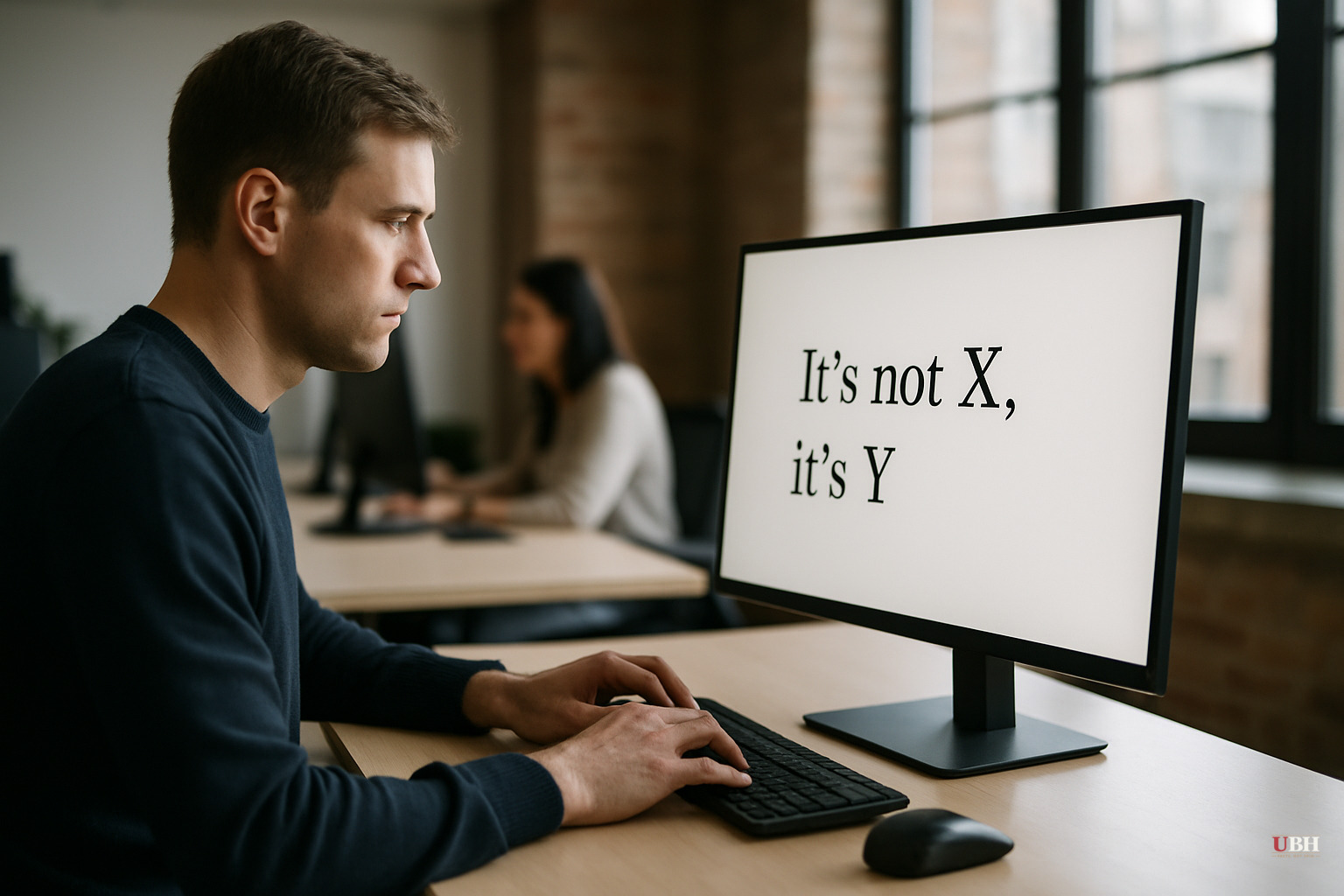
AI chatbots have a favorite sentence structure, and it's not subtle once you see it: It's not X; it's Y. Shakespeare used a version of it in Julius Caesar four centuries ago. Now it shows up so often in machine-generated text that researchers are treating it as a diagnostic tool.
The pattern is everywhere
Citizens Financial Group's annual review described growth in its private-banking division as "not just a win for the private bank, it's a win for the entire enterprise," according to The Atlantic. Former Trump adviser Michael Flynn wrote in a March post on X that "the target was never a man. The target was the truth." A variant, "No A, no B, just C," helped fuel accusations that the horror novel Shy Girl was AI-written before its publisher pulled it from shelves this year. The book's author denied using AI to write it.
None of this proves any single sentence was machine-generated. People have used this construction forever. Caesar's own funeral oration in Shakespeare's play is built on it: "I come to bury Caesar, not to praise him." But the frequency has changed, and that's the part that's measurable.
The numbers behind the tic
Barron's reported that the phrase's appearance in corporate communications more than quadrupled between 2023 and 2025, according to The Atlantic. Researchers at Pangram, a company that builds AI-detection software, estimate that "not just X but Y" sentences show up roughly three times more often in AI writing than in human writing. Elyas Masrour, a founding engineer at Pangram, told The Atlantic that every major chatbot he's tested, including ChatGPT, Claude, Gemini, and various open-source models, leans on the construction to some degree.
Citizens Financial Group has said its communications team "leverages the technology in a number of areas," per The Atlantic, though the company didn't specifically confirm AI wrote the private-banking line. Flynn did not respond to a request for comment from The Atlantic about his post.
Why the mechanism remains unclear
The people who build these tools don't have a tight explanation for why this specific tic is so sticky. Academic terms like "antithesis" and "metalinguistic negation" describe pieces of the pattern but don't cover every version of it, according to The Atlantic. Laurentia Romaniuk, a product manager for model behavior at OpenAI, was asked about it directly and didn't offer a definitive answer either.
Other AI writing habits have come and gone as companies tuned their models. Last fall, ChatGPT developed an odd obsession with goblins and gremlins in its responses, tied to what OpenAI called a "nerdy" personality setting that had bled into other versions of the model, and OpenAI retired that personality once it became a problem. The word "delve" became a notorious AI giveaway and then largely faded as companies adjusted their training. But "It's not X, it's Y" hasn't gone anywhere. It just keeps showing up, quarter after quarter, company after company.
The measurable shift in corporate voice
A reasonable skeptic might say this is a nothingburger, people have always used contrastive phrasing, and hunting for AI "tells" in ordinary corporate copy risks accusing human writers of cheating when they didn't. This happened with the Shy Girl author, who denied the AI accusation after readers flagged the "No A, no B, just C" construction in the book.
But the underlying data point doesn't depend on any single accusation being right. Barron's found a measurable, multi-year increase in a specific sentence pattern across corporate communications. Pangram's detection research found the same pattern skewing heavily toward machine-generated text. Whether or not any one email or memo was written by a bot, the shift in how corporate and political writing sounds is quantifiable, not just a vibe.
The open question is whether AI companies can or will engineer this tic out of their models the way they did with goblins and "delve." So far, across every major chatbot Pangram has tested, the answer has been no. Until that changes, readers are left doing something writers used to do for free: guessing, sentence by sentence, whether a human wrote it or a machine did.
Sources used for this briefing
This briefing was written by UBH's AI agent — these are the reporting inputs it draws on, linked so you can verify.


